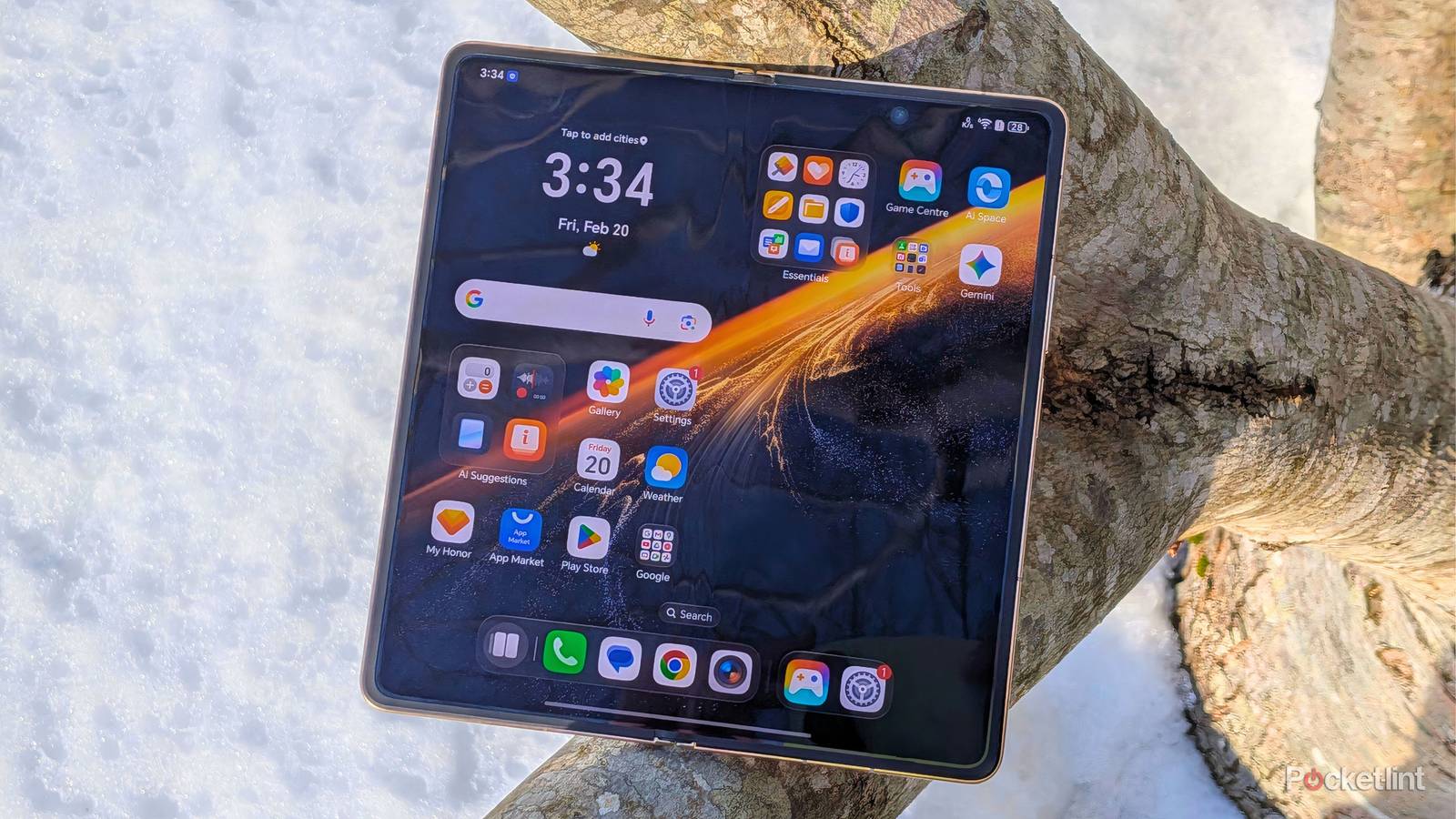
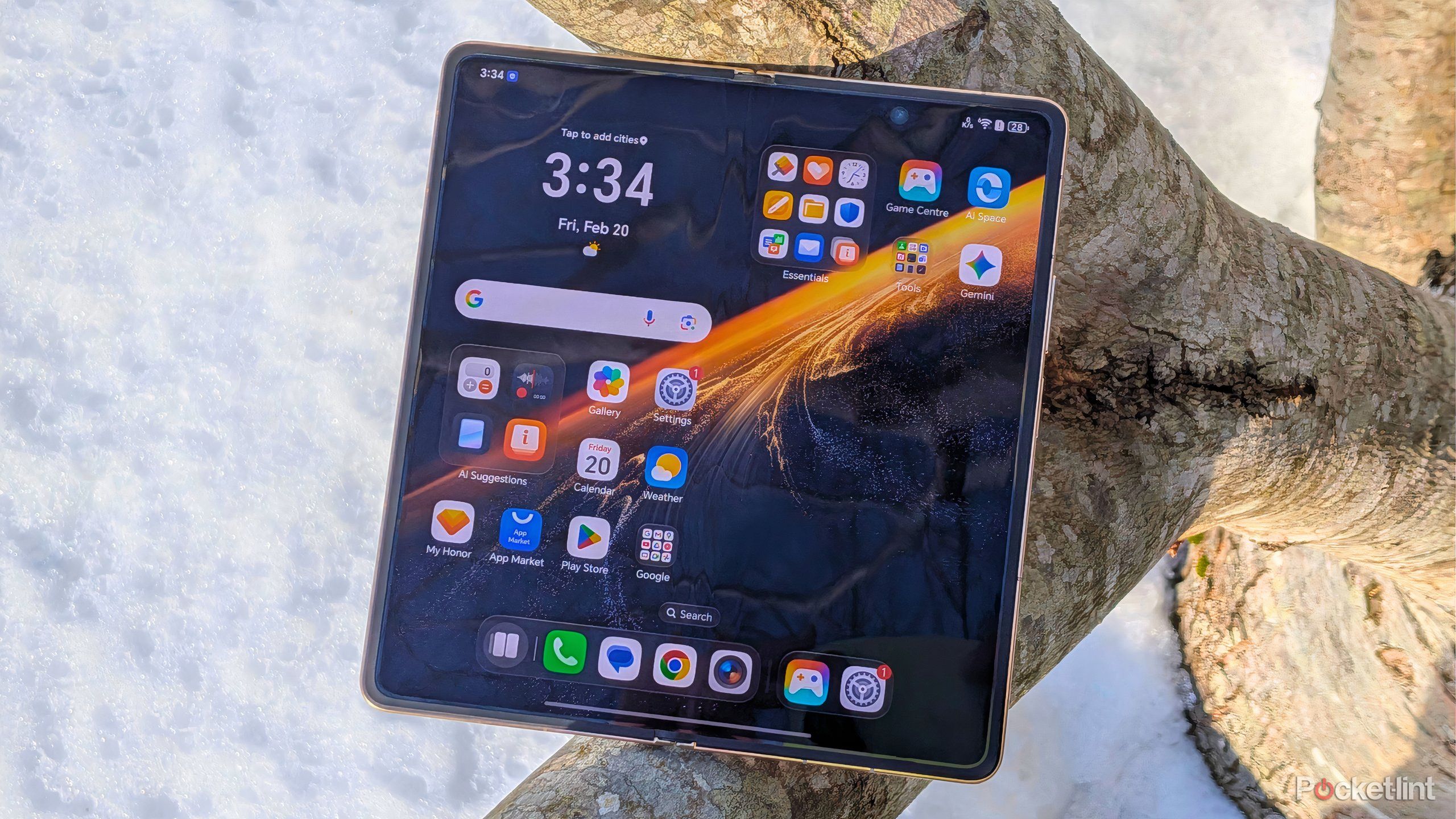
The foldable smartphone market is about to experience a pretty major shake-up. Apple is reportedly ready to enter the fray with a wider passport-style iPhone ‘Fold’ or ‘Ultra’ device, and other phone makers like Samsung and Huawei are gearing up to release (or have already released) ‘wide’ foldables of their own, giving the impression that book-style folding handsets as a whole are on the eve of some kind of transformation.
Honor, a notable player in the space, will no doubt have a Magic V7 foldable on the market soon enough to compete with next-generation wider book-style foldables, but that that time is not today. Rather, for the time being, the company is releasing its Magic V6 flagship to global markets, after having first launched the product at Mobile World Congress 2026 in early March, and then subsequently launching it in its domestic market of China.
Unsurprisingly, Honor’s ‘global’ Magic V6 release excludes North America, meaning that the unit can’t be directly purchased at retail stores in the United States or in Canada. This is a shame, given that the V6 is a powerhouse product offering, even if it retains the tall-and-narrow form factor that I personally expect to fall by the wayside in the coming years. With this in mind, here are three exciting aspects of the Magic V6 that are extremely compelling, and that I genuinely wish all book-style foldables would adopt — wide, narrow, or otherwise.
A rugged physical design
This thing can absolutely take a beating
Folding phones have a reputation for being physically fragile, owing to their extra moving parts, their hinges, and their need for soft internal screens that can be bent in half over and over again. While early models suffered major durability issues, the same can’t be said about modern-day foldables.
While it’s true that all book-style devices have internal displays that can be scratched with a fingernail, newer models no longer crack spontaneously, they no longer feature shoddily-adhered mandatory screen protectors, and, in many cases, they’re even water and dust tight for added peace of mind.
In the case of the Magic V6, Honor has gone above and beyond in its quest to deliver a physically robust book-style handset. The device features Super Armored Inner Screen technology to improve rigidity, a 2,800MPa Super Steel hinge design, and a 500,000-fold-strong total lifespan. The company has gone as far as to demonstrate the V6’s strength through a variety of real-world stress tests, including using the unit as a zip-line support handle.
The Magic V6 is also the very first book-style foldable to be both IP68 and IP69 certified, the former of which allows for 1.5m submersion for up to 30 minutes, and the latter allowing for limited high-pressure and high-temperature water jet immunity.
A massive battery capacity
Silicon-carbon technology to the rescue
Rather than settling for a standard lithium-ion (Li-Ion) battery, Honor has outfitted its Magic V6 with a far more energy-dense silicon-carbon (Si-C) power pack. The global model features a capacity of 6,660 mAh, while the China-specific SKU measures in at a whopping 7,150 mAh in its highest-end configuration.
Needless to say, the inclusion of Si-C battery technology is an extremely welcome addition here, and it’s even the first foldable to receive a TÜV Rheinland 24-hour battery life certification. In my testing, I can comfortably last well into a second day with tons of extra juice in the tank, and that’s with high brightness, 5G, and always-on display (AOD) mode enabled.
The Magic V6 also charges up extremely quickly, with its support for 80W wired charging and 66W wireless inductive charging. Unfortunately, there’s no Qi2 Magnetic Power Profile (MPP), and so you’ll need a dedicated case or a separate magnet sticker to take advantage of MagSafe, Pixelsnap, and Qi2 accessories.
An (almost) truly high-end camera system
Flagship-level cameras are a must at this price
One area where foldable phones have traditionally lagged behind their flagship candy bar-style equivalents is in the camera optics department. The fact of the matter is that space is extremely limited when it comes to the book-style form factor, resulting in smaller sensors and fewer lenses than would otherwise be included.
The Honor Magic V6 doesn’t fully buck this less-than-flagship-grade camera predicament, but it comes closer than many of its competitors. There are triple rear cameras here, which is a step-up from the dual rear camera setups found on some competing models in the same price range. Below is a brief overview of each rear camera’s respective tech specs:
- Wide-angle camera: 50-megapixel, 1/1.56-inch sensor size, f/1.6 aperture size
- Ultra-wide camera: 50-megapixel, f/2.2 aperture size, 122-degree field of view
- Periscope telephoto camera: 64-megapixel, 1/2.0-inch sensor size, f/2.5 aperture size, 3x optical zoom
Other camera-related specs include laser-based autofocus (AF), an LED flash module, support for high dynamic range (HDR), and the ability to record 10-bit video at up to 4K resolution at 60 frames per second (fps) across all rear cameras. The two selfie cameras are both 20-megapixel units with an f-stop of f/2.2, which is mostly in line with other front-facing shooters in the space.
In my experience, shots taken using the Magic V6 come out crystal clear, with speedy shutter speeds and lots of features to play around with. I do tend to prefer the Pixel’s color science, which is the result of different computation photography algorithms, but the difference isn’t too noticeable (and I can always shoot in RAW, anyway). The only major gripe I have is that the 3x optical zoom is a bit limiting — I’d have preferred 4x for added detail when punching into photos.
An inner screen that respects your eyesight
Tons of eye care technologies are on deck
We stare at our mobile devices for hours each and every day, and so I appreciate it when companies go the extra mile in combating eye strain. Honor has been on top of its game recently when it comes to eye comfort technologies, and the Magic V6 is no exception. The foldable’s inner screen is endowed with a 5-star SGS reliability certification, in addition to a TÜV Rheinland Eye Protection Certification. These ratings are the result of hardware-level optimizations that reduce blue-light harshness without negatively impacting picture quality.
The Magic V6 also features a “Black Diamond Screen,” complete with a 5,600-layer silicon nitride display coating for reducing reflectivity and glare to as little as 1.5 percent. The device also features high-frequency 4,320 Hz PWM dimming to reduce flicker, which should help offset the occurrence of headaches in those who are sensitive to the lower PWM levels found on many other OLED-based screens.
Elsewhere, there’s a dedicated E-Book Mode that turns the screen grayscale, and various AI-powered comfort tools are available to simulate natural light during the daytime, to reduce blue-light in the evening, and to avoid circadian rhythm distractions more broadly. Put together, these optimizations are surprisingly comprehensive, and they’re the sort of tools I wish more handset makers would implement into their rivaling foldable devices.
This device was provided to Pocket-lint by Honor.