


Jan Bartek – AncientPages.com – An ancient scroll that survived the eruption of Mount Vesuvius in 79 AD has finally given up its secrets.
The scroll was found in the 1750s, but it was too delicate to open. Thanks to AI technology, scholars have now read the entire text, which turns out to be a philosophical essay about ethics and human progress.
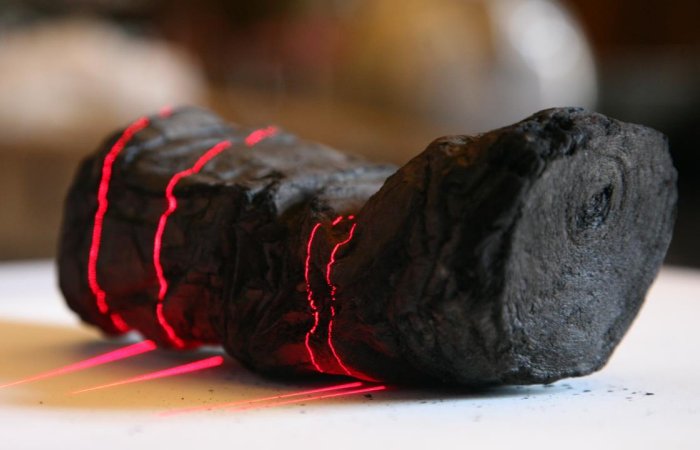
The scrolls from Herculaneum. Credit: EduceLab.
“For nearly two millennia, many of these texts have been physically preserved but intellectually inaccessible,” Brent Seales, Vesuvius Challenge co-founder and the Stanley and Karen Pigman Chair of Heritage Science at the University of Kentucky, says.
“Today — after years of interdisciplinary work combining advanced imaging, artificial intelligence (AI), academic research and an innovation contest — we are finally able to read them.”
One Of The Oldest Scrolls In The Collection
Among the most significant findings is the recovery of substantial new text from PHerc. 1667, a scroll housed in Naples, Italy.
The Vesuvius Challenge team has now virtually unwrapped the surviving portion of the scroll, revealing nearly 1.5 meters of continuous text and approximately 20 columns of writing.
“This scroll was deemed completely unreadable when part of it was opened in the 1980s,” Federica Nicolardi, assistant professor in papyrology at the Università degli Studi di Napoli Federico II, said.
“The scroll’s handwriting and internal references suggest the artifact dates from the second century B.C. or possibly from the late third century B.C. — making it one of the oldest scrolls in the collection,” she explained.
While the title and author remain unknown, the early dating and content indicate that the author is not Philodemus of Gadara, the Greek philosopher whose works are most commonly found among the Herculaneum papyri.
A Philosophical -Stoic- Treatise?
The papyrological team’s analysis indicates that the text is a philosophical treatise on ethics, arts, and human behavior, likely reflecting Stoic thought.
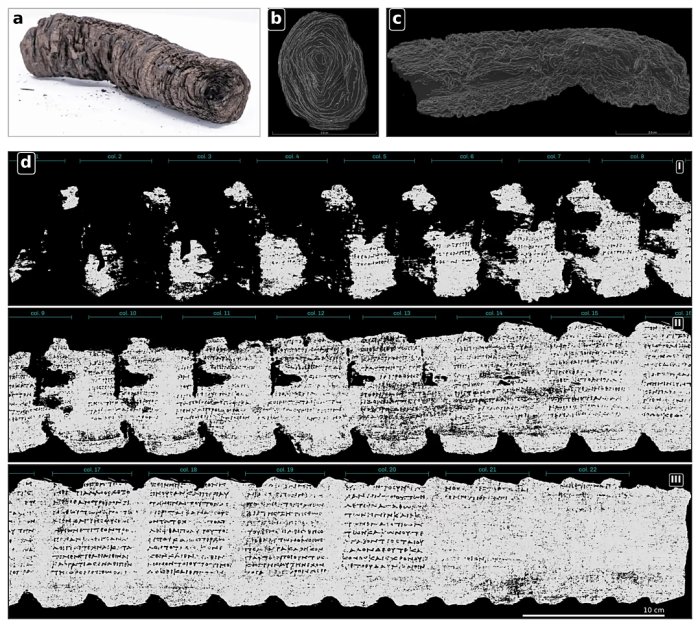
Scientists used high-resolution X-rays and machine learning to reconstruct the scroll’s interior and read it. Credit: Vesuvius Challenge
The recovered text discusses core Stoic concepts, including ὁρμή (hormē), or impulse, defined as the drive to act found in both humans and animals. The author warns against excessive impulse, described as — ὁ πλεoνασμός κατὰ τὴν ὁρμήν (ho pleonasmos kata tēn hormēn), which occurs when reason fails to regulate behavior and results in harmful passion or a diversion from one’s goals.
Another key concept is φρόνησις (phronēsis), or practical wisdom, which refers to the intellectual activities that guide individuals in making the right choices and choosing virtues over vices.
New Philodemus Text Identified
In the final portion of the virtually unwrapped surface, papyrologists from the Vesuvius Challenge were able to read: Φ̣ι[λοδ]ή̣μου | περὶ θεῶν Η̅ — Philodemus, On Gods, Book 8.
The overlined Η is understood as a book number.
This discovery is significant, as it confirms for the first time that On Gods was a multi-book work extending to at least eight volumes. Previously, only the first book was known (PHerc. 26).
Early readInitial readings from the virtually unwrapped surface have revealed key theological terms and phrases, providing early insight into the work’s content. Collectively, these findings indicate a sustained philosophical examination of Epicurean theology, including the nature of the gods, the role of providence, and the structure of the universe.
From Scanning To Scholarship
High-resolution micro-CT scanning at major synchrotron facilities, including Diamond Light Source and the ESRF, enabled this discovery.
The Vesuvius Challenge leveraged the advanced capabilities of ESRF’s Extremely Brilliant Source and its flagship beamline BM18.
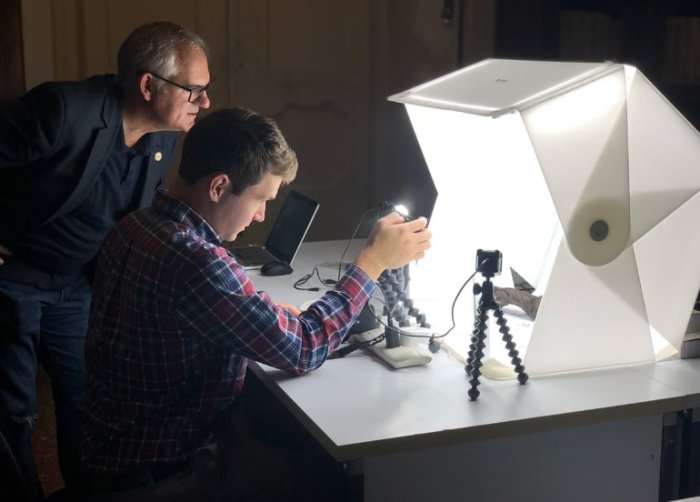
Professor Brent Seales, left, and a member of his team scan the Herculaneum scroll. Credit: EduceLab
“The beam produced by the Extremely Brilliant Source is both exceptionally fine and remarkably stable. At BM18, it enables us to detect extremely subtle variations and reconstruct high-quality tomographic images,” said Alessandro Mirone, ESRF. “Our role is to provide the most precise three-dimensional representation possible. These data serve as the foundation for the virtual unwrapping pipeline developed by the Vesuvius Challenge team, as well as for their neural network analysis.”
The Vesuvius Challenge scans constitute the largest dataset ever produced by the ESRF. Individual scans generated up to 300 terabytes per scroll, resulting in the most detailed three-dimensional maps of the carbonized artifacts to date.
From Discovery To Cultural Recovery
For centuries, the study of ancient papyri has been constrained by fragmentary evidence and the fragility of these artifacts.
Researchers state that today’s discovery marks a turning point, not in technology but in purpose.
As new texts emerge rapidly from the carbonized papyri, the focus is shifting from engineers and computer scientists developing advanced tools to experienced papyrologists, classicists, and historians who can interpret, contextualize, and restore these ancient works to human knowledge.
“This is no longer just about imaging or machine learning,” Seales said. “Now we need experts who can read, edit and understand what they are saying.”
See also: More Archaeology News
More than 600 Herculaneum scrolls remain unopened. Their recovery is now an international effort, uniting research institutions, libraries, and cultural heritage organizations across Europe and the United States to restore one of the most significant surviving libraries of the ancient world.
“Today, we are hearing voices that have been silent for 2,000 years,” Seales said. “For the first time, we are uncovering and reading them, but most importantly, we are beginning to understand them.”
Source: European Synchrotron Radiation Facility
Written by Jan Bartek – AncientPages.com Staff Writer

