



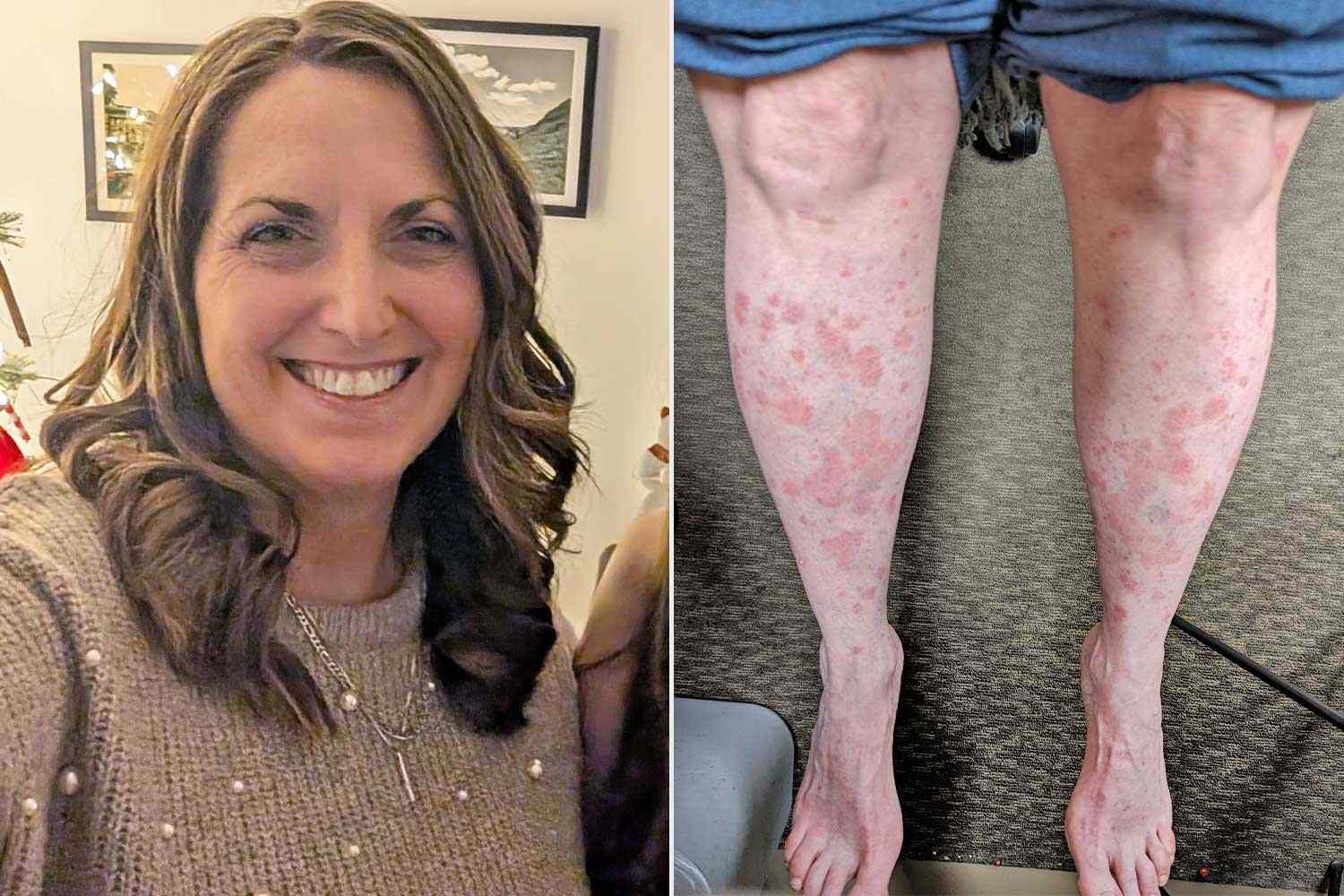
"I was very ashamed. I felt like everywhere people were judging me," Amber Dean tells PEOPLE, recalling when her symptoms were at their worst
:max_bytes(150000):strip_icc():format(jpeg)/Amber-Dean-1-031926-36558b01c64c49c191259b57b689a116.jpg "Amber Dean")
Credit: Courtesy of Amber Dean (2)
NEED TO KNOW
- A woman suffered from plaque psoriasis, and various failed treatment options, for years, before one decision changed her life
- “I was very ashamed. I felt like everywhere people were judging me,” Amber Dean tells PEOPLE, recalling when her symptoms were at their worst
- Now, after joining a clinical trial for ICOTYDE, the first-ever oral option for the chronic autoimmune condition, the 47-year-old woman says, “My skin is my skin now”
A woman suffered from plaque psoriasis for years, revolving her entire life around the chronic autoimmune condition. Then, one decision changed her entire life.
Amber Dean's symptoms began in her early 20s. "Back then, their initial thought was that it was ringworm," she tells PEOPLE exclusively.
The woman's skin issues would sometimes "go away and then get better," but when they would come back, Dean, now 47, says they would "continually get worse."
Numerous doctors dismissed her concerns — including one who told her to stay out of the sun and another who told her ailments were caused by stress — but Dean's skin issues persisted. "What was just a few spots on my lower legs would then be a couple spots on my thighs. They were getting bigger, and they weren’t as easy to hide," she recalls.
Eventually, Dean met with a dermatologist, who diagnosed her with plaque psoriasis, a long-lasting and chronic autoimmune disease that causes cells to reproduce very quickly, per the Cleveland Clinic. (Plaque psoriasis is the most common type of the condition, affecting about 80% to 90% of people with psoriasis.)
Never miss a story — sign up for PEOPLE's free daily newsletter to stay up-to-date on the best of what PEOPLE has to offer, from celebrity news to compelling human interest stories.

Credit: Courtesy of Amber Dean
Plaque psoriasis, also known as psoriasis vulgaris, causes thick patches on the skin, commonly affecting areas such as the back, scalp, elbows and knees. The plaques are often itchy and can be painful.
"The itching was horrible," Dean recalls. "Everything burned. I was trying so hard not to scratch all the time at work or in public, which was on a whole other level of torture — when you can’t itch something that itches. I would fight the urge so much."

Credit: Courtesy of Amber Dean
According to Dean, her psoriasis affected how she lived her day-to-day life. "I would always, no matter what the weather was, wear long pants and always wear long sleeves," she tells PEOPLE. "When the psoriasis spread to my feet, I couldn’t wear sandals or flip flops. I had to make sure that my foot was fully covered."
"It was embarrassing to me. I was very ashamed. I felt like everywhere people were judging me," adds Dean, who works as a controller for new car dealerships.
The PEOPLE Puzzler crossword is here! How quickly can you solve it? Play now!
Alongside her physical ailments, Dean's plaque psoriasis also affected her emotionally. Describing it as "a daily torture," she said, "You’re always ashamed and embarrassed. You can’t do certain things because of the pain and the itching, and the embarrassment of your skin."
"You start getting down on yourself about it. You feel very inadequate, very less than. It destroys your self-confidence completely. You start feeling very judged everywhere you go, like people are staring at you," she continues. "You don’t want to go out. You don’t want to be around people. If you do go out, you make sure you’re clothed in every way so nobody is going to see your plaque psoriasis, because the worse thing you can do is the have people bring attention to it."

Credit: Courtesy of Amber Dean
Dean, a mother to a 19-year-old daughter and owner of two dogs, would try different medications over the years, but says, "They would work, and then a week later, they didn't work, and you start getting flare-ups again."
"It was the constant ups and downs of the roller coaster of, 'Is it going work?' You never know if you want to be hopeful or not be hopeful," she adds. "You’re just being let down by one thing after another. It was just a continuous cycle that never ended."

Credit: Courtesy of Amber Dean
Eventually, Dean was introduced to ICOTYDE, an oral peptide medication designed to treat moderate-to-severe plaque psoriasis, and she joined a clinical trial. The U.S. Food and Drug Administration (FDA) approved the first-ever oral option for the condition, from Johnson & Johnson, on March 18.
"I feel fantastic. I have absolutely nothing on my skin – not a spot, not a shadow of a spot, not a dry patch, no plaques," Dean tells PEOPLE. "If I didn’t have proof of what I went with before, with the pictures of my legs, I would have never believed that they were ever on my skin."
"With all the medicines I’ve tried before, there was always something left behind. That is gone. My skin is my skin now," she adds. "I’m completely amazed. I’m 100% astonished by this medicine, and I will forever encourage people to take this."
Looking back at her own journey with plaque psoriasis, Dean recalls how hard it can be to deal with the condition, for which there isn’t a cure. Still, she tells others, "It’s not what you are. It’s something that you have, it is a disease. It doesn’t define you. It might be one facet of you, but it’s not all of you."
"I held on to the shame and embarrassment of it, and I shouldn’t have, because you shouldn’t be ashamed or embarrassed of any disease you have. You don’t have control over that," she continues. "I would have never known about ICOTYDE if I had not finally said 'I am done' and walked into the trial center. That day is probably one of the best health decisions that I have ever made."