


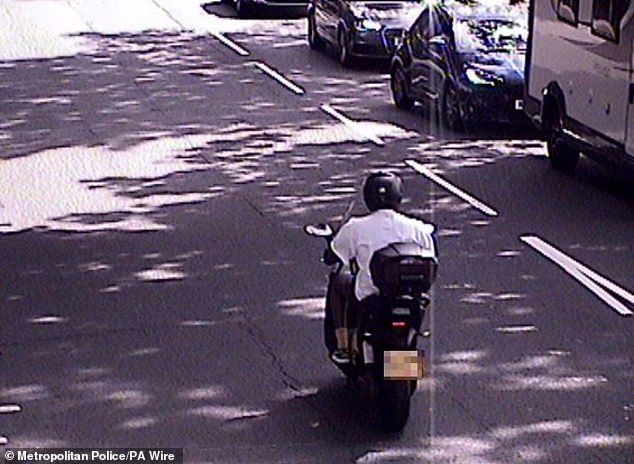
A sunny June day on a riverside road in central London, and an electric moped – driven by the actor Idris Elba – is caught on camera doing 28mph.
It’s a world away from the high-octane car chases Elba, 53, is known for on screen, and entirely unremarkable – other than the fact that the road in question, Chelsea Embankment, has a speed limit of 20mph.
Like countless other roads up and down the country, the speed limit on this stretch was reduced from 30mph to 20mph in late 2021, much to the chagrin – and indeed without the knowledge – of those who use it every day.
The transgression cost Elba a total of £316 – small change for a Hollywood star – but sparked vociferous debate up and down the country.
For it seems 20mph limits are being rolled out daily, sometimes overnight, and these new limits, as Elba found out, are being strictly enforced – even more rigorously, many suspect, than 30mph or 40mph areas.
Today 30.2 per cent of all urban roads in Britain have a 20mph speed limit – a staggering 38,711 miles of crawling asphalt.
More than 19 million of us live in neighbourhoods with a 20mph limit, while another 11 million live in areas committed to bringing one in. In total, that’s a third of the UK population.
The rationale behind it, of reducing collisions, serious injuries and fatalities is indisputable. The mantra oft-repeated by road safety campaigners is that slower driving equals safer driving.
Certainly, no one can argue with increased safety measures on roads where there are schools, families with young children, and vulnerable elderly residents.
But what critics object to is the blanket introduction of 20mph limits, and indeed entire 20mph zones, which do not take into account the size of the roads affected, the traffic flow, or who is using them and when.
Opponents see them as nothing more than a cynical money-making scheme.
So why are 20mph limits creeping in across the UK – and do they really make our roads safer?
Sarah Rainey and Harry Wallop investigate.
ARTERIAL AND MAIN ROADS; NOT JUST SIDE STREETS
Highway authorities have been introducing 20mph roads since June 1999, when they were granted the freedom to do so without getting permission from the Secretary of State.
Guidance from the Department for Transport, updated in 2024, advises that a slower speed limit is most appropriate for built-up residential streets and town centres with high pedestrian and cyclist activity.
Indeed, it specifically warns against ‘over-use’, especially on ‘roads where motor vehicle movement is the primary function’.
But this does not prevent local authorities from bringing them in on main, busy and arterial roads, as well as bus routes and shopping streets.
All that’s required is for the local authority to issue a Traffic Regulation Order – and change the signs.
As a result, frustrated motorists have found themselves driving on new 20mph roads in and around some of the country’s largest cities.
In London, parts of South Circular (A205), a main arterial ring road, are 20mph, as is the multi-laned Finchley Road (A41) in north London. The iconic – and very wide – Park Lane went from a 30mph limit down to 20mph in 2022.
Motorists’ ire is also focused on the Lea Bridge Road (part of the A104), recently reduced to 20mph, the Holloway Road (A1), and the A10 in Hackney, north London, all of which are heavily congested.
In Cambridge, East Road (the A603), which runs past the city’s Crown Court, is now 20mph; while in Oxford, London Road (the A420), runs for several miles around the city at 20mph.
Drivers in Edinburgh frequently complain about Leith Walk (the A900), a busy thoroughfare mostly comprising shops and restaurants – and long queues of 20mph traffic.
Edmund King, president of the AA, says that while it ‘supports 20mph limits where they clearly improve safety’, ‘they need to be targeted, implemented where communities genuinely want them, and supported by proper road design rather than blanket roll-outs’.

Actor, Idris Elba, is caught on camera doing 28mph on Chelsea Embankment in June 2025. He was fined £316 on 27 January, 2026
£225MILLION: THE COST OF CONVERTING TO 20MPH
While it may look like a simple matter of swapping the signage, changing the speed limit on even a single road is a costly and arduous process.
In Wales, where the government announced 20mph would be the new default national limit in urban areas in September 2023, £34.4million has been spent on converting roads to date.
In London, the figure’s more than £8million – according to a recent Freedom of Information request.
As for the rest of the country, road safety campaign group ‘20’s Plenty for Us’ suggest it costs around £7.50 per person to implement a 20mph limit in a local authority.
Multiplying this by the 19.1 million people who already live in such areas, the cost to UK taxpayers to date could be as high as £143.25million.
And if pledges to widen the 20mph net to areas in which 30 million people live come to fruition, this rises to £225 million – more than the cost of the Covid-19 inquiry.
THE UNSPOKEN RISKS OF DRIVING AT 20MPH
So does driving more slowly make you safer on the roads? Various experts dispute this, and there’s a raft of scientific evidence to back them up.
First, there’s the distraction factor, outlined in an Australian study from 2017, which suggests that drivers going at 20mph develop what’s called ‘speedometer fixation’.
‘Essentially, the driver spends more time looking at their speedometer – not outside, and what’s going on with other road users,’ explains Brian Gregory of the Alliance of British Drivers.
‘Your peripheral vision decreases, so you’re not aware of what other people are doing. You’re a 19.9mph missile.’
There’s also the phenomenon known as ‘flow state’, whereby driving at slower speeds can feel so dull that part of our brain switches off.
This can consequently lead to a drop in concentration, and reduced alertness.
WHY 21MPH IS PENALISED THE SAME AS 40MPH
Don’t assume that being caught speeding in the 20mph to 30mph range means a lower penalty.
While many police forces follow guidelines that allow some leeway (the 10 per cent plus two rule is often cited), it’s perfectly possible for drivers to be caught, fined and prosecuted for exceeding the 20mph limit by just 1mph.
Indeed, according to official banding of speeding offences, a driver going between 21-30mph in a 20mph zone is subject to Band A rules.
These state that first-time offenders may be asked to complete a National Speed Awareness Course (NSAC), typically costing between £80 and £100.
If it’s your second offence, the minimum penalty is a Fixed Penalty Notice (a fine of £100) and three points on your licence.
Band A rules, however, also apply to drivers doing between 31-40mph in a 30mph zone.
This means that a driver doing 21mph could, legally, be subject to the same penalty as a driver caught doing 40mph. And if they’re caught four times, they too could lose their licence.
THE CONSEQUENCES OF BREAKING THE NEW LIMIT
Half a million tickets were issued for drivers speeding on 20mph roads in 2024, and that same year a record number of people – 1.84 million – attended speed awareness courses.
Advocates of 20mph limits say these figures shouldn’t be taken at face value.
According to 20’s Plenty for Us, the majority of the fines (87 per cent) were in London or Wales, both of which have ‘lots of 20mph roads’.
The increase, they say, ‘reflects the growing pains of a culture shift’.
But a series of freedom of information requests in 2024 found that people driving over 20mph received fines at a rate eight times higher than speeding drivers exceeding 60mph.
While the money from fines goes to the Treasury, speed awareness courses fund the private providers of the courses, as well as local authorities and police forces – all of whom are lining their pockets from this new source of income.
Brian Gregory of the Alliance of British Drivers (ABD) is unsurprised by the spiralling figures.
‘When we first went to the Department for Transport to talk about this in the Nineties, they said that of all the factors that precipitate road accidents, speed was the easiest to address.
‘But simply lowering the speed limit and penalising everyone who breaks it not going to improve road safety.’
THE TRUTH ABOUT COLLISIONS AND CASUALTY RATES
Charities and campaign groups insist the benefits of 20mph zones are several-fold – not least a proven reduction in collisions and casualty rates. So what’s the evidence?
According to the Royal Society for the Prevention of Accidents, a pedestrian hit by a car driving 30-40mph is between three-and-a-half and five-and-a-half times more likely to be killed than if that car was driving below 30mph.
The reason for this is stopping time, a factor emphasised by national road safety charity Brake.
‘When we drive at 30mph, our stopping distance is 23 metres,’ explains Luca Straker, Brake’s campaigns manager. ‘When we travel at 20mph, that goes down to 12 metres.’
But it’s important not to assume speed is the only problem.
A 2018 study, hailed as the most comprehensive investigation into the effects of 20mph speed limits, found that drivers’ average speed only decreased by a tiny amount – 0.7mph in residential areas and 0.9mph in city centre zones – where roads had previously been 30mph.
What’s more, Brian Gregory says excessive speed is not one of the main causation factors for accidents.
‘The top three are: failed to look, looked but did not see, and failed to judge the path or speed of a converging road user,’ he explains.
‘They’re judgment or hazard perception-related; it’s not about speed.’
Government data proves this: only between seven and 14 per cent collisions in 2024 were caused by a driver exceeding the speed limit.
LONGER JOURNEYS – AND DAMAGE TO DIESEL CARS
To travel 60 miles at 30mph takes two hours, while the same journey at 20mph takes three hours – 50 per cent longer. So it stands to reason that journey times will increase.
If a road you use daily to commute to work, or to bring your children to school, changes from a 30mph to a 20mph, all this lost time quickly mounts up.
This also leads to less efficient road use, which can cause tailbacks and lengthen emergency vehicle travel times.
Not only could this have knock-on effects on ambulance, fire service and police responses, but it could impact drivers on those roads, too.
‘More time on the roads means more fatigue and more stress,’ says Brian Gregory.
There’s also the emissions argument. While research – by Imperial College London – has shown that slowing traffic to 20mph has no net negative impact on exhaust fumes most likely because drivers, frustrated by the build-up of traffic on 20mph roads, are seeking alternative routes, others argue this simply pushes emissions elsewhere.
Driving at 20mph for long periods at time can, many claim, damage your car.
Slow moving, stop-start traffic can cause wear to your brake pads, while diesel vehicles reportedly struggle with clogged exhausts, as at 20mph they don’t reach the required temperature to clear DPFs (diesel particulate filters) – which might ultimately lead to engine failure.
TEMPORARY RESTRICTIONS: THE INTERNATIONAL MODEL
Experts have suggested a more moderate policy – already in place in some UK towns and cities – to replace blanket 20mph limits.
It makes sense, for example, to restrict the 20mph to relevant times of day outside a school.
‘What is the use of a 20mph zone at 4am, or during the summer holidays, when the school isn’t open?’ asks Brian Gregory.
So-called ‘dynamic signage’ is in force across several European cities – including Paris and Brussels – to enforce 30km/h (19mph) zones only during specific, high-risk hours.
The AA’s Edmund King points out an American model which would have a similar effect.
‘In the USA, they have flashing orange lights when children are coming in and out of school and drivers slow to 10mph,’ he says.
‘The lights don’t flash at 2am when no children are around.’
BACKPEDALLING IN WALES – A SIGN OF THINGS TO COME?
Data released recently from Wales heralds its 20mph zones – which paved the way for the UK roll-out – as a grand success, showing a 26.5 per cent reduction in casualty rates since the default 20mph speed limit was introduced.
But mixed views on the policy remain. While 63 per cent of respondents in a recent survey said they supported a lower limit, other areas have seen 20mph signs vandalised, while 460,000 people signed a petition opposing the move.
And in 2024, following a public consultation, Newport Council announced it was changing some roads – which had only been converted to 20mph the previous year – back to 30mph.
In total, residents suggested the speed limits on 335 roads should be returned to their original level. Speed limits were also reversed in Cardiff and Wrexham.
The total cost of all this backpedalling? A whopping £5 million.
AN AGENDA PUSHED BY ‘LYCRA LOUTS’, BY MOTORING EDITOR RAY MASSEY
Just like the road to hell, the seemingly unstoppable proliferation of the 20mph zone was originally a road paved with good intention.
But what started as a benign road safety policy has grown over time to become a key weapon in the armoury of the puritanical and sanctimonious anti-car lobby – who use it ruthlessly as a proxy to cover their more general dislike of any personal motorised transport.
A phrase much heard in transport circles relates to policies that ‘deny road space’ to motorists. Drivers experience this in all manner of ways: the wide sweeping two-lane road suddenly reduced to one lane; narrowing a road to make way for a cycle lane; and now, the 20mph limit.
The irony in many 20mph zones is that motorists in their cars are regularly overtaken by pedal-pushing cyclists and speeding e-bikers on their supercharged steeds. Dare anyone overtake a cyclist? No. Instead, drivers queue up behind the two-wheelers, letting them control the flow-speed of the road.
The 20mph crackdown has become a convenient cover for wider anti-car sentiment. They simply won’t rest until we are all cycling everywhere. The ‘lycra-ocracy’ appears to rule Britannia’s roads – at 20mph.