


I first wrote about red light therapy more than a decade ago, long before it became trendy on social media. At the time, I was deep in my own healing journey with Hashimoto’s, trying to understand why my body felt so depleted and what I could do to support it at the root level.
Red light therapy was one of the tools I used during that season. And while I still believe it can be incredibly helpful, my perspective has shifted. I no longer see it primarily as a “device-based therapy.” Instead, I see red light as part of a much bigger conversation about light and mitochondria. Especially how disconnected many of us have become from the natural light environment our bodies were designed for.
While red light devices are still a powerful tool, there’s an even easier and simpler solution to get the benefits.
What Red Light Therapy Actually Is (Without the Overwhelm)
Red light therapy, also called photobiomodulation, refers to using specific wavelengths of red and near-infrared light to influence how our cells work. The cellular function part is important, because this isn’t just about shining a red glow on your skin. It’s about how light interacts with our biology at the most foundational level.
The most commonly discussed wavelengths fall into two ranges:
- 620–700 nanometers (visible red light)
- 700–1100 nanometers (near-infrared light)
These ranges matter because they penetrate tissues differently and interact with the body in distinct ways. To understand why that’s important, we need to zoom into mitochondria.
The Mitochondria Connection
When I was recovering from Hashimoto’s, I became fascinated by mitochondria. We often hear them described as the powerhouses of the cell, but that label barely scratches the surface. I’ve come to think of them as tiny solar power plants. They’re constantly responding to environmental inputs, including light.
Inside the mitochondria is an enzyme called cytochrome c oxidase (CcO). It plays a key role in the electron transport chain, which is the final step in producing ATP, the usable energy currency of the cell. When ATP production is impaired, we feel it in fatigue, slower healing, poor stress resilience, and all the subtle signs that the body is struggling.
Nitric oxide, which is beneficial in the right places (like supporting blood vessel dilation), can sometimes bind to CcO and slow down energy production. In that context, it acts almost like a brake. Red and near-infrared light are absorbed by CcO. When this happens, the light can displace nitric oxide in a process called photodissociation. Once nitric oxide is freed, electron flow improves, mitochondrial membrane potential increases, and ATP production rises.
In simpler terms, the cell’s battery charges more efficiently.
When I first understood this mechanism, it clicked for me why light exposure could have such far-reaching effects. During my healing process, supporting mitochondrial function was a priority, and red light became one of several ways I approached that.
Repair Signals Beneath the Surface
The ATP boost is just one piece of the story. Red light also triggers secondary signaling pathways that influence inflammation, repair, and cellular resilience. There’s often a brief increase in reactive oxygen species (ROS). While we often think of ROS as harmful, in this controlled context they act as a signal rather than damage. They can activate antioxidant pathways and help regulate the body’s internal cleanup systems.
Red light also influences calcium signaling inside cells. Small shifts in calcium inside our cells act as a communication system. They tell the nucleus to coordinate protein production, tissue repair, and reduce inflammation.
This is one reason why I’ve lately been really focusing on sending my body safety signals. When our body feels safe it can repair and regenerate. Light, especially in the right wavelengths can be one of those safety signals.
Not All Red Light Is the Same
One thing I’ve learned over years of researching and testing is that wavelength matters. A lot.
Visible red light in the 620–670 nm range tends to be absorbed more superficially. This is why it’s often used for skin health, like fine lines, superficial wounds, and boosting collagen production. These wavelengths only go a few millimeters to about a centimeter into the body. When I started using a red light panel I noticed firmer skin and my old C-section scar was healing better.
Near-infrared light, especially in the 800–850 nm range, penetrates deeper. This makes it a better choice for muscles, tendons, joints, and even peripheral nerves. Around 810–830 nm is often considered the sweet spot because it interacts well with CcO while still reaching deeper tissues.
During my Hashimoto’s recovery, I experimented with both ranges. I used red light for skin and surface-level support and near-infrared light over deeper tissues, including my thyroid area. I cycled sessions and paid close attention to how I felt, because these effects are hormetic. Meaning a little can be helpful, but more is not necessarily better.
This experience taught me something important: red light works best when used thoughtfully and in context.
What the Research Says (And Where It’s Still Growing)
There are some great studies that support red light therapy for musculoskeletal pain and recovery, especially in athletes. Some studies show improvements in inflammation markers and pain scores (with appropriate wavelengths and doses).
There’s also emerging research in oral health and mucosal healing, which I find especially interesting. Seeing dentistry adopt red light protocols reinforces that this isn’t just a wellness trend. It’s being taken seriously in clinical settings.
At the same time, it’s not a cure-all. Results depend heavily on wavelength, dose, distance, timing, and consistency. In my experience, disappointment often comes from using the wrong parameters or expecting it to replace foundational habits. Red light is an adjunct to health, not a substitute for the basics.
Here Comes the Sun
As I’ve written and podcasted more about circadian biology, I’ve become increasingly convinced that our overall light environment may be even more important than any single therapy.
Sunrise and sunset are uniquely rich in red and near-infrared light. During these times, sunlight travels through more of the atmosphere. This filters out much of the ultraviolet spectrum and shifts the light composition toward red and near-infrared wavelengths. This means we can access these beneficial wavelengths daily, for free.
My morning routine now almost always includes stepping outside within an hour of sunrise. It’s become one of my non-negotiables. I do this without glasses, contacts, or sunglasses and not through a window, since glass filters parts of the light spectrum. I don’t stare directly at the sun, but I allow the ambient light to reach my eyes.
I often pair this with hydration, gentle movement, or simply standing barefoot on the grass. Over time, I’ve noticed that by prioritizing morning light, my sleep is better, my energy feels more stable, and my stress resilience is better.
Sunset has also become a meaningful daily ritual. Spending 10 to 20 minutes outside before dusk helps tell our bodies to wind down for the evening. Afterward, I dim indoor lights (they’re on a timer) and avoid bright overhead lighting as much as possible. This shift of prioritizing natural light at the bookends of the day has had a greater overall impact than any device alone.
When Devices Can Still Be Helpful
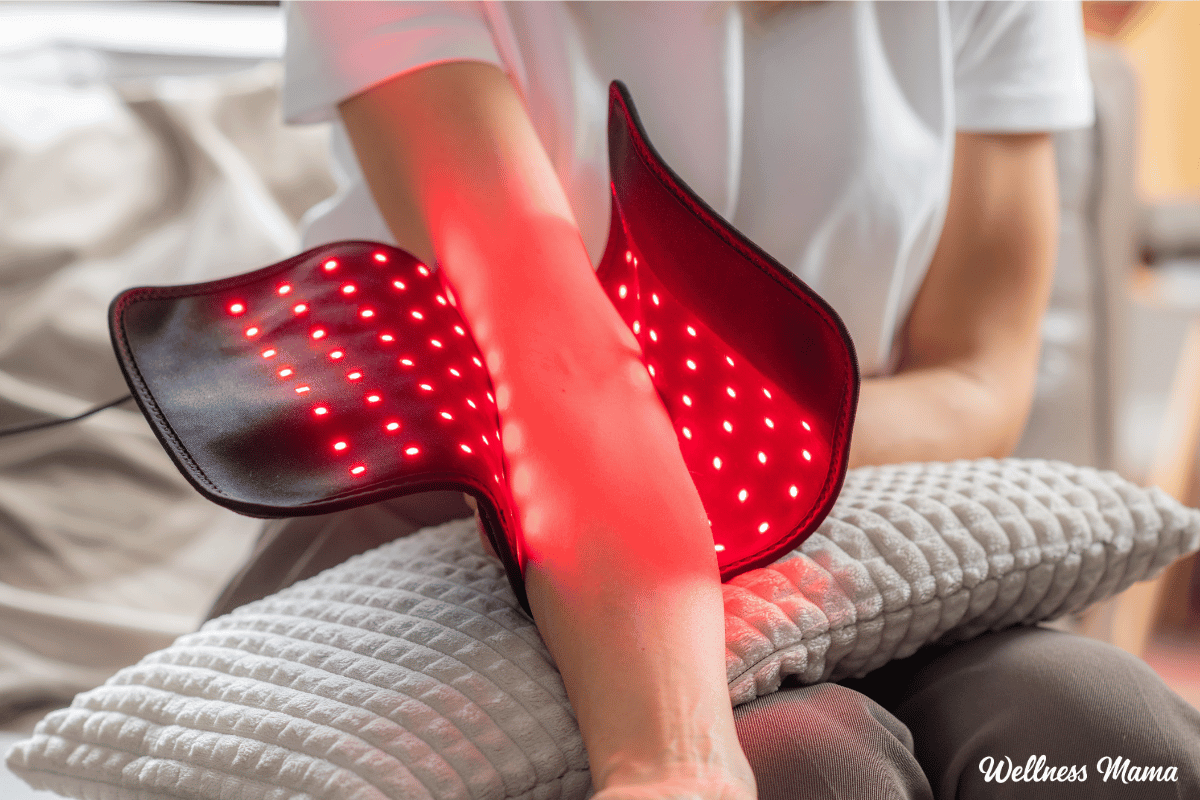
That said, I have not thrown out my red light devices. In fact, I’ve actually added to my collection! I consider these red light devices as a supplement to what I’m already doing. If you’re looking for a red light device I recommend paying attention to:
- Wavelength
- Irradiance (intensity at the surface)
- Total energy dose
- Distance from the body
- Session duration
Most effective sessions are relatively short, often five to fifteen minutes. For skin support, studies commonly use 630–660 nm several times per week. For joint and muscle recovery, 800–850 nm is typical, often used multiple times weekly for a few weeks before tapering down.
My Favorite Red Light Therapy Devices
During my healing phase, I used devices more frequently and cycled them strategically. Now, I use them as needed, for muscle soreness, targeted recovery, or occasional skin support. However, they’re never a replacement for time outdoors. I’ve also started using this red light toothbrush for better oral health.
Here are the ones that I’ve personally tried and recommend:
Safety, Context, and Listening to Your Body
Researchers have looked at red and near-infrared light for eye health, but I’m cautious about high-intensity exposure directly into the eyes. I don’t stare directly into the red light panels, but I do keep my eyes open while I’m facing sideways. I also pay attention to heat with higher near-infrared wavelengths.
As always, anyone pregnant, undergoing cancer care, using photosensitizing medications, or managing a complex medical condition should work with a practitioner who understands their case.
One of the biggest lessons from my own journey is that bio-individuality matters. What supported me during Hashimoto’s recovery may need to be adapted for someone else.
Final Thoughts: Start With the Sun
After more than a decade of writing about red light therapy, testing devices, and using it personally, my approach is simpler than it used to be. Try starting with sunrise then add sunset. Natural light exposure can be a daily habit before layering on anything else.
Red light therapy is not a hoax, and it’s not magic. The mechanisms are real, and the research is promising. But it works best along with light signalling from the sun and foundational changes (like drinking enough water.)
For me, red light was one supportive piece of my Hashimoto’s recovery. I still continue using red light devices as a supplement, but I mainly get it from sunrise and sunset exposure. The more I pursue wellness the more I’ve discovered that it’s not about the fancy devices, but getting our body in alignment with natural rhythms.
Have you ever experimented with red light therapy before? I’d love to hear about it in the comments!