

Ukraine’s president has stated that Vladimir Putin ‘doesn’t have too much time left’ -as questions are raised over the whereabouts of the Russian dictator, who has not been seen in more than a week.
Speaking to Politico during the Munich Security Conference on Friday, Ukrainian leader Volodymyr Zelensky said: ‘I’m younger than Putin…He doesn’t have much time, you know.’
While his remarks prompted a laugh from the audience, the Ukrainian president said: ‘No, no, believe me, this is important.’
Zelensky spoke as 73-year-old Putin has mysteriously vanished from the public eye for over a week.
In recent days, Moscow state media has broadcast pre-recorded footage of Putin meeting officials.
The Kremin leader was last seen by the public delivering a speech on February 5.
It is unclear if his latest absence is for health or other reasons.
This is not the first time Putin has vanished from the public eye; however, the dictator is known to disappear for periods of time with no explanation.

Ukraine’s president has stated that Vladimir Putin’doesn’t have too much time left’

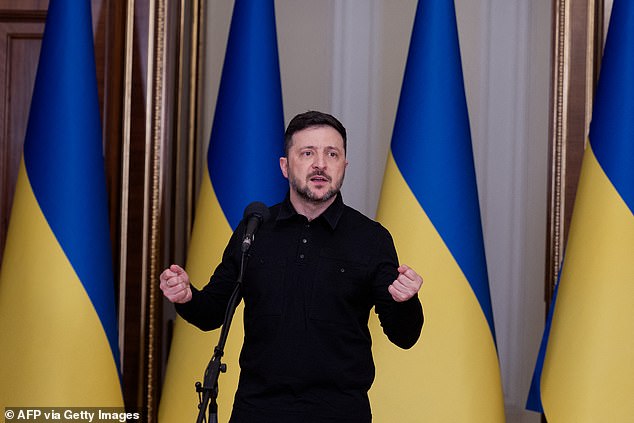
Ukraine President Volodymyr Zelensky speaks at a panel discussion during the 62nd Munich Security Conference (MSC) at the hotel ‘Bayerischer Hof’, in Munich, Germany, 14 February 2026

Putin has mysteriously vanished for more than a week, while Moscow state media has been using pre-recorded o the dictator
Such absences have led to speculation of Putin undergoing secret medical treatment.
Zelensky’s statement comes as the United States continues to strive for Russia and Ukraine to end the almost four-year war – with Trump recently setting a June deadline for the two sides to negotiate peace.
On Friday, Trump said Zelensky would miss an opportunity if he doesn’t ‘get moving’, and claimed Russia was willing to end the war through a peace deal.
He said: ‘Russia wants to make a deal and Zelensky’s going to have to get moving. Otherwise he’s going to miss a great opportunity. He has to move.’
Between February 17 and 18, a new round of peace negotiations involving Ukraine will be conducted by the US and Russia in Geneva.
The Kremlin has confirmed Vladimir Medinsky, a presidential aide to Vladimir Putin, will lead the Russians.
Questions over Putin’s whereabouts come as a group of European countries on Saturday said Russian opposition leader Alexei Navalny was poisoned by the Kremlin.
The foreign ministries of the UK, France, Germany, Sweden and the Netherlands said analysis of samples taken from Navalny’s body ‘conclusively confirmed the presence of epibatidine’ – a neurotoxin found in the skin of dart frogs in South America.
A joint statement said: ‘Russia had the means, motive and opportunity to administer this poison.’
The five countries said they were reporting Russia to the Organisation for the Prohibition of Chemical Weapons for a breach of the Chemical Weapons Convention.
The announcement came as Navalny’s widow, Yulia Navalnaya, attended the Munich Security Conference in Germany as the second anniversary of Navalny’s death approaches.
Navalny, who crusaded against official corruption and staged massive anti-Kremlin protests as President Vladimir Putin’s fiercest foe, died in an Arctic penal colony on February 16, 2024, while serving a 19-year sentence that he believed to be politically motivated.
‘Russia saw Navalny as a threat,’ British Foreign Secretary Yvette Cooper said. ‘By using this form of poison, the Russian state demonstrated the despicable tools it has at its disposal and the overwhelming fear it has of political opposition.’

It comes after five European countries today claimed that Russian opposition leader Alexei Navalny was poisoned by Russia. Pictured: Navalny attends a hearing at a court in Moscow in 2017

Navalny pictured with his wife Yulia in 2020
‘Putin killed Alexei with a chemical weapon,’ she wrote on social network X. She said Putin was ‘a murderer’ who ‘must be held accountable.’
Russian authorities said that the politician became ill after a walk and died from natural causes.
Epibatidine is found naturally in dart frogs in the wild, and can also be manufactured in a lab, which European scientists suspect was the case with the substance used on Navalny. It works on the body in a similar way to nerve agents, causing shortness of breath, convulsions, seizures, a slowed heart rate and ultimately death.
Navalny was the target of an earlier poisoning in 2020, with a nerve agent in an attack he blamed on the Kremlin, which always denied involvement. His family and allies fought to have him flown to Germany for treatment and recovery. Five months later, he returned to Russia, where he was immediately arrested and imprisoned for the last three years of his life.
The U.K. has accused Russia of repeatedly flouting international bans on chemical and biological weapons. It accuses the Kremlin of carrying out a 2018 attack in the English city of Salisbury that targeted a former Russian intelligence officer, Sergei Skripal, with the nerve agent Novichok. Skripal and his daughter became seriously ill, and a British woman, Dawn Sturgess, died after she came across a discarded bottle with traces of the nerve agent.
The poisoning of Navalny shows ‘that Vladimir Putin is prepared to use biological weapons against his own people to remain in power,’ French Foreign Minister Jean-Noël Barrot wrote on X.

Yvette Cooper pictured with Navalny’s widow Yulia today during the Munich Secuirty Conference

Yulia Navalnaya, human rights activist and wife of Russian opposition leader Alexei Navalny, gives a press statement on the death and circumstances of her husband’s death on the sidelines of the Munich Security Conference in Munich, Germany, Saturday Feb. 14, 2026
Navalny’s widow said last year that two independent labs had found that her husband was poisoned shortly before he died. She has repeatedly blamed Putin for her husband’s death. Russian officials have vehemently denied the accusation.
Yulia Navalnaya said Saturday that she had been ‘certain from the first day’ that her husband had been poisoned, ‘but now there is proof.’
A British inquiry concluded that the attack ‘must have been authorised at the highest level, by President Putin.’
The Kremlin has denied involvement. Russia also denied poisoning Alexander Litvinenko, a former Russian agent turned Kremlin critic who died in London in 2006 after ingesting the radioactive isotope polonium-210. A British inquiry concluded that two Russian agents killed Litvinenko, and Putin had ‘probably approved’ the operation.
At the Munich Security Conference this weekend, Zelensky also poked fun at Hungarian leader Victor Orban’s belly, saying Ukraine’s fight against Russia allowed Europe to live freely.
Zelensky was describing how Europe gains from having Ukrainian forces battling Russian troops in Ukraine.
Ukraine’s relations with neighbouring Hungary have been strained by Orban’s support for Russia and have deteriorated further in recent weeks as the veteran leader has ramped up attacks on Ukraine ahead of a closely fought parliamentary election in April.
‘There can be a sovereign Moldova and a Romania without dictatorship and even one Victor can think about how to grow his belly, not how to grow his army to stop Russian tanks from returning to the streets of Budapest,’ Zelensky said.
‘But look at the price. Look at the price, look at the pain Ukraine has gone through, look at the suffering Ukraine has faced. It’s Ukrainians who are holding the European front,’ he said.
Although Ukraine applied to join the European Union days after Russia invaded, it has been unable to advance accession talks because of Orban’s vetoes.
Unlike other European countries, Hungary has not diversified its imports from Russia since Moscow’s assault on Ukraine.