
New data suggests Commonwealth Bank is bracing for more interest rate rises, despite publicly forecasting only one further increase as the fight against rising inflation continues.
Analysis from Bheja Home Loans reveals the bank’s fixed‑rate pricing is signalling expectations of two RBA cash rate increases, even as its economists publicly forecast just one more rise in May.
Bheja chief executive Pravin Mahajan said that ahead of the RBA’s February cash rate decision, Commonwealth Bank lifted its three‑year fixed interest rate for owner‑occupier loans by 0.7 percentage points to 6.04 per cent – the largest 30‑day increase by any Australian lender on a single product.
While CBA economists officially expect the cash rate to peak at 4.1 per cent in May, Mr Mahajan said the bank’s pricing behaviour tells a different story.
‘The move effectively prices in three consecutive 0.25 per cent RBA increases,’ Mr Mahajan said.
‘CBA moved before the RBA even announced the first rise – their pricing tells us they expect at least two more rises.’
With meetings scheduled for March 17 and May 5, multiple rises could arrive rapidly.
After the latest February rate hike, two further 0.25 percentage-point increases would leave a homeowner with a $750,000 mortgage paying about $360 more per month.

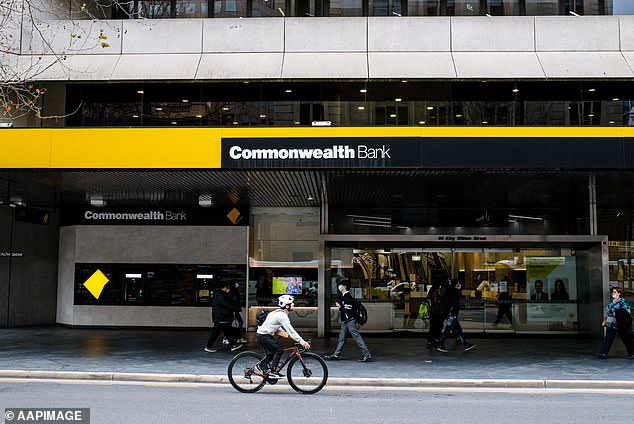
Revealing data shows Commonwealth Bank is bracing for triple rate hikes, despite forecasts of only one RBA increase in May

Canstar data insights director Sally Tindall said the fixed‑rate tide is on the way up
Canstar data insights director Sally Tindall said fixed interest rates are beginning to rise again.
‘It’s a big change from last year when the bank was offering up a 2-year special at 4.99 per cent,’ she said.
‘While the majority of borrowers are on variable rates, anyone who was considering fixing may feel like they’ve missed the boat.’
She urged Aussies to shop around for a better mortgage deal, even if they were on a variable rate.
‘Now is the time to be proactive. For an owner-occupier who’s paying down their debt, a competitive rate is now around 5.50 per cent, but, once the dust settles, we expect the market leader to sit closer to 5.25 per cent.
‘If you’re sitting on a rate starting with a 6, there’s no sugar coating it: you’re paying a loyalty tax.
‘Rates, as a whole, are on the rise, but that doesn’t mean the banks won’t negotiate on an individual basis. If you haven’t asked for a rate review in the last six months, pick up the phone or fire off a request from your banking app asking for one.’
Any further rate rises will add fresh pressure to households already dealing with elevated repayments.

Reserve Bank governor Michele Bullock is fighting to keep inflation under control
Required mortgage payments as a share of household income are now above the historical average, according to the RBA Board’s minutes, even as households funnel extra funds into offset and redraw accounts.
‘For those staring down the barrel of unaffordable repayments, it can be hugely tempting to switch to interest-only payments or extend out your loan term,’ Ms Tindall said.
‘While these moves offer immediate relief, potentially dropping repayments by hundreds of dollars, they can come with a massive sting in the tail.
‘For someone with a $600,000 debt and 25 years remaining on their loan, extending your loan term by five years might see your minimum repayments drop by $274 a month, but it could cost you over $134,000 extra over the life of your loan.
In the RBA’s updated forecasts, core inflation was forecast to remain above three per cent for all of 2026.
The Reserve Bank raises interest rates when inflation is high to slow down spending and reduce pressure on prices.
Higher rates make mortgages and loans more expensive, which means households and businesses have less money to spend.
As demand in the economy eases, businesses find it harder to keep lifting prices
‘This is too high and will not be tolerated by the RBA,’ Commonwealth Bank head of Australian economics Belinda Allen said.
‘But it remains a line-ball decision and is dependent on the data flow from here.’

Treasurer Jim Chalmers rejected suggestions higher public spending was contributing to inflation
Treasurer Jim Chalmers said the government was doing its part to ease living costs by cutting taxes and making medicines cheaper, but rejected suggestions higher public spending was contributing to inflation.
Dr Chalmers’ mid-year budget update, delivered in December, showed government expenditure was expected to rise to 26.9 per cent of GDP this financial year – the highest level in decades, excluding the pandemic.
But he was quick to point out the RBA board, in its post-meeting statement, singled out surprisingly strong private demand as a driver of inflation and made no mention of higher government spending.
‘What’s happened over the last six months or so is that private demand has turned out to be much stronger than we had been forecasting,’ governor Michele Bullock said in her post-meeting press conference.
Bullock attributed much of the blame to Australia’s dire productivity growth, which meant the economy could not sustain a higher level of growth without price pressures kicking off.
Deloitte Access Economics partner Stephen Smith said the blame for that extended beyond the current government.
‘The fact that an economy growing at 2.3 per cent breaks out in inflation sweats points to a more fundamental problem in our economy – our poor capacity to produce goods and services and our low run rate,’ Mr Smith said.
‘That we are here is an indictment on the piecemeal and lacklustre nature of reform over the last three decades.’
The result is lower forecast growth in household disposable income – essentially, living standards.
‘This is not ambition for Australia,’ Mr Smith said.
‘If this is really as good as it gets for economic growth, then Australia has bigger problems than an interest rate rise.’
The hike would increase pressure on the government to deliver reforms allowing the economy to expand without adding to inflationary pressures, he said.
Chalmers said the government needed to better address intergenerational inequity, but his focus was on increasing housing supply and previously announced changes like reducing superannuation tax concessions.
‘Any further changes to taxes, beyond those which we’ve already flagged, would be a matter for cabinet in the usual way, and would be consistent with the reform directions that we set out after the reform roundtable a few months ago,’ he told reporters.