

Ukrainian skeleton racer Vladyslav Heraskevych has issued a final demand to Olympic bosses to back down from their threat to disqualify him over the use of a helmet that pays tribute to his compatriots killed since the Russian invasion.
Taking to social media just two hours before the start of the skeleton competition at 9.30am local time on Thursday, the 27-year-old made it clear he will not relent in his stance, leaving the International Olympic Committee in the fiendish spot of having to relax their position on political messaging, or eject a Ukrainian hero.
The latter would be the worst PR imaginable for the Games organisers, who may have expected Heraskevych to comply after a week of escalating warnings.
Despite being the fastest in practice on Wednesday, and therefore a serious medal contender, Heraskevych is evidently ready to risk disqualification on a hugely evocative point of principle.
How that would be administered is not yet clear, assuming it comes to pass. Sources have suggested a disqualification could be triggered at the conclusion of his first run in the helmet, but other figures within the Games have told Daily Mail Sport that they do not expect Heraskevych to reach the start line. It is a desperately fraught situation.
But neither side is budging. Heraskevych’s position was reiterated in a social media post at 6.51am on Thursday, in which he requested an apology, an immediate lifting of the helmet ban and for the IOC to fund repairs to Ukrainian sites shelled by Russia.

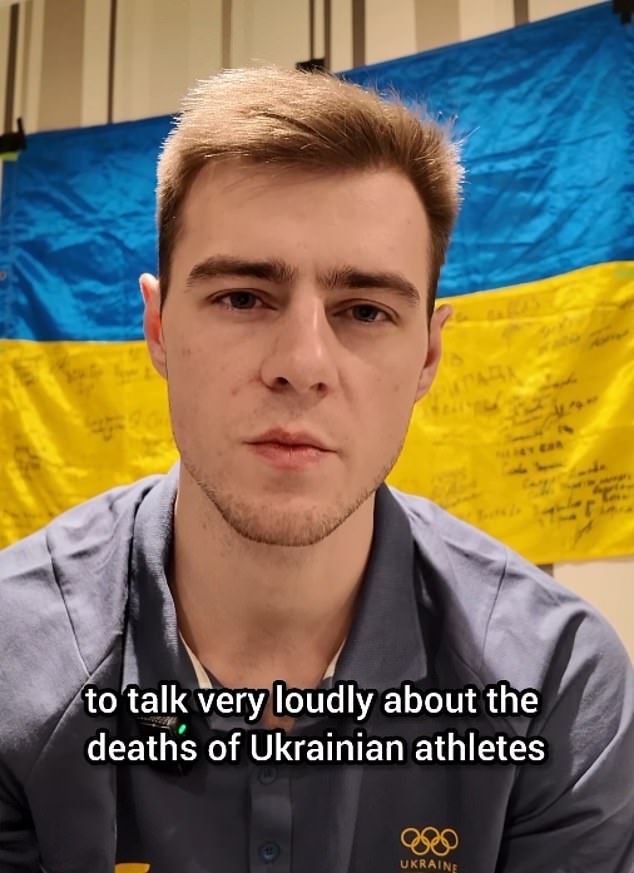
Vladyslav Heraskevych took to Instagram to make one last plea not to be disqualified

Winter Olympics bosses have threatened to disqualify Heraskevych over his ‘remembrance helmet’ – which protested against Russia’s invasion of his homeland Ukraine

He was warned against continuing to wear a helmet depicting the images of Ukrainian sportsmen and women killed in the war
He wrote: ‘I never wanted a scandal with the IOC, and I did not create it. The IOC created it with its interpretation of the rules, which many view as discriminatory.
‘Although this scandal has made it possible to loudly speak about Ukrainian athletes who have been killed, at the same time the very fact of the scandal distracts a tremendous amount of attention away from the competitions themselves and from the athletes participating in them.
‘That is why I propose to end the scandal. I ask: 1. Lift the ban on the use of the “Memory Helmet”. 2. Apologize for the pressure that has been put on me over the past few days. 3. As a sign of solidarity with Ukrainian sport, provide electric generators for Ukrainian sports facilities that are suffering from daily shellings.
‘I very much hope for a response before the start of the skeleton competitions.’
Speaking in Milan on Wednesday, IOC spokesman Mark Adams said: ‘We will contact the athlete today and we will reiterate the many, many opportunities (in press conferences) that he has to express his grief. We will try to convince him. We want him to compete.’
Asked directly about the option of disqualifying Heraskevych, who was the Ukrainian flag-bearer at the opening ceremony, Adams added: ‘I don’t think it’s helpful in this situation to look at hypotheticals, particularly since we are actually trying to get to a place where we can get him to take part.
‘But obviously there are rules and regulations and they will ultimately be enforced.’
The reticence on the side of the IOC should not be understated. But this remarkable scenario has also seen them unwittingly pinned between a rock and a hard place.
Their fear is that by allowing Heraskevych to depict fallen Ukrainian athletes on his helmet would inevitably see those from other nations doing the same, potentially in support of questionable regimes.