


An alleged Iranian spy has been arrested after being accused of trying to enter Britain’s Faslane nuclear naval base.
The 34-year-old suspect, accompanied by a female, 31, also reportedly Iranian, was in a vehicle when approaching a gate at HM Naval Base Clyde in Scotland.
The pair lacked the right passes to enter and were turned away, it has been reported – before being detained after ‘acting suspiciously in the vicinity’.
The naval base is the Royal Navy’s headquarters in Scotland and is home to Britain’s nuclear submarines including the Vanguard vessels armed with Trident missiles.
The arrests come as Iran’s foreign minister warned the UK it sees its choice to let the US use British bases as ‘participation in aggression’ in a phone call with Foreign Secretary Yvette Cooper.
Iranian foreign minister Abbas Araghchi criticised what he called the ‘negative and biased approach of Britain’ towards the US-Israeli military action against Iran, as well as the UK’s decision to provide military bases for the US to use.
Sir Keir Starmer has granted the US permission for ‘defensive’ action against Iranian missile sites from RAF Fairford in Gloucestershire and Diego Garcia in the Indian Ocean.
Commenting on the Faslane arrests, a Police Scotland spokesman said: ‘Around 5pm on Thursday, 19 March, 2026, we were made aware of two people attempting to enter HM Naval Base Clyde.

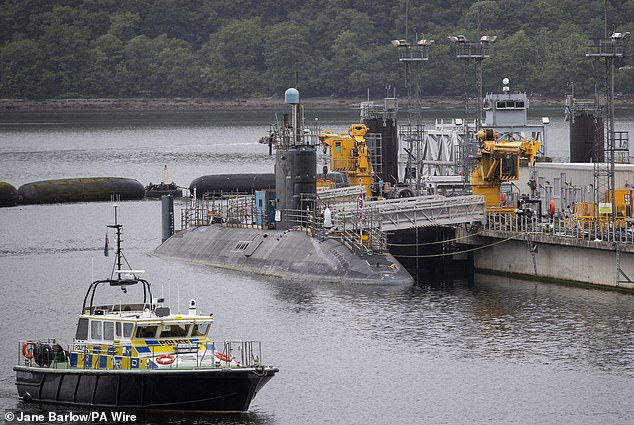
The Faslane naval base is the Royal Navy’s headquarters in Scotland and is home to Britain’s nuclear submarines including the Vanguard vessels armed with Trident missiles

A 34-year-old suspect, accompanied by a female, 31, also reportedly Iranian, was in a vehicle when approaching a gate at HM Naval Base Clyde in Scotland
‘A 34-year-old man and 31-year-old woman have been arrested in connection and enquiries are ongoing.’
A Royal Navy spokesman said: ‘Police Scotland have arrested two people who unsuccessfully attempted to enter HM Naval Base Clyde on Thursday 19 March.
‘As the matter is subject to an ongoing investigation, we will not comment further.’
HM Naval Base Clyde, commonly known as Faslane, is home to four Trident-armed ballistic missile submarines as well as the Navy’s seven Astute-class nuclear-powered attack submarines.
The base, 25 miles north-west of Glasgow, hosts submarines powered by nuclear reactors.
A serious nuclear incident took place at the base early last year, it was revealed last August.
There was a Category A event at HMNB Clyde on Gare Loch in Faslane between January and April.
The Ministry of Defence defines a Category A incident as the most serious and those which carry an ‘actual or high potential for radioactive release to the environment’.

The Faslane base is the Royal Navy’s headquarters in Scotland and hosts Britain’s nuclear submarines including the Vanguard vessels armed with Trident missiles
But the government department insisted the incident at HMNB Clyde did not pose a risk to the public nor result in any radiological impact to the environment.
It was revealed in a written parliamentary answer by defence procurement minister Maria Eagle after she was asked to provide the number of Nuclear Site Event Reports (NSERs) at the Faslane and Coulport naval bases.
NSERs detail incidents at nuclear facilities and are categorised based on their safety significance and impact.
She disclosed that there had been a category A event at Faslane between January 1 and April 22 as well as two category B, seven category C and four category D incidents.
Ms Eagle added that there were five further events deemed ‘below scale’ and less serious.
The Faslane base is guarded by Ministry of Defence Police as well as Royal Marine Commandos from the 43 Commando Fleet Protection Group.
The criticiswm of Britain from Iran came in a post in Farsi on the website Telegram, in which Mr Araghchi said he told Ms Cooper: ‘These actions will definitely be considered as participation in aggression and will be recorded in the history of relations between the two countries.
‘At the same time, we reserve our inherent right to defend the country’s sovereignty and independence.’
Downing Street defended the UK’s position, with the Prime Minister Sir Keir Starmer’s official spokesman saying: ‘Our position is very clear. We didn’t participate in the initial strikes, and we’re not getting drawn into the wider war.
‘We have authorised the US to use our bases for a specific defensive and limited purpose in response to Iran’s continued and outrageous aggression, and we’ve always said that this is the best way to eliminate the urgent threat and restore a path to diplomacy.’
Housing Secretary Steve Reed said the Prime Minister had been ‘very measured’ in his approach to the conflict.
Mr Reed said: ‘He took the decision quite rightly, not to involve the United Kingdom in the initial attacks against Iran, but it is quite right that the UK should defend British nationals.
The UK has faced repeated criticism from Donald Trump since the war began, and is among countries the US president has recently berated for failing to respond to his request for support in the Strait of Hormuz.
Tehran’s throttling of the key shipping route and attacks on energy facilities across the Gulf have heightened concerns about the security of the supply of fossil fuels.
On Friday, oil and gas prices retreated after painful cost spikes the previous day and financial markets calmed at the end of another turbulent week.
The declines follow a statement late on Thursday by Israeli’s prime minister Benjamin Netanyahu that he would hold off on any further attacks on Iran’s gas field at the request of Mr Trump after the Iranian retaliation sent oil prices skyrocketing.
Sir Keir meanwhile acknowledged the cost-of-living pressures people are facing ahead of new measures being set out on Friday to revamp neighbourhoods.
As households brace for a further squeeze on their wallets, Mr Reed said the Government is ready to ‘intervene as is appropriate’.
Mr Reed told the Press Association: ‘The Government is monitoring the situation hour by hour, and we stand ready as things change, to intervene as is appropriate.’
He pointed to a £53million support package for low‑income households who rely on heating oil that has already been brought in but also insisted the UK’s economy was in the ‘best place’ to weather challenges.
He added: ‘People should feel as well the Government can’t always stop all the storms that may happen around the world, but when those storms come in, we can weather them far better because of a much more stable economy that we’ve got now, because of the choices this Government made.
‘So whatever happens, we’re in the best place that we could be to withstand it.’
Sir Keir has said that the longer the conflict continues, ‘the bigger the impact on the cost of living,’ arguing that ‘the best way forward is a negotiated settlement with Iran’.
Bank of England governor Andrew Bailey has said reopening the Strait of Hormuz is the ‘best thing to do’ to prevent interest rates rising, after a vote to leave the rate unchanged at 3.75 per cent on Thursday.
Mr Bailey said any further cuts were ‘not on the horizon’ as he hinted at possible hikes, adding that the war in the Middle East would likely increase household energy costs in summer and put pressure on food prices.
He told LBC’s Andrew Marr: ‘The duration of this problem is crucial. I would also say very clearly that the best way to solve this situation is not through monetary policy. It is through sorting out the source of what’s going on.
‘Frankly, reopening the Strait of Hormuz is the best thing to do – get the energy market back on its normal footing, as it were.’