



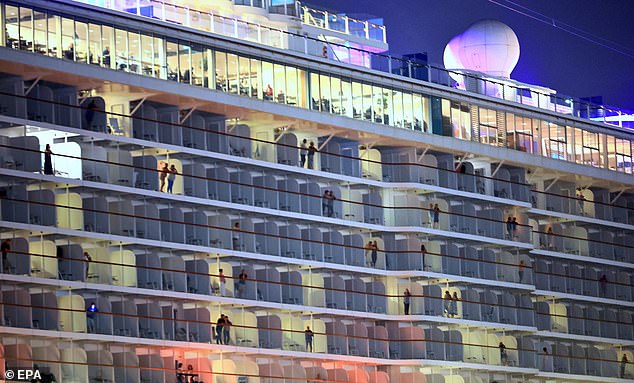
Thousands of cruise line passengers are trapped in ports in the Gulf due to the war in the Middle East.
They and crews are unable to leave the ships, which have become floating hotels, due to the escalating hostilities.
At least six ships from big companies are said to be at a standstill and awaiting news of when they can leave.
This situation has left thousands of travellers and crew stranded in the ports of Dubai and Doha, with no viable exit routes or ‘safe corridors’ open at the moment.
There are now worries about how long the passengers will be stranded and how the ships are going to cope with all the basic services, food, drink, water etc.
‘The activation of emergency protocols has forced captains to suspend scheduled itineraries in the face of the latent risk in the Strait of Hormuz and the exponential increase in the cost of insurance policies that, in many cases, they have stopped covering operations in the area.
‘This forced immobilisation is not only a problem of fuel or supply logistics, but a matter of security that transcends leisure to enter the terrain of a large-scale operational crisis’ says leading travel portal Hosteltur.com.
‘The sector, which was in the middle of the peak of the winter season, is now facing a situation of technical paralysis that transcends the simple cancellation of itineraries.
‘The impossibility of carrying out the planned rotations has forced companies to reevaluate not only the safety of their guests and crews but also the viability of their logistics structures.

Thousands of cruise line passengers are trapped in ports in the Gulf due to the war in the Middle East. Pictured: A cruise ship is docked at the terminal close to the old port, in Doha, Qatar
‘The industry is waiting for safe corridors that allow the evacuation or repositioning of fleets to less compromised international waters.’
The magnitude of the standstill is currently affecting at least six large cruise ships that are immobilised in the ports of Dubai and Doha.
These vessels, which were scheduled to continue their voyages or transfer passengers, have been ordered to remain docked or anchored in areas considered safe until international organisations determine new shipping routes.
The situation has led to a saturation of port services, complicating not only passenger management but also the provisioning necessary to maintain the basic operational capacity of the ships, which have effectively become floating hotels with no ability to move.
The impact is concentrated mainly on the groups that dominate winter operations in the Persian Gulf.