

A British economist who made millions betting on the 2008 financial crisis has warned Australia risks sliding towards India‑level inequality unless it introduces a wealth tax.
Economist Gary Stevenson is visiting Australia for the first time as part of a speaking tour aimed at rallying support for his global campaign against widening wealth gaps between the rich and the poor.
Raised in a working‑class family in East London, Stevenson became Citibank’s most profitable trader during the financial crisis.
He now commands an audience of 1.5 million YouTube subscribers and has reinvented himself as a fierce critic of widening wealth gaps.
‘I always remember when Donald Trump used a very insulting term to refer to poorer countries,’ Stevenson told the ABC.
‘What that implied was that he thought – and I think many British and Australian people naively think – that the kind of inequality and poverty you see in parts of Africa, Latin America or Asia could never happen here.
‘It can. It absolutely can happen.’
Stevenson said he wanted Australians to look closely at what has unfolded in Britain.

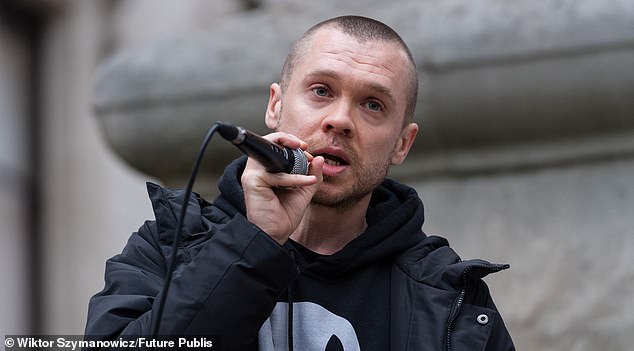
Inequality economist Gary Stevenson (pictured) said there was little financial incentive for the rich and powerful to support meaningful reform

Mr Stevenson argued the expanded 5 per cent Home Guarantee Scheme was inflating house prices and pushing young Australians into increasingly ‘risky’ multi‑million‑dollar mortgages
‘I want to come and show Australians what is happening in the UK, what is happening in Europe,’ Mr Stevenson told the ABC. ‘Public services being shut down, poverty exploding.
‘That will happen in Australia unless we deal with inequality.’
He argued modern tax systems must be restructured to shift the burden away from lower-income earners and towards the wealthy.
‘This is a country that tells people it believes in having a fair go,’ he said.
‘And it is a country which has, for a long time, provided affordable housing and good living conditions to ordinary working Australians.’
Stevenson said the biggest consequence of rising inequality was unaffordable housing.
‘The big thing I want Australians to understand is that if wealth inequality gets bigger and bigger – and the super rich take a bigger and bigger share – ordinary Australians will get squeezed out.
‘The biggest consequence of that is unaffordable housing.’

Mr Stevenson told the ABC’s The Business program he will pressure local MPs to develop practical policies to expand access to housing during his speaking tour
He claimed government schemes designed to help first-home buyers were actually making the affordability crisis worse by pushing up demand without increasing supply.
The expanded 5 per cent Home Guarantee Scheme introduced by the Albanese government allows eligible buyers to purchase a home with just a 5 per cent deposit, with the government guaranteeing the remainder so they can avoid paying lenders mortgage insurance.
Stevenson said it risked inflating prices and pushing young buyers into dangerous levels of debt.
‘I think the only people that really benefit from that are the mortgage lenders,’ he said. ‘They’re not taking the risk.’
‘Is that what we want for our kids – $2 million, $3 million, $4 million mortgages? Do we want this country to be one where the only way to buy a house is to take a $5 million bet?’
He warned house prices could not sustainably rise to three, five, ten or even twenty times a person’s annual wage.
‘If your kids can’t buy houses, who’s buying the houses? The houses aren’t disappearing. That wealth is being transferred to the rich.
‘If you’ve got $1 billion in wealth, you’re going to make $50 million a year — $1 million a week. What are you going to do with that? It’s impossible to do anything other than buy assets.’

Treasurer Jim Chalmers (pictured) has floated the idea of scaling back the generous CGT for property investors in Australia

Stevenson argued Australia was uniquely placed to tax wealth because so much of it is tied to property and natural resources
Stevenson said Australia was following the same path as the UK.
‘We now have many families in the UK – and I know also here in Australia – with two working people, often with degrees, who will never be able to afford a home.
‘You’re going in the same direction. You’re not taxing rich people. You’re developing a billionaire class. That billionaire class pushes up asset prices.
‘What that means is your kids can’t afford a home – they’ll be renting their whole lives. And where does that rent go? To the billionaires, who use it to push house prices up even further.’
He warned that simply increasing housing supply without addressing inequality could deepen divisions within Australian cities.
‘Listen, if you want, you can turn this city into Mexico City. You can – if you want,’ he said.
‘You can have a tiny, super-rich luxury centre in Sydney or Melbourne or Perth or Brisbane, surrounded by desperate poverty. And you can build those cities bigger and bigger and bigger.
‘If you try to build your way out of an inequality crisis, what you will build is slums. The whole world shows you that.
‘I’m not saying don’t build – of course you should build. But if you build in the context of inequality, there will only be two kinds of housing: super-luxury homes for the super rich in the centre, and extremely low-quality housing for the poor on the outskirts.’

He rejected claims migration is the main driver of soaring house prices, instead pointing the finger squarely at the ‘billionaire class’
He rejected arguments that migration was the main driver of rising house prices, or that cutting migration would solve the problem.
‘If people want lower migration, they can argue for lower migration. I try to stay out of that debate,’ he said.
‘But very often the arguments that keeping migrants out will fix the problem are funded by right-wing parties backed by billionaires.
‘The people driving house prices up in Australia are the same people driving them up in the UK, Europe and America. It’s the billionaire class.’
Stevenson argued Australia was uniquely placed to tax wealth because so much of it is tied to property and natural resources.
‘Australia has an enormous amount of wealth, and the vast majority of it is in housing and natural resources under the ground.
‘They can’t take that away.
‘I don’t think there’s a single country in the world that has a better shot at taxing the super rich and protecting that wealth for its people.’
He said allowing natural resources to be dominated by wealthy elites would leave working Australians worse off.

Mr Stephenson warned that if inequality continues unchecked, countries like Australia could resemble parts of the developing world
‘If you allow those resources to be monopolised by the very rich, then they don’t have to do anything for working people. You need to protect it.’
Former prime minister Kevin Rudd attempted to introduce a 40 per cent super-profits mining tax in 2010, but it was heavily opposed by mining giants and later watered down.
His comments come as the Albanese government has not ruled out changes to capital gains tax concessions for property investors in the May Budget.
Under current rules introduced by the Howard government in 1999, investors pay tax on only half the capital gain from properties held for more than 12 months.
More controversial proposals include the possible introduction of an inheritance tax. Deloitte has argued such taxes could help address intergenerational inequality.
‘Broad-based taxes on wealth – such as an inheritance tax – are a way to repair the budget and help prevent inequality from cascading through future generations,’ a Deloitte report said.
Stevenson said political reluctance was the biggest obstacle to reform.
‘The frustration I get is that whenever I talk to politicians, they always say, ‘That’s too difficult. We’re not ready. We’re worried about the next budget.
‘And every year the same thing happens: house prices go up and housing becomes less affordable.’
He warned that if inequality continues unchecked, countries like Australia could resemble parts of the developing world.
‘Have you ever been to India? That’s the future.
‘The idea that the kind of inequality you see in poorer countries can’t happen here is naïve. It can.’
Stevenson said he wanted to ‘light a fire’ under Australians.
‘Because the politicians are not going to give it to us.
‘And I want Australians fighting by my side.’