


Ever since I picked up my M1 Pro MacBook Pro back in 2021, I’ve been waiting for the day a Windows laptop could get close to matching the power and convenience it delivers. And to be clear, that’s not a knock on my MacBook — I genuinely love it, and it got me through college. But I’ve always preferred Windows to macOS. Even with my frustrations with Microsoft’s handling of Windows 11 over the past couple of years, I still use it daily on my desktop PC more than macOS. It’s simply my bread and butter.
So when I heard Asus was releasing the ProArt GoPro Edition (PX13), I was cautiously optimistic that it could finally be a Windows laptop capable of dethroning my MacBook. It’s designed with creators in mind, features a unique GoPro-inspired design thanks to a collaboration between Asus and GoPro, and, most importantly, boasts some seriously impressive hardware. We’re talking about the AMD Ryzen AI+ 395 processor, Radeon 8060s integrated graphics, and a staggering 128GB of LPDDR5X RAM.
Over the past month, I’ve had the chance to test the Asus ProArt GoPro Edition (PX13). While I do have a few gripes, I’ve been seriously impressed with the build quality and the level of performance it delivers. For creative workloads like video and photo editing, and for gaming, this thing is an absolute powerhouse with a really distinctive design that stands out.


4/5
- Operating System
-
Windows 11
- CPU
-
AMD Ryzen AI MAX+ 395 Processor (16 cores, 32 Threads)
- GPU
-
AMD Radeon 8060s
- RAM
-
128GB LPDDR5X RAM
- Strong performance
- 128GB of RAM
- Solid battery life
- Very expensive
- 60Hz refresh rate
- Fans can get loud
Price, specs, and availability
The Asus ProArt GoPro Edition (PX13) is now available in the US and Canada, priced at $3,000 USD ($4,000 CAD). The laptop is made of aluminum, with a Nano Black color scheme, that incoporates unique GoPro accents on the lid.
Internally, the laptop has an AMD Ryzen AI Max+ 395 processor with 16 cores and 32 threads, an AMD XNA NPU capable of up to 50 TOPS, and an AMD Radeon 8060s iGPU. It’s also equipped with 128GB of LPDDR5X RAM, a 1TB SSD, and a 73WHrs battery.
By default, the Radeon 8060s iGPU has 4GB of VRAM, but using the MyAsus app, you can set it to share some of the system’s RAM with it to have up to 64GB of VRAM if you so choose, which could be handy depending on what you do with the laptop, such as gaming, editing, or running large language models (LLMs). Personally, for my testing purposes, I set the 8060s to use 16GB of VRAM, leaving the remaining 112GB of RAM for the rest of the system’s processes and apps.
Turning to the screen, it’s a 13.3-inch 2-in-1 OLED touchscreen with a 2880 x 1800 pixel resolution (3K),16:10 aspect ratio, and a 60Hz refresh rate.
For I/O, it has one USB 3.2 Gen 2 Type-A port, two USB 4.0 Gen 3 Type-C ports supporting display and power delivery, one HDMI 2.1 port, one 3.5mm combo audio jack, and one microSD 4.0 slot.
- Operating System
-
Windows 11
- CPU
-
AMD Ryzen AI MAX+ 395 Processor (16 cores, 32 Threads)
- GPU
-
AMD Radeon 8060s
- RAM
-
128GB LPDDR5X RAM
- Storage
-
1TB SSD
- Battery
-
73WHrs
- Display (Size, Resolution)
-
13.3-inch, 3K (2880 x 1880) OLED
- Colors
-
Nano Black
- Brand
-
Asus
- Starting Price
-
$3,000
What I liked about the Asus ProArt GoPro Edition
A stunning design paired with equally impressive performance

Going into this, my expectations were high — and for a laptop with this kind of hardware and a $3,000 price tag, they should be. Luckily, I wasn’t disappointed. The AMD Ryzen AI Max 395+ inside is AMD’s most powerful APU, and it definitely delivers. In my everyday use, I threw everything at it: tons of photo editing, dozens of apps and browser tabs, and plenty of gaming, and it handled it all effortlessly.
In Geekbench 6, I recorded a single-core score of 2,929 and a multi-core score of 17,651. For comparison, when Pocket-lint tested the M5 MacBook Pro last year, it scored 4,245 on single-core and 16,532 on multi-core. So yes, the ProArt GoPro Edition trails in single-core performance, but it more than makes up for it in multi-core performance, which is arguably more important for creative workloads that include lots of rendering, encoding, and exporting.
I was also very pleased with the gaming performance. I experienced no issues running popular titles like Cyberpunk 2077, Indiana Jones and the Great Circle, and Arc Raiders at high settings at 60 FPS with AMD FSR set to Balanced. The Radeon 8060s iGPU performs about as well as an RTX 5060 laptop GPU, which is impressive considering it’s integrated rather than dedicated.

Of course, I also need to mention the laptop’s 128GB of unified RAM. With rising RAM costs amid the ongoing memory shortage, seeing this much RAM packed into this machine is impressive, and for someone like me who opens way too many Chrome tabs throughout my workday, in addition to running too many apps at once, it’s been extremely beneficial and has kept performance smooth.
Battery life on the laptop has also been solid. In gaming and editing sessions, I always used it plugged in to get the best performance, but during a workday, unplugged, using it for writing and web browsing at just over half-brightness, I was able to get around 10 hours of battery life.
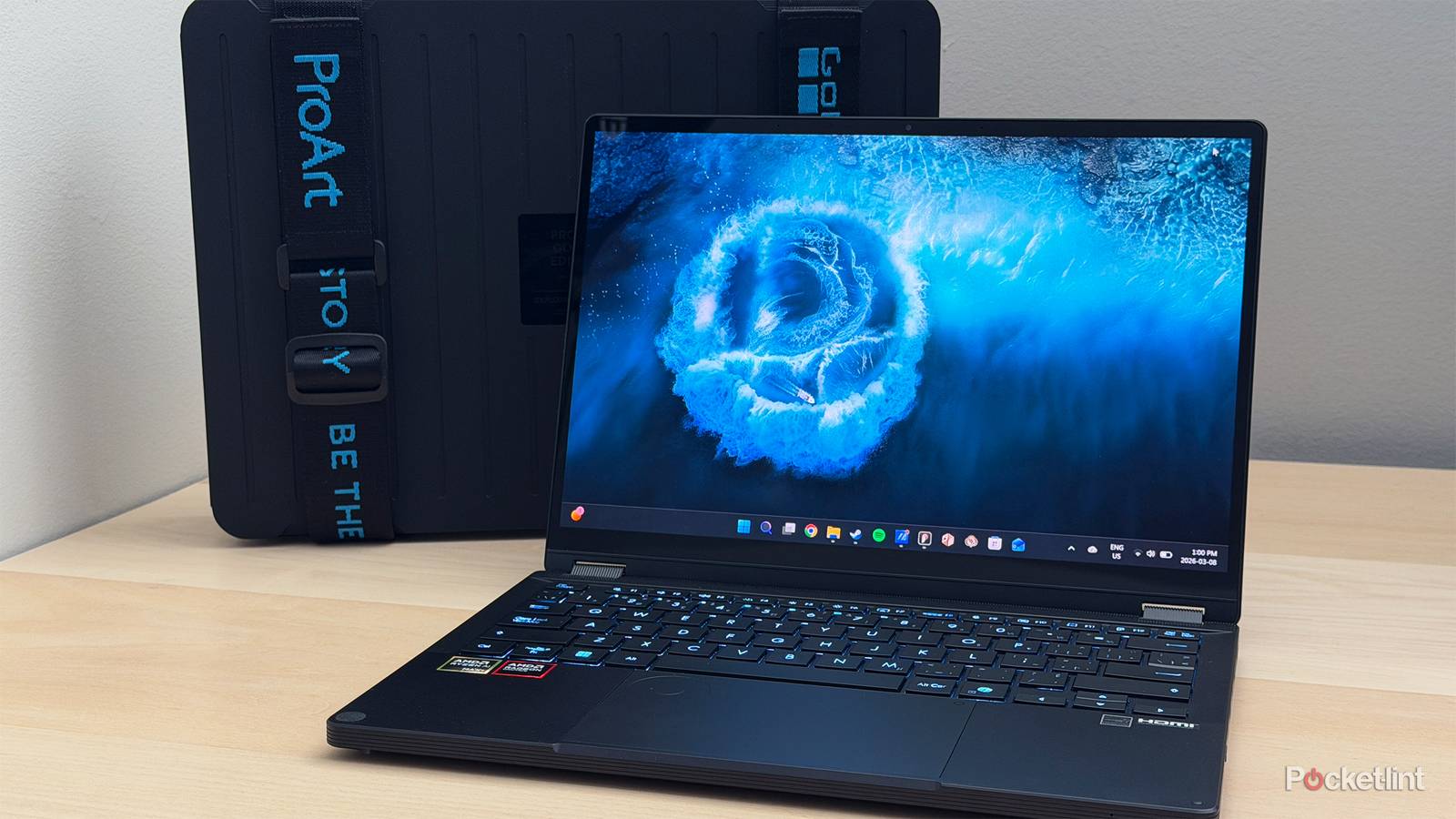
As for the laptop’s design and overall feel, I’m a big fan of its GoPro-inspired look. It gives the laptop a distinctive identity, with its black metal finish and subtle GoPro accents on the lid. It stands out without feeling over-the-top (looking at you, gaming laptops), which I appreciate.

The keyboard has been fantastic for writing — and considering that’s how I spend most of my day, that matters. The key travel feels just right, with a responsive, satisfying press that never feels mushy. It’s also backlit with a clean blue glow that looks great without being distracting.
The trackpad is generously sized, giving you plenty of room to move around comfortably. But the standout feature is the integrated DialPad in the top-left corner. It’s customizable, works across a ton of apps, like Photoshop and Premiere Pro, and can also handle simple system controls, like adjusting the volume.
The Asus ProArt GoPro Edition also comes with a high-quality storage case and a travel sleeve with shoulder straps, which I thought was a really nice touch. I’ve never had a laptop come with everything you need to take it on the go right out of the box, and it just adds to how unique this machine feels overall.
What I didn’t like about the Asus Pro GoPro Edition
The 60Hz refresh rate is a huge letdown

While the Asus GoPro Edition has a stunning 13.3-inch OLED display that makes videos and games look fantastic, its biggest drawback is the 60Hz refresh rate. Given that this laptop costs $3,000, I expected much better, like 120Hz, so this was really disappointing to see. It’s a major downside if you want to do both gaming and video editing on a device like this.
Another thing that really bothered me about this laptop is the loud fan noise. While I was writing and browsing the web, it was quiet, but during performance-demanding tasks, the fans really ramped up and made a lot of noise, which was very distracting. If you’re wearing headphones, you might not notice it as much, but if you’re using its speakers, you definitely will. Considering its hardware, this isn’t unexpected, but if you plan to put it under heavy workloads, be aware that this laptop can get quite loud.
Storage is another area where I feel this laptop falls slightly short. Given that it’s aimed at creators, the fact that it only has 1TB of storage seems odd. 2TB would have made much more sense to me, and again, considering this laptop costs $3,000, I don’t think that’s too much to ask for.
Should you buy the Asus ProArt GoPro Edition?
It’s one of the best Windows laptops for creators, but $3,000 does sting

Overall, I’ve had a really great time using the Asus ProArt GoPro Edition (PX13) as my daily laptop over the past month. Thanks to the stacked hardware inside, I didn’t miss my MacBook Pro at all, and that 128GB of RAM is simply incredible for multitasking, creative apps, and even gaming.
…if you’re a creator who prefers Windows to macOS and want a portable, sleek, durable, and seriously powerful Windows laptop — and you can justify the $3,000 price tag — the Asus ProArt GoPro Edition (PX13) won’t disappoint.
That said, the price tag is the real elephant in the room. At $3,000, it’s asking a lot. While the hardware backs it up, it’s hard not to compare it to something like the 14-inch M5 Pro MacBook Pro with 2TB of storage and 48GB of RAM, which you can get for $3,000 instead.
Still, if you’re a creator who prefers Windows to macOS and want a portable, sleek, durable, and seriously powerful Windows laptop — and you can justify the $3,000 price tag — the Asus ProArt GoPro Edition (PX13) won’t disappoint.
This device was provided to Pocket-lint by Asus.