



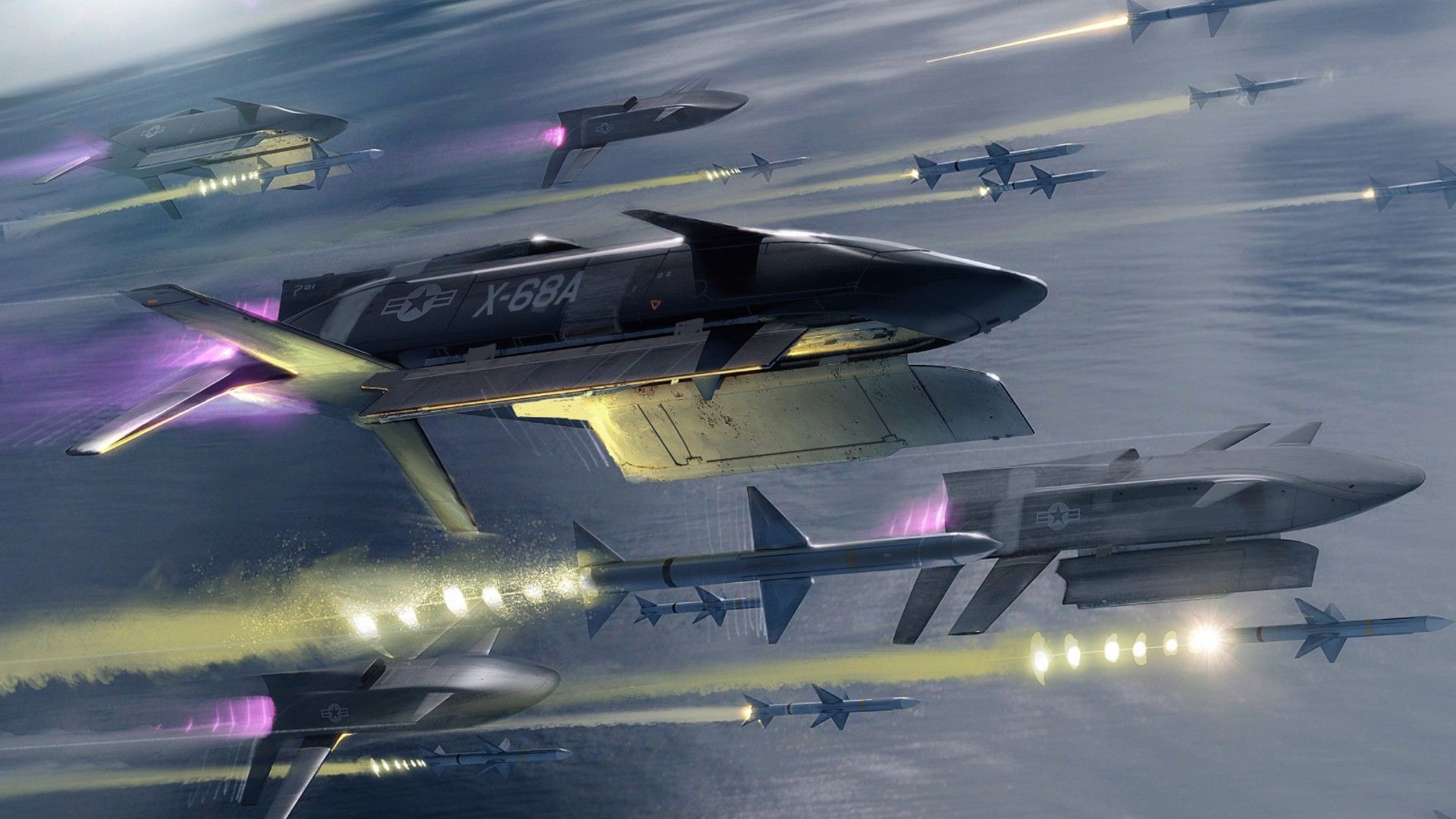
The U.S. military is developing a new experimental aircraft that looks a lot like a cruise missile, one that is also capable of launching its own missiles.
The new X-plane (X for “experimental”) has officially received a U.S. Air Force designation and is now known as the X-68A. It is an uncrewed aerial vehicle (or UAV) that closely resembles a cruise missile, uncrewed self-propelled vehicles that fly long distances within Earth’s atmosphere, typically with jet engines. But unlike cruise missiles, which typically possess an explosive munition (warhead), the X-68A is designed to launch from another aircraft and then launch air-to-air weapons of its own.
Getting ready to fly
Before the X-68A can fly for the first time, the vehicle must undergo extensive testing. DARPA published a Feb. 17 statement that details the recent tests they’ve been working on for the experiment aircraft. A few of these include testing the X-68A inside a full-scale wind tunnel, as well as trials to see how the vehicle performs with parachute recovery and weapons-release systems.
Casey said these tests “demonstrate significant progress” for the X-plane’s capability. “Since we began the program, we have made significant progress in the detailed design of a complex flight vehicle and its actuation mechanisms to go from a captive store to a flying vehicle,” Casey said.
Essentially, the research team must ensure that the X-68A can leave its mothership safely, so there’s no risk to the pilot who’s flying the jet that carries it. They also need to make sure the X-68A can eject its own weapons while flying at a high speed.

The first test flights, which may happen as early as the end of this year, will prove “safe and effective employment of the X‑68A from an F-15 Eagle” and demonstrate the vehicle’s ability to “safely eject a captive sub-munition,” a spokesperson from General Atomics Aeronautical Systems wrote in a Feb. 19 announcement.
In other words, the flights will test the X-68A’s ability to launch from another aircraft like a missile, and then launch its own missiles.

This concept of using vehicles that can be employed from another aircraft while it’s in the air is intended to work with different kinds of aircraft, like fighters and bombers. DARPA calls this “host-platform agnostic.”
Defense Advanced Research Projects Agency (DARPA) acts as the military’s research arm, often working on moonshot technologies that go on to have wide-ranging impacts in society. For example, DARPA previously helped design and develop the X-37, a reusable spacecraft that served as a precursor to the U.S. Space Force’s X-37B.