

The ultra-rich are growing increasingly anxious about protecting their fortunes as war in the Middle East fuels fears of wider instability, with expats fleeing Dubai and turning to Switzerland to shield their wealth and dodge tax bills.
Wealth managers say the more money clients have, the more urgently they are trying to move it out of the Gulf following the US-Israeli strikes on Iran, amid concern the conflict could spread across the region.
Reputation expert Bernhard Bauhofer said anxiety among the world’s wealthiest is intensifying.
‘The ultra-rich are worried. The more money they have, the more they fear losing it,’ he said.
Dubai and the wider United Arab Emirates have long attracted global wealth with luxury lifestyles and generous tax breaks.
But the war has exposed the risks, prompting a renewed flight to Switzerland.
‘Whenever there is a crisis, whether during the Cold War or today, we see Switzerland’s value reflected in the strength of the franc,’ Bauhofer said, pointing to its political stability and neutrality.
Dubai, once dubbed the ‘Switzerland of the East’, is now facing pressure as uncertainty grips the region.
Bankers and financial advisers say wealthy individuals are now actively exploring shifting assets from the Gulf to Switzerland as the conflict escalates following the U.S.-Israeli strikes on Iran.

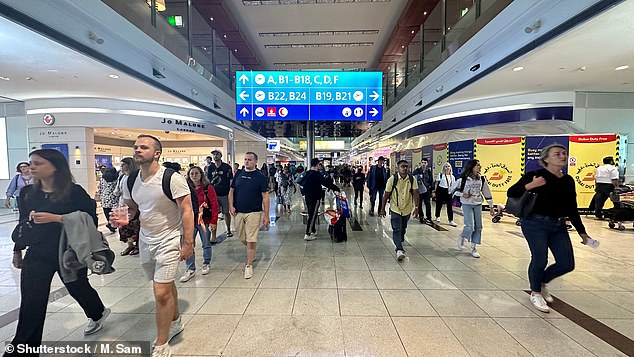
Pictured: A stock image of travelers at Dubai Airport’s departure gate
More than a dozen bankers and financial advisers, collectively representing assets worth more than $1 trillion, were broadly optimistic that Switzerland would attract more money from the Middle East, particularly after Iranian attacks on Gulf states.
Although Switzerland, long considered by investors as a safe haven, has faced growing competition from financial hubs in the Middle East and Asia, cash positions booked in the country by private individuals and non-banks from the United Arab Emirates have risen around 40% over the last three years.
This gained momentum after earlier attacks by Israel and the U.S. on Iran in June last year, said Patrik Spiller, head of wealth management at consultancy Deloitte Switzerland.
‘Due to recent events, we expect that assets from the Middle East will increasingly be booked in Switzerland. We’re hearing from banks, family offices, and other high-net-worth individuals that discussions are currently underway,’ Spiller said.
The Swiss Bankers Association said it could not comment specifically on asset flows from the Middle East since the recent strikes on Iran, but noted Switzerland had long positioned itself as an attractive place for wealthy investors.
‘It’s now to our advantage that we can score points with Swissness, namely secure conditions, political stability, and the rule of law. I believe this is particularly valued in times like these,’ said SBA chief economist Martin Hess.
After the U.S.-Israeli strikes on Iran, the Swiss franc hit its highest level against the euro in a decade.
Although it would likely take weeks or months for inflows to register, Switzerland could eventually see ‘several dozen billion’ dollars coming in from the region, Spiller said.
‘But that will depend a great deal on how the war develops, and how long it lasts,’ he added, noting cash usually came first followed later by assets such as stocks or bonds.
UBS (UBSG.S), Switzerland’s biggest wealth and asset manager, declined to comment, as did Julius Baer (BAER.S),which has the third-largest total of assets under management (AuM).
Swiss private bank Pictet, which ranks second largest by AuM, said in a statement it is seeing inquiries from customers, but the increase could not be described as significant.
‘We reported a record high in AuM at the end of the year, despite the weak U.S. dollar, and the positive trend has continued since the beginning of the year. Swissness works,’ Pictet added.
Till Budelmann, chief investment officer at Bergos, a Zurich-based private bank with about 8 billion Swiss francs ($10 billion) in AuM, said the war with Iran had brought Switzerland back into focus, including among European investors.
Budelmann said one European investor who had been thinking about setting up an account requested an immediate appointment to set the process in motion after hostilities began.
While it was too early to quantify possible inflows, Budelmann said he sensed the conflict had ‘given a boost to Switzerland as a safe haven’.