

On an industrial estate off the A14 in the outskirts of Bury St Edmunds, a team of scientists are mining for gold.
With a test tube in one hand, Dr Andrew Carrick hands me a small plastic Ziplock back. ‘That’s £12,000 worth of gold in there,’ he reveals with a grin.
But far from shiny bullions, the bag contains just a few spoonfuls of a dull, brown powder the colour and consistency of ground coffee.
Dr Carrick can sense my disappointment: ‘There’s no eating or drinking in here,’ he jokes from behind oversized safety goggles: ‘In case someone mistakes the gold for Nescafe.’
Indeed, it would certainly be an expensive cuppa. For this unassuming – albeit very weighty – brown powder is in fact 99 per cent pure gold and will later be sold to jewellers in London’s legendary Hatton Garden. There, it’ll be melted down at 1,064 degrees Celsius until it takes on that iconic yellow hue and finally, moulded into 24 carat rings, charms and bracelets.
But just how did a 32,000 sq ft warehouse in suburban Suffolk become one of Britain’s most lucrative gold mines, churning out 7kg of the metal every month with a market value of £350,000?
This is the remarkable story of a small British business called Bioscope – backed by two former rugby stars – that uses bacteria to extract precious metals from discarded phones, laptops and circuit boards.
The process is relatively straightforward, or so I’m told. Products are stripped of their electrical components, which are then ground up into millions of tiny pieces and soaked in a miracle bacteria solution that isolates the valuable elements.

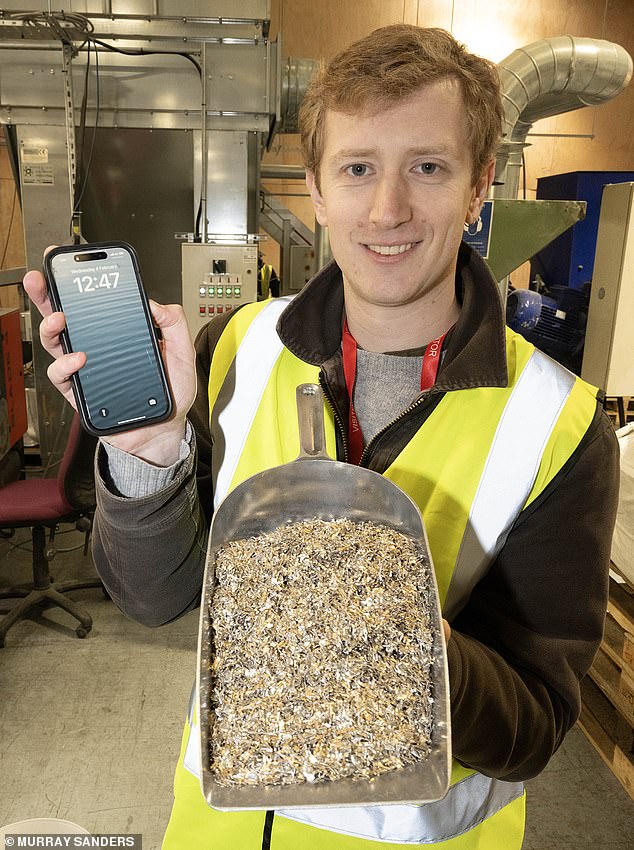
Fred with a scoop of the ground computer connectors containing predominantly gold, with some copper ready for refining
‘It’s like baking sourdough,’ smiled Bioscope CEO Rob Bolton as we stare at the huge vats of living bacteria. ‘But rather than bread, we get gold.’
More than 60 million tonnes of electronic waste are produced every year, up from just 34 million tonnes in 2010. That’s roughly one and a half times the weight of London Bridge of tech discarded every day. Pile it all into standard 40-tonne trucks and they’d stretch bumper-to-bumper around the equator. According to the UN’s Global e-waste Monitor from 2024, that 60 million tonne figure is expected to rise to over 80 million tonnes a year by the end of the decade.
Shockingly, just 22 per cent of e-waste is currently recycled. The remaining 78 per cent is estimated by the UN to be worth a staggering £46 billion in raw materials including gold and silver, and yet much of it is shipped – illegally – to the subcontinent where it is either incinerated or dumped in landfill.
It’s difficult to overestimate the value locked in our everyday electronics: 7 per cent of the world’s gold reserves are currently sitting in disused electronics with 100 times more gold in a tonne of smartphones than in a tonne of gold ore.
So, no wonder then that there is a growing appetite to cash in by extracting the metal from disused tech.
But how to open a gold mine in Suffolk?
When Former London Wasps hooker Simon Taylor, 59, met up with an old teammate – former England scrum-half Andrew Gomarsall, 51 – back in 2019, he decided to buy a 75 per cent stake in the Gomarsall family recycling business, N2S.

CEO Rob Bolton in the top secret bunker, with 18 inch thick walls, where computer components have their data removed and then crushed ready for gold and copper removal
The plan was to branch out from recycling scrap metal to the highly advanced process of ‘bioleaching’ gold out of old electronics. In January 2022, Bioscope was born – a sister company to N2S.
‘I’m massively patriotic,’ Simon Taylor revealed to the Daily Mail. ‘And at the moment, all our precious resources in old technology are shipped off to Japan, China and India who use it to build their own stuff. That’s a tragedy as far as I’m concerned.’
Taylor and Gormarsall’s plan made sense. What if you could search for gold in a British rubbish tip rather than a west African mine?
My tour of the Bioscope facility begins deep underground in a room called ‘The Bunker.’ It has concrete walls a foot and a half thick, as well as concrete in the ceiling and the floor. It’s designed so that as Stefan, head of security explains, ‘it would take two people with sledgehammers an hour to break in.’
The security is necessary. For the Bunker is where old computers and hard drives – from clients including the NHS, the Ministry of Justice and private banks – come to be wiped of all their highly sensitive data.
‘We’ve had countless attempts to hack our IT system,’ reveals CEO Rob Bolton, examining twelve industrial red bins full of hard drives. ‘Mainly from China and Russia, but none have been successful.’

Fred with a tonne bag of computer connectors containing gold, when refined will be worth £50,000
With millions of Britain’s credit card, health and personal details held here, the implications of a breach are hardly worth thinking about.
After the data has been wiped, the hardware is sent for shredding, some of which is done onsite, though most happens at a separate facility in Mansfield.
‘It’s basically an enormous paper shredder,’ continues Rob as he picks up a handful of metal cuttings with a large spade, careful not to cut himself on the jagged edges.
This byproduct is then poured into 8 enormous 900 litre vats where it is mixed with the somewhat magical, organic bacteria that will separate the precious metals from the base metals in the process known as ‘bioleaching’.
In short, the bacteria – first discovered decades ago in Chilean copper mines – absorbs cheaper metals such as copper and tin, leaving the more expensive metals to sink to the bottom and form a dirty sludge. The exact ratios and process, of course, is a closely guarded secret.
This method uses significantly less water and electricity and also emits negligible CO2 compared with other rare metal extraction techniques, such as extreme heating in a furnace or exposure to corrosive acids.
The bioleaching vats are warm to touch, though there’s no heat added here. The process is entirely organic and the heat is a byproduct of the chemical reaction, which takes around 24 hours. Even better, the bacteria is renewable and can be used over and over again.
The resulting sludge is then taken to the laboratory where it is further purified, dried off in a microwave oven so low-powered it’s no different to household ones. And then there it is, a small bag of brown powder that isn’t Nescafe, but rather powdered gold waiting to be turned into jewellery.
‘It never gets boring, holding pure gold in the palm of your hand,’ Rob assures me.
In 2025, Bioscope turned over £2.3million by processing 1,250 tonnes of electronic waste, producing over 11kg of gold – worth over half a million pounds – as well as 10kg of palladium and over 100kg of silver. This year, those figures are set to rise ten-fold with a significant expansion in operations.
Furthermore, the company admits their profits are set to be bolstered by a growing demand for recycled gold and silver as customers chase ethically responsible jewellery. Luxury watch brands Omega and Rolex both recently announced an intention to produce timepieces made from exclusively recycled metals for which Bioscope can charge a premium fee.
And likely another major money spinner will arrive in the form of the sprawling data centres being built across the world to power Artificial Intelligence.
According to investment bank Morgan Stanley, an incomprehensible £2.2 trillion will be spent from now until 2029 on such projects. These plants are essentially housing units for millions of computers, all of which contain circuit boards that need to be replaced every three years.
While Bioscope CEO Rob Bolton remained tight lipped, he did reveal that he is already talking to data centre stakeholders in the US about rolling out similar recycling plants across the Atlantic.
Scott Butler, executive director of non-profit Material Focus – which campaigns against e-waste – believes that bioleaching can offer real hope for the future.
‘It’s less energy intensive, for a start,’ he told the Daily Mail. ‘And techniques such as bioleaching have the potential to target materials that aren’t currently reached by traditional methods.’
Indeed, while bioleaching is currently focused on gold and silver, there are up to 50 elements on a typical printed circuit board, many of which are yet to be effectively harvested.
‘Ultimately, recycling these metals is better than mining for new ones,’ Scott concluded.
Before leaving the Bioscope warehouse, I hand my phone over to Dr Andrew Carrick and ask how much gold is inside.
‘The older models contain more gold,’ he admitted looking disappointedly at my iPhone. ‘The technology was less sophisticated, and they needed more conducting material, so more gold. We’re much more excited by a circuit board from the 60s than something made today. So, in this phone, probably about 0.03 grams. I could shred it and extract the gold, if you like? It’s probably worth about £4.’
So, not exactly a bumper pay day then. Indeed, Dr Carrick went on to admit that even the average consumer laptop only contains about 3 grams of gold, worth around £40.
But then I started adding up all the old electrical items sitting in a drawer back home, unused and never to be turned on again. Two old laptops, a couple of phones, numerous chargers, adapters, an MP3 player, iPod, DVD player…
It might be rubbish to me, but if Bioscope proves anything, it’s that one man’s trash is another man’s treasure.