



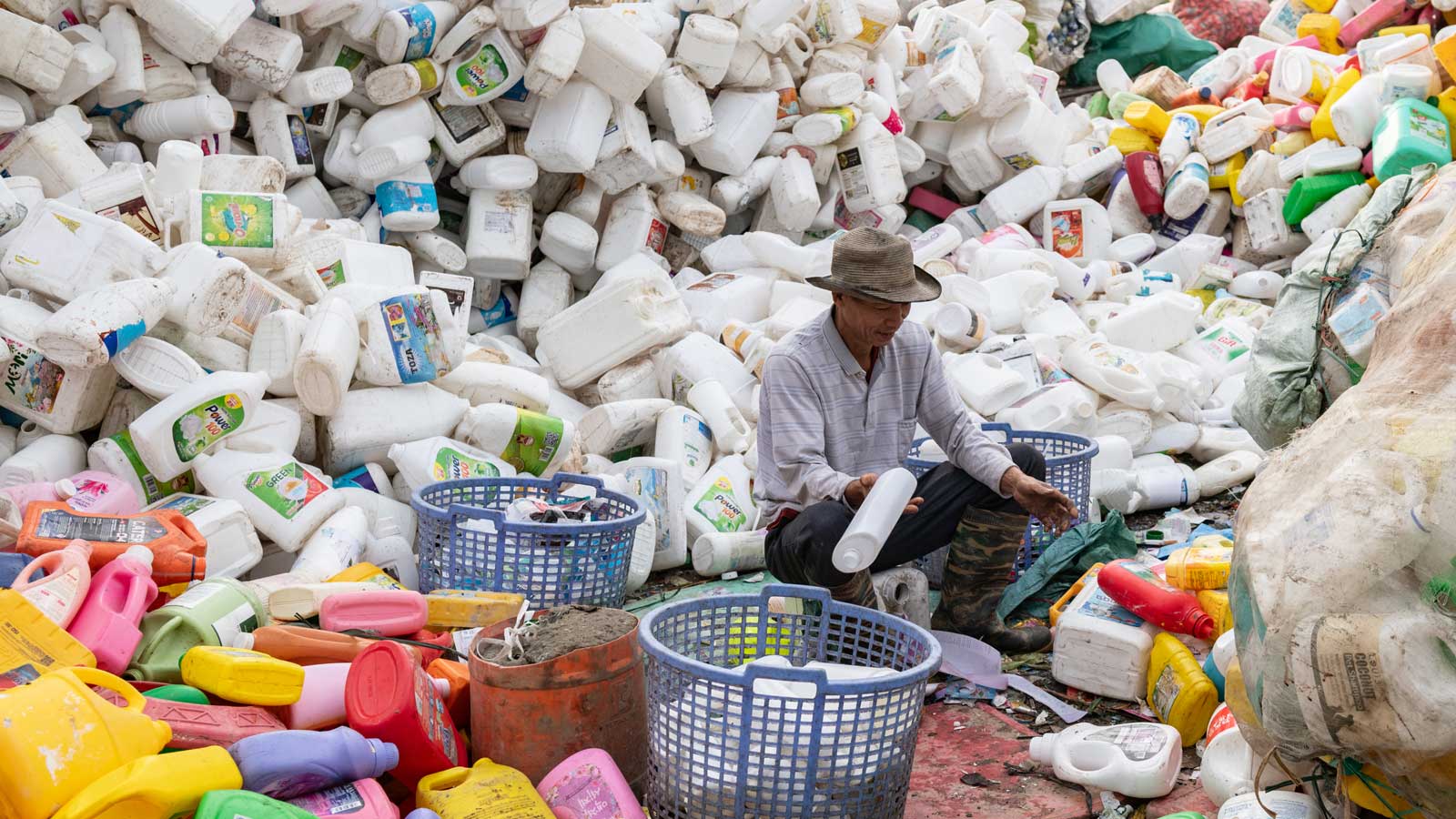
You can try hard and still find yourself surrounded by plastic. From food packaging to clothing fibers, takeout containers, and furniture, plastic is nearly impossible to avoid.
According to environmental journalist Beth Gardiner, that’s by design. Her new book, “Plastic Inc.,” traces how the fossil fuel and petrochemical industries helped build today’s disposable economy and why plastic production continues to increase despite rising concern about pollution, climate change, and health risks.
Plastic production worldwide has grown from about 2 million tons a year in the 1950s to more than 350 million tons a year in 2015. The World Economic Forum predicts plastic production will double by 2040.
Yale Climate Connections spoke with Gardiner about why plastics became embedded in our lives, what scientists are learning about the health effects of plastic chemicals, and what real solutions might look like.
This conversation has been edited for length and clarity.
Yale Climate Connections: Most of the public conversation about plastic focuses on individual waste and recycling habits, not the industrial systems driving plastic production. What first made you want to investigate that broader story?
Beth Gardiner: I’ve always been the person carrying a reusable water bottle and trying to remember to bring my bag with me when I go to the grocery store, feeling guilty if I forgot it. Like so many people, I feel this level of distress and powerlessness about how much plastic flows into our lives and straight into the trash.
Then, about seven or eight years ago, I saw an article saying the fossil fuel and petrochemical industry was pouring billions of dollars into expanding plastic production, especially in the U.S.
It felt like a kick in the teeth. Here I am carrying around my little canvas bag to the store, while all these global, super wealthy and powerful corporations are actually planning to make more plastic in the years to come?
The gap between the framing of “personal responsibility” and what these corporations were doing – and the fact that we weren’t even talking about that – that chasm felt like “There’s a story there.”
Even as an environmental journalist, I realized I couldn’t clearly explain where plastic actually comes from, beyond oil and gas. And I did not go into it thinking that this industry was really a good citizen. But it was actually even more shocking than I had understood.
I found that it was even more intentional and coordinated than I had imagined. The system of disposability we live in today was built by the fossil fuel, petrochemical, packaging, and consumer goods industries. They designed and promoted disposability because it was more profitable.
YCC: Many of us grew up with parents or grandparents who reused everything. When did this shift to a disposable culture really happen, and how intentional was it?
Gardiner: The shift really accelerates in the years after World War II.
Plastic had proven incredibly useful during the war. It helped make radar more powerful and effective in the fight against the Nazis. But in the years after World War II, there was this recognition that the industry had this production capacity to make plastic, and the question became, “How are we going to sell it?”
In the 1950s and 1960s, at industry conferences, executives were very explicit. They looked at reusable systems – like Coca-Cola’s old glass bottle deposit system, where bottles were washed and refilled dozens of times – and literally described that as “lost money.” One bottle that got washed and reused and refilled countless times could have been 40 or 50 new bottles sold.
They understood that single-use packaging was a huge profit opportunity. So companies like Coca-Cola dismantled the reuse infrastructure and replaced it with disposable containers: first cans and throwaway glass, and later plastic bottles once the technology was ready.
At the same time, the cost of dealing with the empties – the packaging waste – was shifted off the companies’ balance sheets and onto the public, because as taxpayers or ratepayers for trash pickup and recycling, we pay to clean it up, to landfill it, to send it to a recycling center.
So what feels to us like a natural, inevitable disposable culture was not inevitable at all. It was built on purpose, because it’s more profitable.
YCC: People often treat plastic pollution and climate change as separate crises. In your book, you argue they’re deeply connected. How?
Gardiner: I used to think that they’re both serious, big problems, but they’re separate.
What I learned is that they are really interconnected, in part because producing and disposing of plastic is super, super carbon-intensive.
One analysis by the group Beyond Plastics found that if plastics were a country, they would be among the world’s largest carbon emitters. So you can’t seriously address climate change without confronting plastic production and disposal.
Then there’s a more indirect connection. Plastic is now a crucial revenue stream for the fossil fuel industry. Oil and gas markets are famously volatile – prices swing with wars, pandemics, economic cycles. By turning more oil and gas into plastics and petrochemicals, companies create a second revenue stream that helps pad the bottom line, keeping wells open even when fuel prices are low.
Fracking is a great example. Wells produce methane, which we know as natural gas, but they also produce ethane. Early in the fracking boom, ethane was often burned off as waste. Then the industry invested billions of dollars in petrochemical plants that turn ethane into ethylene and then polyethylene – the world’s most common plastic polymer. Suddenly, waste became profit.
It is helping even as the industry can see now that there is a threat to the continued growth of fossil fuels as fuels – not only because of policy and climate action, but also now economically they’re being undercut. It’s increasingly cheaper and more secure to get energy from renewables and batteries than from fossil fuels.
So plastic is a way of keeping that business model alive as long as they possibly can.
Plastic production helps prolong the fossil fuel model itself, which is profoundly damaging to the climate.
YCC: As a physician, I’m especially concerned about the health impacts. What did you learn about the health risks of plastic and the chemicals added to it?
Gardiner: There are tremendous numbers – thousands – of different chemicals that are used in plastics in the products that we use every day, that hold our food and drinks, that are in our clothes and our carpeting and our couches and furniture. Plastic, as a category, is much larger than the things we think of most easily.
Plastic has a basic backbone polymer, and then additives are mixed in to give it different properties like flexibility, hardness, color, durability, resistance to degradation. These additives are less tightly bound to the plastic structure, which means they can more easily migrate out – especially under stressors like heat.
So when you leave a plastic water bottle in a hot car, or microwave food in plastic containers, you’re increasing the chance that these chemicals move into your food or drink.
A major area of concern is endocrine-disrupting chemicals, or hormone disrupters – chemicals that interfere with our hormone systems. Many people associate hormones mainly with reproduction, and it’s true that these chemicals are linked with issues like infertility, endometriosis, and premature birth.
But hormones control so many of the systems in the body. Insulin is a hormone. Cortisol – stress hormones – control your body’s stress reactions and your blood pressure, and your metabolism is controlled by thyroid hormones. So many different systems, including brain development, are controlled by hormones. These systems operate with incredibly fine hormonal balances. One metaphor I saw a lot was that a shift equivalent to one drop in 20 Olympic swimming pools can be enough to alter how hormones function in the body.
At the same time, we’re seeing rising rates of conditions that used to be considered rare now appearing more frequently and at younger ages. There are many environmental factors at play, but chemicals from plastics are high on the list of plausible contributors.
It’s really alarming because plastic is so intimate in our lives – touching our food, our water, our skin, even our medical equipment.
Worrying preliminary research
Research on the health impacts of plastic is still evolving, but increasingly concerning. Scientists have linked plastic-related chemicals and microplastic exposure to:
- Neurodevelopmental issues such as ADHD and possibly autism spectrum disorders
- Cardiovascular problems, including elevated risks of heart attacks and strokes
- Hormone-sensitive cancers, including breast, ovarian, uterine, and prostate cancers
YCC: That leads me to regulation and the precautionary principle. Where do you see these concerns being taken more seriously, and where does regulation better meet the moment than in the U.S.?
Gardiner: Europe is the place that’s doing the most. If you talk to European environmental and health advocates, they’ll tell you they’re frustrated – they see industry lobbying, political backtracking, and laws they feel are too weak. But if you look at it from an American perspective, they are so far ahead of us in terms of scrutinizing and regulating the chemicals that go into everyday products that we use.
In the United States, chemicals in everyday products are governed mainly by the Toxic Substances Control Act (TSCA), originally passed in 1976 and updated in 2016. But it is a broken law, and it has really failed to accomplish much at all. It came onto the law books in the same era as the Clean Air and the Clean Water Acts, but those were extremely well-designed laws that had a tremendous amount of accountability written into them.
The default is most chemicals are innocent until proven guilty. The burden is on the EPA to prove a chemical is dangerous, not on companies to prove it’s safe. When TSCA first passed, thousands of chemicals were grandfathered in with no real safety review.
There were never the staff additions that would have actually been necessary to really look at chemicals and their safety. The Environmental Protection Agency has been subject to mass layoffs, which makes it even harder to implement and enforce whatever weak regulations do actually exist.
I think most Americans, if you asked them, would absolutely assume that a chemical being put on the market had to be shown to be safe before it could be used in a bottle or a takeout package or a toothpaste tube or whatever. I think most people would be shocked to actually learn that that is not the case. But it’s not. So that is a big problem.
YCC: Many parents want to buy less and protect their kids, but plastic is everywhere, and alternatives are limited or misleading. How do you think about this disconnect between people trying to shift demand and the reality that they’re still being slammed with supply?
Gardiner: I think plastic actually reverses the usual relationship between supply and demand.
Industry constantly talks about “consumer demand” for plastic. They’ll point to growing markets in the Global South or say that shoppers are demanding convenience.
But in fact, in the case of plastic, it’s really pushed on the supply end rather than pulled on the demand end. The example I always use: if you go into a grocery store and you buy bananas and they come in a plastic bag, you did not demand plastic. Economically, you demanded bananas. It’s a disconnect.
The reason why plastic is able to reverse that relationship that we’re normally accustomed to thinking of – demand driving supply – is because it’s so cheap. The industry is pushing it out into the market.
That cheapness is not an accident. It’s rooted in the fact that plastic is made from oil and gas, often from what were once considered waste streams. Turning those streams into plastic converts waste into profit, and there’s a strong incentive to push as much of it into the market as possible, even at low prices, because the volume is high.
So we’re not truly demanding plastic in the way industry suggests. Yes, there are valuable uses of plastic – no one is arguing that we should ban all plastic medical equipment, for example. But there is an enormous amount of packaging and disposables that we wouldn’t miss at all if they disappeared and were replaced with reuse or other systems.
Industry not only shifted the costs of managing waste onto us, it also shifted the blame – insisting that consumers are both the source of the problem (“you demanded it”) and the solution (“just recycle better”). That narrative obscures the role of corporate decisions and policy choices in creating this system.
YCC: Near the end of your book, you write about how industry greenwashing and false solutions confuse the public. What do you see as the most real solutions – and which ideas should we be skeptical of?
Gardiner: It can feel like whatever question you ask of a petrochemical or plastics company about solutions to the plastic problem, the answer is recycling. They want us to think that recycling is just the answer to all of our worries about plastic, and it’s not. That’s been used to confuse us, and just lull us into thinking that it’s fine to have this much plastic being produced and pushed on us all the time.
In reality, only a very limited subset of plastics, like PET [polyethylene terephthalate] bottles, can be reliably recycled in practice. And even those materials don’t recycle as efficiently as glass or cardboard.
So if you’re talking about recycling in a limited way, then do it. But if [companies] are confusing us by saying that every type of plastic can be recycled, you’re only jamming up the recycling facilities, and then they can’t even recycle what should be recyclable.
Fundamentally, the answer is less plastic. How do you make that happen?
As individuals, it’s hard to have an impact on that system. But when you talk to people who are policy experts in this area, the holy grail that they tend to talk about is something called extended producer responsibility, which puts the cost of dealing with the waste back onto the companies that are producing the stuff in the first place, rather than letting it stay where it is now – on the consumer and the public.
The idea is that extended producer responsibility not only shifts the burden but changes the incentives so that maybe industry wouldn’t have such a strong economic incentive to produce so much unnecessary, wasteful plastic, and they could pare back to what is more essential.
YCC: For people who are alarmed and want to do more than bring a reusable bottle, where should they focus their energy?
Gardiner: I talked to this activist named Judith Enck, who has a group called Beyond Plastics. They’re trying to get people to channel their concerns about plastic into lobby[ing] your city council or your state legislature around bans on specific items.
They have something they call the plastics trifecta – where you can work with to push for a city, county, or state law to prohibit three of the most common single-use plastic items that are major sources of plastic pollution … plastic bags, plastic straws, and Styrofoam. The idea is that they are training people on how to speak to lawmakers.
It’s great, absolutely, if you bring your reusable water bottle and make it metal so that it won’t leach chemicals into your kid’s juice. But if you’re talking about actions that you want to take to really change the system, it needs to happen at a larger and higher level than the individual level.