
The Department of Defense is now facing mounting pressure to replace its military working dogs with robots after a watchdog report exposed deplorable conditions inside the Pentagon’s canine program.
A recent Office of Inspector General report detailed ‘unsatisfactory kennel facility conditions’, accusing the military program of neglect and failing to walk and medically care for the animals.
The investigation found that 22 dogs at just one base in Texas sustained heat injuries over a three-year period and that at least four suffered preventable deaths.
Those findings underscore that animal mistreatment persists in the military despite three decades of reform efforts and regardless of a 2022 report by the Government Accounting Office (GAO) calling out abuse and neglect among the nearly 5,600 dogs working for agencies throughout the federal government.
The Air Force oversees military working dogs, known as MWDs.
In a letter sent Friday to the White House and obtained exclusively by the Daily Mail, People for the Ethical Treatment of Animals (PETA) urged President Trump to phase out the use of dogs in the military as well as police work and deploy dog-like robots instead.
‘Unlike the brave service members and officers who choose to put their lives on the line, [military and police dogs] can’t consent to being used as living shields or being sent into violent situations they did not cause — and many pay with their lives,’ reads the letter, signed by Daniel Paden, PETA’s vice president of legal advocacy.
Aside from risks associated with putting dogs in crisis scenarios, Paden pointed out that they ‘are not even safe on domestic bases.’

Animal rights activists, including PETA, are urging the Trump administration to replace military working dogs (MWDs) with robots after a recent report raised concerns about staffing shortages and facility conditions at some base

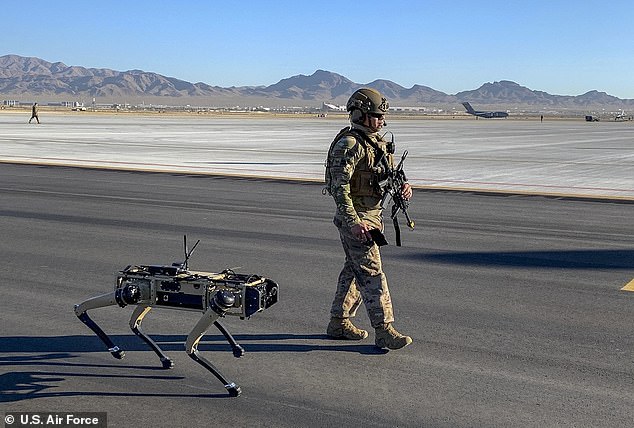
Robot quadrupeds, like Boston Dynamics’s ‘Spot’, are already being tested by US military branches for patrol and recon missions
In an email to the Daily Mail, one of its spokesmen wrote that it ‘is committed to the ethical and effective utilization of MWDs while prioritizing their well-being throughout their service and into retirement.’
She noted that the program is working to put in place the inspector general’s recommendations for improvement, and referred questions about replacing dogs with robots to the White House, which could not be reached for comment.
There are currently about 2,200 MWDs across all branches of the military.
They are used as guards, search and rescue scouts and to sniff out drugs, explosives, survivors of combat and disasters and dead bodies.
Most are German shepherds, Dutch shepherds, Belgian malinois, golden retrievers, Chesapeake retrievers, labrador retrievers or terriers — all ‘high-drive’ breeds that, by the military’s own standards, require significant daily physical, social and cognitive stimulation.
A scathing, 34-page report released this month by the Defense Department’s inspector general found the military is falling short of meeting those needs, ignoring several care and kenneling policies put in place over the many decades it has been criticized for mistreating dogs.
During inspectors’ visits to the MWD program’s headquarters at the San Antonio-Lackland Air Force Base and other military kennels in 2024, they found so-called ‘manpower challenges’ causing a shortage in caretakers.
That meant dozens of dogs were being walked only three or four days a week for only ten minutes a day, if that.

Jjiago, one of the military working dogs for the 22nd Security Forces Squadron K9 unit at McConnell Air Force Base, Kansas

An image published in the report shows a military working dog, known as MWD, gripping its metal water bucket – behavior inspectors cited as a possible sign of stress during their review of kennel conditions at Joint Base San Antonio Lackland
As a result, inspectors reported that pooches ‘experienced higher rates of diseases, injuries, and behavioral problems than other dogs.’
Those included ‘stress behaviors, such as continuous spinning, jumping, chewing on their metal water buckets’ and excessive barking and yelping.
Inspectors found dogs being housed, unprotected, in extremely hot and cold temperatures and in rainy and snowy conditions that compromised their health.
They reported ‘Physical signs of heat stress, including rapid panting with enlarged tongues and ears swept back,’ as well as dogs being held in moldy and leaky cages and kennels, some without proper air ventilation and others without adequate poop removal.
Those conditions, according to inspectors, led to the spread of diseases on and between military bases and caused at least four preventable deaths from 2021 through 2023.
The Air Force, in its email to the Daily Mail, disputes those findings, saying autopsies showed those deaths ‘were not attributed to neglect.’
A GAO report to Congress in 2022 identified many of the same problems that remain unaddressed by the military.
PETA is tired of waiting for reform, saying the Defense Department has proven it can’t be trusted to take proper care of its dogs.

A military working dog in an open-air kennel at Joint Base San Antonio Lackland, where inspectors said some animals were exposed to extreme heat, cold and other ambient weather conditions

Additional photos included in the report show severe mold problems at the MWD Kennel Facility at Fort Bragg
‘They apparently view dogs as the cheapest, easiest, but least state-of-the-art ‘equipment’ choice, but dogs suffer and die, unlike the robots we’re calling for them to be replaced with,’ Colin Henstock, PETA’s associate director of project strategy, told us.
‘The extensive suffering detailed in this report should be the impetus for a major change in that viewpoint.’
In its letter to Trump on Friday, the group recommended robot K-9s such as ‘Spot,’ made in the US by Boston Dynamics, as alternatives to military dogs that require far less care and upkeep.
It noted that Massachusetts State Police and other law enforcement departments are already using robots ‘to de-escalate highly volatile and dangerous situations like domestic violence calls’ and that ‘four of these ‘mechanical first responders’ will be used for security during the World Cup in Mexico.’
China has, in the past year, publicly demonstrated armed quadruped robots during military exercises. Other countries, including the US, are testing similar armed and unarmed systems.
A model called Vision 60, built by Ghost Robotics, is being evaluated by the Air Force and Marines to patrol remote areas, secure perimeters, run reconnaissance in buildings, tunnels or on dangerous terrain, sense chemical, biological, radiological and nuclear hazards, and reduce risks to military personnel.
The robots weigh 100 pounds, run up to three hours on batteries, can operate in extreme cold and heat, are equipped with cameras and sensors, and can be teleoperated or run semi-autonomously.
Also among their many upsides are that, unlike real dogs, they can’t suffer or feel pain, don’t require lifelong care and raise fewer animal welfare concerns.

The watchdog report found dozens of dogs have suffered heat injuries at a Texas base over a three-year period
Their obvious downside is that they lack the sensory skills and emotional intelligence of trained military dogs.
One Pentagon insider told us that robot dogs are not nearly sophisticated enough or properly tested to replace real military dogs anytime soon.
Besides, he added, animal rights advocates – like other activists perceived as ‘woke’ by the right-wing Trump administration – are the last people whose suggestions Defense Secretary Pete Hegseth is likely to entertain.
‘There’s no way Pete’s taking marching orders from PETA,’ he said.
Animal mistreatment is apparently nothing new in the US military.
The Pentagon was fiercely criticized for abandoning about 4,000 dogs – primarily German shepherds and labrador retrievers- that it deployed for patrol and detection work in the Vietnam War.
When US forces withdrew in the early 1970s, most of the dogs were not returned with them, and many were likely killed.
Veterans and handlers saw the move as a betrayal, and their complaints became a rallying point for reform efforts decades later.

Among the pros of robo-dogs, is unlike living animals, robotic K-9s do not require daily care or retirement placement
Post 9/11, MWDs were deployed to Iraq and Afghanistan for base security, detection of explosive devices and special operations.
There were isolated reports of those dogs suffering from overexertion and heat exposure, and receiving inadequate veterinary care.
In 2006, animal welfare advocates criticized the military over how retired MWDs were handled at Lackland Air Force Base.
Although a 2000 law required that most retired working dogs be made available for adoption, critics said some were still euthanized for medical or behavioral reasons that were not fully explained publicly.
Concerns over that base’s treatment of dogs linger 20 years later.
‘That’s like the Abu Ghraib for dogs over there,’ one longtime animal rights advocate in Texas told us.
‘It’s pretty much the fantasy of dog lovers throughout San Antonio to break in and let those poor dogs free.’