


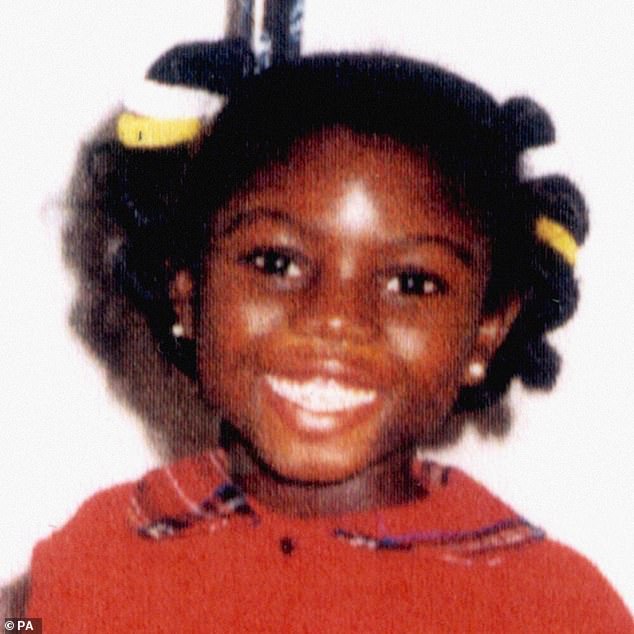
A quarter of a century has passed since the death of eight-year-old Victoria Climbie and the shocking realisation that voodoo-style murder and abuse were taking hold in the capital of a modern, affluent democracy.
Victoria met a horrific end. Tortured, beaten with implements including coat hangers and a bike chain, deliberately scalded and forced to sleep in a bin liner in a freezing bathroom, she finally died of multiple organ failure at the age of eight. Her tiny body, weighing just 3st 10lb, was marked by 128 separate injuries.
Her ‘crime’? The girl was said by relatives to have been possessed by ‘kindoki’, or evil spirits, requiring exorcism by a pastor and justifying a campaign of sadistic violence.
The killing in 2000 and the public enquiry that followed should have been seismic: a warning to the public and politicians that, however improbable, belief in witchcraft was emerging as a fact of life in Britain.
Yet today, despite the horror of Victoria’s death and subsequent cases, there is disturbing evidence that ritual violence – involving beliefs and practices overwhelmingly imported from abroad – is continuing to spread unchecked.
The latest official figures show a huge increase in the number of children identified as potential victims of abuse ‘linked to faith or belief’, a category including claims of witchcraft and spirit possession.
Analysis released late last year by the Local Government Association, representing councils and their social services departments in England, found there had been 2,180 cases of possible faith-linked abuse in 2024, a disturbing 49 per cent increase in the seven years since 2017.
Moreover, the true scale of the problem could be significantly worse amid fears that ritual abuse is routinely under-reported because social workers and others wish to avoid being labelled racist.

Among the most notorious cases was eight-year-old Victoria Climbié, tortured to death in 2000 by relatives who believed she was possessed
With motives ranging from ignorance and fear to the demented belief that human sacrifice confers supernatural protection, and even wealth, the cases that do reach the public eye are harrowing, the majority with links to sub-Saharan Africa.
A recent documentary film, Kindoki Witch Boy, tells the story of Mardoche Yembi, who had been sent from the Democratic Republic of Congo to live with his aunt and uncle in North London.
At the age of 12, Mardoche was branded a witch by relatives, accused of bringing bad luck and subjected to two months of traumatic exorcisms. The film is now available on YouTube.
I’m Sam Greenhill, Chief Reporter, and nearly 25 years ago I had an encounter with killer Ian Huntley that still sends shivers down my spine.

Ian Huntley is one Britain’s most notorious child killers. But when I was invited into his home for tea and biscuits days before he was arrested for the Soham Murders, this was the last thing on my mind. I’ve written about it in The Crime Desk newsletter – sign up to read it for free.
An even more disturbing case took place on Christmas Day in 2010, when 15-year-old Kristy Bamu was beaten and drowned by his sister and her boyfriend in the London borough of Newham after being accused of ‘kindoki’, like Victoria Climbie.
Kristy endured four days of torture with knives, sticks, metal bars, a hammer and pliers. He drowned after being forced into a bath for ritual cleansing. Kristy’s siblings were also beaten but survived because they ‘confessed’ to being witches.
Magalie Bamu, then 29, and her partner Eric Bikubi, 28 – both Congolese – were jailed for life in 2012.
In sentencing them, the judge said: ‘The belief in witchcraft, however genuine, cannot excuse an assault to another person, let alone the killing of another human being.’
There are accusations of ‘possession’ in other cultures, too, with cases of abuse reported in Christian, Hindu and Muslim families, where some still believe in the idea of evil spirits known as ‘djinns’.
Just days before Kristy’s Bamu’s murder, Shayma Ali strangled then disembowelled her four-year-old daughter with a kitchen knife during a frenzied attempt to exorcise the girl.
Ali, who had gouged out the eyes of her daughter’s dolls to prevent them ‘seeing evil’, was sent to a mental hospital.
In 2005, two women were jailed at the Old Bailey after being convicted of child cruelty for torturing and threatening to kill an orphaned child refugee from Angola whom they claimed was a witch.
The Old Bailey was told that the girl, known only as Child B, was starved, cut with a knife, beaten with a belt and a shoe and had chilli peppers rubbed in her eyes to drive ‘the devil out of her’.
At one point, the eight-year-old was bundled into a zip-up laundry bag and told she would be ‘thrown away’ into a river. She was rescued after being found in her bare feet, shivering, outside a council house in Hackney.
The cleansing power of water, whether in a bathtub or a river, is a common element in African witchcraft rituals. In 2001, a young boy – later given the name Adam by the police – was pulled from the Thames after a passer-by spotted his mutilated torso floating near Tower Bridge.
His head, arms and legs had been removed in what detectives believe was a ritual killing, potentially as a sacrifice or in a ‘muti’ ceremony, in which body parts are taken in the belief they produce potent magical remedies.
The boy, aged between four and seven and found wearing only a pair of orange shorts, had recently arrived from Nigeria.
Britain’s leading rituals expert, Dr Richard Hoskins, brought into advise on the case, concluded that Adam was a victim of human sacrifice.

Victoria Climbié had been sent to England by her parents who hoped she would gain a better education than in her native Ivory Coast

Victoria’s parents set up the Victoria Climbié Foundation following her death, campaigning for improvements to child protection in the UK
His 2012 book on the subject, The Boy in the River was serialised in The Mail on Sunday and is now scheduled to be dramatised as a feature film.
Dr Hoskins concluded that the boy had been trafficked to London, speculating that he was butchered while drugged but conscious by a ‘babalawo’ witchdoctor using rituals from the Yoruba people Osagiede of south-west Nigeria.
In Yoruban religion, wrote Dr Hoskins, ‘deities forming a bridge between this world and higher realms require sacrifice.
‘Not necessarily human sacrifice, of course, and especially not nowadays, but the practice persists in some deviant offshoots.’
In 2002, a Nigerian woman called Joyce Osagiede told Glasgow social workers that she had married a member of a cult called The Black Coat Eyes Of The Devil Guru Maharaj. When later interviewed by British police in Lagos, she said she had been a cult organiser and had bought a pair of orange-red shorts similar to those found on Adam. She added: ‘I know he was killed in Lewisham.’
Osagiede later claimed to an ITV journalist that she had brought Adam to London and that his real name was Ikpomwosa. No one has ever been charged with his murder.
Yet it is the fate of Victoria Climbié that today remains the most notorious case of witchcraft abuse and killing in this country.
Victoria had been sent to England by her parents to gain a better education than in her native Ivory Coast but found only misery and death.

Victoria Climbié was starved, tortured, beaten with bike chains and kept prisoner in a freezing bathroom by her great-aunt Marie Therese Kouao and her partner Carl Manning (pictured)

Marie-Therese Kouao (left), Victoria Climbié’s great-aunt, was complicit in her murder
Her great-aunt Marie Therese Kouao and her partner Carl Manning were jailed for life in 2001, convicted of murder and child cruelty.
The case was followed by a major public enquiry under Lord Laming which, in turn led to an overhaul of child protection measures in the UK, including the landmark 2004 Children Act.
Even now, ritual violence receives all-too-little attention, says Lancaster University’s Professor Charlotte Baker, who is co-director of the International Network Against Accusations of Witchcraft and Ritual Attacks.
‘If you spoke to many people about this issue, they’d think it was something from about 1,400 years ago,’ she told The Daily Mail last week.
‘Many schoolteachers might feel they shouldn’t ‘go there’, if they suspect something is taking place because they’re not comfortable handling such issues.
‘This needs to be treated seriously, disclosures need to be treated seriously – and the right questions need to be asked.
‘The UK must improve and make sure that anyone who does speak up to make disclosures about this abuse being carried out are taken seriously and responded to professionally.’
Former Conservative MP Tim Loughton, children’s minister in David Cameron’s coalition government and later chairman of the Home Affairs Select Committee, had his own experience of trying to combat ritual abuse.

Victoria’s parents Berthe and Francis are pictured at her grave in Kensal Rise Crematorium in London, along with daughter Joelle, in 2003 on the third anniversary of Victoria’s death

A boy named Adam’s head, arms and legs were removed in what detectives believe was a ritual ‘muti’ killing – his torso was discovered in the River Thames near Tower Bridge in 2001
‘The particular problem [at the time] was among communities of migrants from places such as the Congo, which were very closed communities, mostly but not exclusively in London, with very evangelical Christian church settings,’ he recalls.
‘There were very strange practices, all connected with voodoo – abusing children in attempts to drive the devil out of them and all this sort of nonsense.’
During his time in office, he launched a task force on faith-based child abuse, but he fears that official attention has now slipped.
Rohma Ullah, director of the National FGM (Female Genital Mutilation) Centre – which also tackles what it refers to as witchcraft and spirit possession abuse – is among those who believe frontline staff are wary of raising the alarm.
‘Witchcraft and spirit possession are among the most poorly understood areas in child protection,’ she says. ‘That’s really concerning and alarming. We know the data is not good enough and that professionals don’t know how to act. They don’t know what to do.
‘Professionals are anxious about discussing someone’s faith or beliefs because it’s very personal.
‘They fear being accused of being racist, for example – and so questions don’t get asked and opportunities get missed.’
She says that teachers as well as social workers should be alert to signs of abuse – such as, for example, a child appearing tired through having to pray all night to be rid of a devil inside them, or losing weight because food is being withheld at home.

15-year-old Kristy Bamu was beaten and drowned on Christmas Day 2010 by his sister and her boyfriend in east London after being accused of being a witch

Following the murder, Magalie Bamu (left) and Eric Bikubi (right) were jailed for life
‘I would say the situation is fragmented,’ she continues. ‘Social workers are skilled in safeguarding, teachers are skilled in educating, police officers are skilling in preventing and addressing crime – but they also need to be equipped with specialist knowledge on this particular issue.’
Ms Ullah suggests the current figures, disturbing as they are, ‘probably don’t reflect the true prevalence of something that’s very hidden.’
She believes allegations of witchcraft and spirit possession receive too little attention when abusers to court and suggests they should be flagged as aggravating features when the perpetrators are sentenced.
It is not as if we haven’t been warned. It is more than a decade since the United Nations reported that, ‘hundreds of children have been abducted from their families in Africa and trafficked to the UK, especially London. Many are raped and sexually abused.’
Commenting in The Mail on Sunday at the time, Dr Hoskins went further, arguing that ‘London has become the hub, the epicentre for a global trafficking enterprise involving thousands of children for exploitation, sexual abuse and even, in some unspeakable cases, ritual voodoo killing…’
‘There is a vast reservoir of lost children gathering in our own capital anonymously shuffled from flat to shabby flat – a dark pool feeding child exploitation and misery across the planet.’
Today’s evidence suggests that, chillingly, this terrible picture might now be darker still.