As a child growing up in Melbourne during the Cold War, John Harry knew his father as a reserved and respected public servant, devoted to his job but remote from his family.
Ralph Harry worked in the Department of the Exterior. He played golf and chess, solved cryptic crosswords and collected stamps. John never saw his father drunk and he had few friends.
What John did not learn until the late 1980s was that his father had been the director of the Australian Secret Intelligence Service (ASIS).
As head of the nation’s foreign intelligence agency, Ralph Harry was Australia’s top spy – in charge of a clandestine organisation equivalent to the US’s CIA and Britain’s MI6.
Ralph’s years controlling ASIS prepared him well for a distinguished future career in diplomacy, which included postings as ambassador to Belgium, South Vietnam, Germany and the United Nations.
He would eventually be recognised as a master of international relations with investitures as a Commander of the Order of the British Empire and Companion of the Order of Australia.
Ralph rose to the second highest office in the Department of Foreign Affairs but never secured the top job, which left him bitter. He died aged 85 in 2002.
While Ralph never discussed his real job, John has no doubt he was involved in ‘black ops’ – covert espionage missions conducted outside normal protocols and without any official scrutiny.

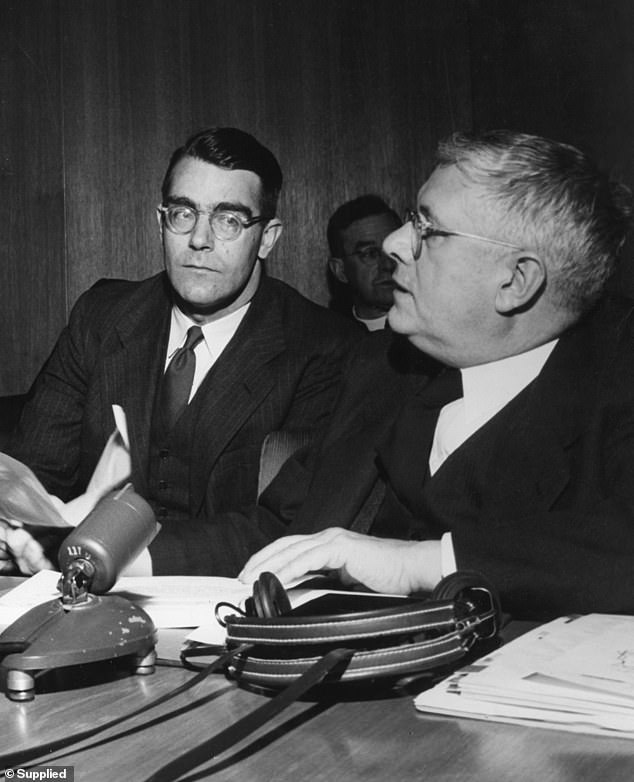
Ralph Harry was a distinguished diplomat whose son John did not did not know had been director of the Australian Secret Intelligence Service. Ralph Harry is pictured with H.V. ‘Doc’ Evatt at the United Nations in New York in 1947

While Ralph never discussed his job, son John has no doubt he was involved in ‘black ops’ missions. John is pictured with his parents and sisters in 1954 outside their home in Canberra
John believes his father would have helped develop the CIA-led Phoenix Program, which sought to destroy the Viet Cong by means including assassination, while stationed in Saigon in the late 1960s.
Ralph was also a key player in Australia’s support of Indonesia’s response to a failed Communist coup in 1965 which left more than 500,000 of its people dead.
‘Assessing the merit of his work in ethical or any other terms isn’t possible,’ John says. ‘But that he led a double life and that his life was brutally contained by his secrecy commitments was beyond doubt.’
John, who spent part of his childhood in Switzerland and Singapore, went on to study law and work for mining giant Rio Tinto before being made a partner at Allens. He reinvented himself as a winemaker and has now written his first book.
Part of John’s memoir Talking of Michelangelo examines his complicated relationship with his father, whose ASIS history he first discovered in his 40s.
Ralph Lindsay Harry was born in Geelong in 1917. His father Arthur was a classics master at Geelong College and his mother Ethel had been the first woman to graduate with a Master of Arts from Adelaide University.
Alice’s father, Sir Frederick Holder, was a South Australian premier and the first speaker of the first federal parliament. He died in 1909 on the floor of the House of Representatives.
Ralph attended Launceston Grammar and received a first-class honours degree in law from the University of Tasmania. He was that state’s Rhodes scholar in 1938.

Ralph Harry was Australia’s ambassador to South Vietnam from 1968 to 1970, during the height of the nation’s commitment to the Vietnam War. Australian soldiers in Vietnam are pictured

John believes his father would have helped develop the CIA-led Phoenix Program, which sought to destroy the Viet Cong by means including assassination and torture. Stock image
At Oxford’s Lincoln College, Ralph completed a politics, philosophy and economics degree. Spy turned novelist John le Carré later attended the same college and it was there Ralph might have first been spotted as a potential intelligence recruit.
Ralph returned home and joined the Department of External Affairs in 1940 then enlisted in the army as an intelligence officer and served during the Second World War in New Guinea. He returned to the department in 1943.
Ralph had started as a departmental cipher clerk and according to John took part in the establishment of a joint Australian/US/UK wartime intelligence group.
‘From that point on, there was probably no time in his career when he wasn’t involved in some intelligence activities,’ John writes in his book.
‘Once he entered into the community, parenting would become even more difficult, because he would never have the time…
‘And he would never find the process of parenting as magnetic as running a portfolio of agents, briefing Cabinets and always keeping more secrets than anyone else.’
Ralph was attached to the Australian contingent led by H.V. ‘Doc’ Evatt which set up the United Nations in San Francisco in 1945 and three years later became a delegate to the UN.
John was born in 1947 and his early years were spent in the nation’s capital when his father was based there.

Ralph is pictured with Queen Elizabeth II on a visit to Commonwealth First World War graves at Tyne Cot Cemetery in Belgium in the late 1960s

John says his father, who he describes as ‘an imposing figure’, even applied spy tradecraft on him. John is pictured aged at Melbourne Grammar in 1958 when his father was boss of ASIS
‘My first memory is seeing him in the early Canberra mornings, with his back to me, putting on his shirt and ties and fiddling with his radio to get it turned to the ABC,’ he writes.
‘I remember being hugged by him at bedtime; I remember him trying to teach me chess; more clearly, I remember feeling tested and examined for talent.
‘But he always seemed lofty and important in a way I felt I never could be.’
Ralph prepared the first draft of the ANZUS treaty in 1951, was consul-general to Geneva from 1953 to 1956 and Australian commissioner to Singapore from 1956 to 1957.
The year Ralph returned to Australia he was asked to report on the structure and operation of ASIS, which had been formed in 1952, and was subsequently appointed its second director.
‘The first thing to say about my father and his intelligence life was that not once as I was growing up did he say or do anything that suggested that he was an intelligence operative, or anything about any of his intelligence activities,’ John writes.
‘He was a blank wall. So if you ask me about what he did, my answers will be speculative but, I believe, likely to have been true.’
Ralph, whose family lived in Melbourne while he served as ASIS director from 1957 to 1960, was a ‘serious, contained and reticent man’ and his relationship with John was ‘distant and tentative’.

John Harry (above) worked for mining giant Rio Tinto before being made a partner at law firm Allens. He reinvented himself as a winemaker and has now written his first book

Ralph is shown a captured Viet Cong AK-47 assault rifle by members of the Australian Army Training Team Vietnam at Danang in 1968

Talking of Michelangelo by John Harry is published by Hembury Books
‘He was a searching observer and analyst, but there wasn’t much poetry or song that he ever revealed to me,’ John writes. ‘I never saw him drunk or frivolous or abandoned.
‘He believed that he needed to shield himself from the possibility of unwise contacts that might compromise his work, which restricted his friendships.’
John says his father, who he describes as ‘an imposing figure’, even applied spy tradecraft on him.
‘I realise now that these tricks were used on me routinely,’ he writes in his book.
‘There was no place to hide, no document that would have been unread, no phone call unobserved, no lie undetected, no bluff unpenetrated.’
Ralph’s last diplomatic position from 1975 to 1978 was as Australia’s permanent representative to the UN.
John did not find out his father had been the director of ASIS until the 1989 publication of Oyster, an unofficial history of the spy agency by Brian Toohey and William Pinwell.
‘In his last years he destroyed all the personal or controversial parts of his papers and correspondence, and reused any discussion with me that would disturb the shape of the life he wanted to leave behind,’ John writes.

Ralph Harry is pictured in South Vietnam in December 1970 being escorted from a helicopter by the commander of the 1st Australian Task Force , Brigadier William Henderson

Ralph (right) is pictured with defence minister Malcolm Fraser in the VIP lounge of Tan Son Nhut Air Base near Saigon in April 1970
Join the debate
Should a parent ever keep such huge secrets from their family for the good of their country?
‘He left those sanitised papers to me in his will, me, the one who most wanted him to reveal himself.’
After Ralph’s death John dined out with some of his father’s old intelligence colleagues ‘to see whether I could get closer to the truth about who he was and what he had done’.
But as John notes might be expected from old spies, ‘the information came to me mainly in the form of hints and pauses’.
‘Whether the lies, compromises and brutalities of his trade were justified is something I’ll never be sure of,’ John writes. ‘I’ll never know, despite the hard work, reticence and courage he needed, what he really achieved for the good of Australia.’
Talking of Michelangelo by John Harry is published by Hembury Books.