
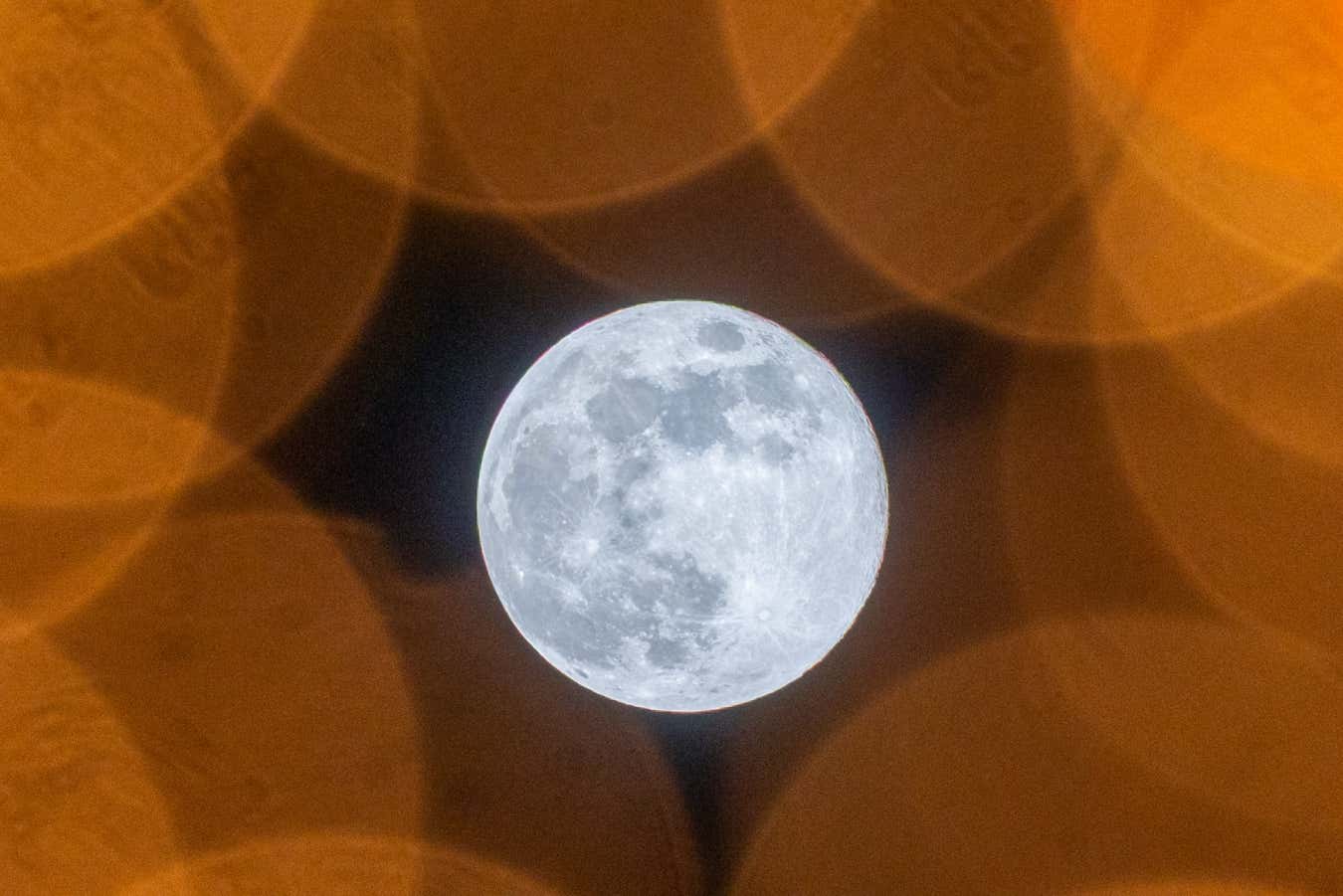

Christopher Cokinos’s history of the moon Still As Bright is out this month. Pictured is a supermoon in January 2026, seen behind illuminated Christmas lights
Matt Cardy/Getty Images
April is said to be the cruellest month, as the poem goes, “mixing memory with desire”. And this is oddly reflected in some of the non-fiction books we’ve rounded up for you this month. There’s the life spent largely in a log cabin, often with only trees and other non-human life for company. Then there’s the problem of reconciling science with life’s toughest questions – and lived experience. Or how about an inspiring journey though the moon’s history, in the month we actually head back to it for the first time in 50 years? Perhaps you should really go for it and share one researcher’s tough quest to end violence, and another’s to future-proof our brains for the 21st century. Buckle up for some bumpy emotions this month.
One for naturalists who like spending a lot of time out in the woods. This, say his publishers, is the life of Bernd Heinrich – a former professor of entomology, a biologist, a naturalist and runner – who, for much of the year, lives in the cabin he built amid a “vast sea of spruce, fir and larch in the mountains of western Maine”. He’s been doing this on and off for some 40 years, facing, with the rest of the life around him, vast changes in the landscape as it is covered in snow, gives way to summer heat and sometimes is beset by fire, drought and flood. The “common uncommon” of the title reflects the characteristics of the spiders, ants, chestnut trees, porcupines, owls and mice in the woods near him. It’s “a narrative of small surprises in nature, some delightful and some – brought on by climate change – devastating, all seen through the sharp eye of a world-renowned naturalist”. Apart from the climate change, it sounds like Heinrich is a bit of a modern-day Thoreau, and his log cabin a stand-in for that occupied by the 19th-century writer, who isolated himself with nature in Walden, Massachusetts – albeit just for two years.

A statue of Henry Thoreau by the shores of Walden Pond
Shutterstock/Jay Yuan
Gary Slutkin is a man on a very big mission. Here, he sets out his big idea: we can end violence by recasting it as an epidemic which can be interrupted, controlled and ultimately eliminated. Slutkin is an epidemiologist who earned his spurs tackling the spread of TB in San Francisco in the early 1980s, then moving on to work on cholera and TB in Somalia. From 1987, he worked at the World Health Organization on HIV and AIDS epidemics in Africa. Back in the US, two killings by 12-year-olds prompted him to look closely at violence, where he found the greatest predictor of a shooting is a prior shooting – like an infectious disease, exposure is crucial and so is social acceptance within a group. Slutkin set up Cure Violence Global, and his programmes to “cure” violence look to have been successful where they’ve been applied, so his book should make a fascinating and rewarding read.
Just imagine being a professor of cloud physics. That’s Vincenzo Levizzani’s job and by the sound of his book, his vocation too. In The Book of Clouds: How to read the sky, he sets out to get us all to pay more than aesthetic attention to clouds by replacing our ignorance with what looks to be a very decent grounding. And yes, he cites lots of art and cultural cloud references, from chunks of Shelley’s poem The Cloud (Prometheus Unbound) to Cesare Pavese’s Grappa in September (Hard Labor). But if you want to recognise those clouds, find out how they form and create rain (among other aspects of their behaviour) and, of course, discover how climate change is affecting them, then this is for you. There are wonderful graphics and photos – and a glossary so you know a dropsonde from a graupel.

Vincenzo Levizzani’s The Book of Clouds is out in April
Sue Robinson/Alamy
Googology has everything to do with huge numbers – and nothing at all to do with a certain search engine. Those huge numbers are the stuff (and title) of a new book by Elwes, a mathematician and presenter of Numberphile (a YouTube channel – come on, keep up at the back). According to its publishers, Huge Numbers shows how counting has shaped human thought. Elwes himself describes it all as a “human story”, stretching from the distant past to the far future. There are two main strands here.Firstly, he asks how big are the numbers people need and which ones mark our world’s outer limits? Secondly, what systems do we use for describing or processing these numbers? What are the biggest values they can cope with before they break down? Can you even name the largest number? I defy you not to laugh out loud at least twice.
We live in supercharged, hyper-connected, thrilling yet downright scary times, as wave after wave of unprecedented change fuelled by AI and other forces crash over us. Is this, as some thinkers argue, a full-on major evolutionary transition? Will we have to rethink the nature of the biology of human intelligence, identity and individuality, as culture becomes the dominant driving force? What will we become? In The 21st Century Brain, neuroscientist Hannah Critchlow, an academic at the University of Cambridge and a public intellectual, takes all of this on – and according to her publisher, emerges with hopes that we can future-proof our brains. Her optimism looks to be based on humans drawing on innate capacities, skills and virtues, such as problem-solving, flexibility, curiosity, creativity, courage, empathy and communication. Given the widespread fear of governance by algorithm, of information distortion or hijack, not to mention of the power of social media to destroy childhoods and calls to ban smart phones for under-16s, let’s fervently hope she is right.

How is AI changing our brains? Neuroscientist Hannah Critchlow explores in The 21st Century Brain
Matt Cardy/Getty Images
Now here’s a topic guaranteed to entice and enrage in equal measure: the nature of luck and what we can learn from people who call themselves “lucky”. A sneak-peek at Nobuko Nakano’s Lucky People – a bestseller in Japan – shows that it aims to both deconstruct the idea that luck is random and encourage us to think that lucky people are, for all sorts of reasons, running different “neurological software” from the unlucky ones – software that can be installed. Among the things shaping this lucky personality that we can cultivate, Nakano says, are the brain changes that happen when we shift perception from detecting threats to seeing opportunities. Then there is possessing a positive self-image and generosity toward other people, and regular sleeping and rising habits – preferably early bird rather than night owl. Prayer is also in the mix. Fascinating stuff.
Original Sin by Kathryn Paige Harden definitely needs its subtitle to reassure readers that we haven’t suddenly retitled the magazine New Theologist. So here it is: The genetics of wrongdoing, the problem of blame and the future of forgiveness. Harden, director of the developmental behaviour genetic lab at the University of Texas, studies some of the most important questions in modern life: how do we take responsibility for the people we become, knowing how we are shaped by both biology and experience? And what should we do when people hurt each other – or themselves? And has science made guilt obsolete? These are the ancient tensions between nature and nurture, freedom and constraint, the desire to punish and the longing to forgive. Let’s hope it delivers on such rare promise.
Author and doctor Giulia Enders’s Gut was a bestseller, taking us on an unexpectedly fascinating voyage of the complex digestive system and covering the vital gut-brain connection, the importance of the microbiome and the impact of gut health on mental health. She is back with a new offering, Organ Speak: What it really means to listen to our bodies, which has already spent over six weeks at the top of the German bestseller list, say its publishers. This one could be even more surprising, with its message to look inside to better understand life outside. We can expect to be guided through our inner landscape and meet “the unseen heroes of our bodies”, as Enders explains how our organs have responded to challenges with astonishing intelligence – and just how much they have to teach us. What, for example, can the immune system tell us about our need to feel safe? And how does the process of wound-healing mirror emotional recovery? The bottom line is: what do we truly need to thrive? Definitely another one to watch out for – oh, and celebrity epidemiologist Tim Spector calls it a “thrilling journey through health and disease – seen through the secret lives of our cells and organs”.
The moon is definitely back on the agenda with the launch of NASA’s Artemis II mission around the moon, sending four astronauts on a 10-day flight. The publication of Still as Bright: An illuminating history of the moon, from antiquity to tomorrow could hardly be better timed. Writer Christopher Cokinos tells the story of the moon over time and space, describing its role in the beliefs of ancient cultures and the science of Galileo’s telescopic discoveries, from the obsessions of 19th-century “selenographers” to the astronauts of Apollo, and now, Artemis II. The book also tracks Cokinos’s own lunar adventures as he explores the surface of the Moon using only his backyard telescope. The publishers call it a “cultural and scientific history, as well as memoir… a thoughtful, deeply moving, evergreen natural history”. For all sorts of reasons, readers will never look at the moon the same way again.
Up by Lucy Rogers
We all scan the skies for signs of rain or sun, or just to look at the delightful clouds that change shape as they speed by. Then there’s the birds, effortlessly soaring, swooping or creating spectacularly improbable formations. Lucy Rogers’s book Up: A scientist’s guide to the magic above us, explores “the beauty, science, and surprises of the world above” as she travels the world: stopping off at a kite market in India, at the Borneo jungle to see bats as they pour out of a cave at dusk, and in Mexico to witness a total solar eclipse. Up definitely sounds like it’s one for all of us who crave a glimpse of the aurora borealis or marvel at the ingenuity of flight. Rogers is an engineer (she’s worked on space-debris-mitigation technologies, and you might have seen her as a judge in the BBC TV show Robot Wars) so the sense of wonder and quest for marvels will be well grounded. Looking forward to it.

Ijeoma Uchegbu’s Chain Reaction is out this month
Ijeoma Uchegbu/CC BY-SA 4.0
Where would we be without chemistry quietly holding our chaotic world together? Every aspect of life is chemically mediated: from our DNA, resting tightly within our cells, to how we treat illnesses and physically build our world, to the chemical makeup of PFAs – the “forever chemicals” that are so terrifyingly good at sticking around. In her book, Chain Reaction, Ijeoma Uchegbu, professor of pharmaceutical nanoscience at University College London, reminds us of this science we take for granted and tells us about the chemistry which has shaped her own life.
Helen Pearson is a seasoned editor at one of the world’s leading science journals so it seems fitting that she should tell the extraordinary story of how evidence, rather than opinion, is now seen as the only way to guide human decisions. This “evidence revolution”, say the publishers of her new book Beyond Belief, is a global effort to science-ify policy. This involves using data and scientific methods to discover what really works for questions such as: if police patrols reduce crime, are performance appraisals effective in actually boosting performance? Or can evidence show whether smaller classes help students – and, currently, shed light on whether smartphones really harm teenagers? Policy has always suffered from problems with evidence – possibly because it wasn’t available, or wasn’t in an accessible, timely form. Even medicine has had to creep forward, often relying on doctors’ opinions and conventional wisdom, rather than solid science. Looking forward to the nuts and bolts of this read.
Topics: