

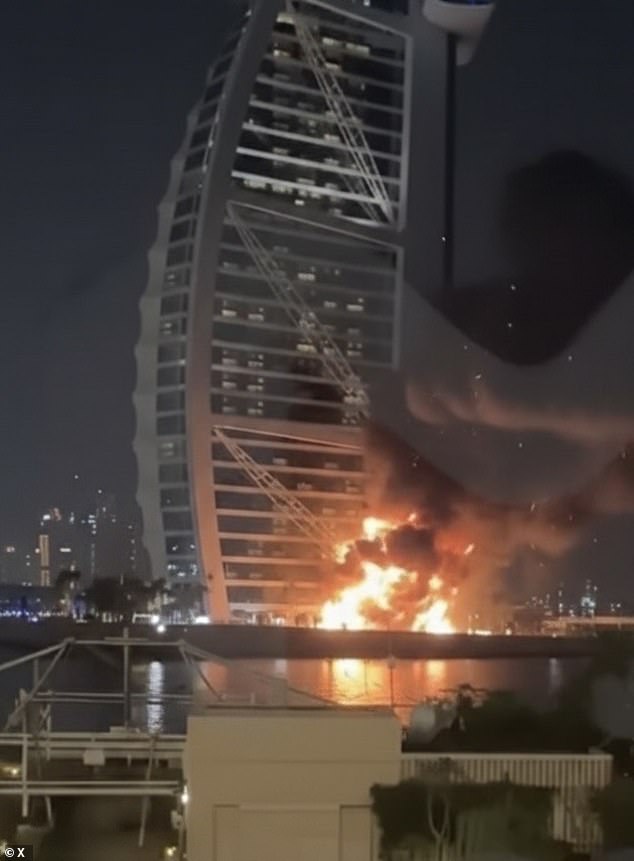
Britons living and travelling in the Middle East were fearing for their lives on Saturday after Iran rained terror on the streets of Dubai, Bahrain and Israel with a devastating blitz of suicide drones.
Plumes of black smoke billowed from the five-star Palm Jumeirah Fairmont hotel after it was set ablaze, as drones battered the Gulf city where more than 240,000 Britons live.
At least four people were injured in the attack on the luxury hotel, and UK tourists took shelter in the basement as countries across the Middle East suffered sustained bombardment.
Missiles continued to streak across the sky above the UAE’s economic capital late into last night.
The Burj Khalifa, the world’s tallest building and a feared target, was evacuated and panic set in among those trapped in the city.
Video footage showed Shahed drones flying over Dubai and the world-famous Fairmont hotel in flames.
Tourists were earlier seen running for shelter and elsewhere staring up from their sunloungers as air defence fire thudded overhead.
British tourist Will Bailey, 26, from Manchester, last night said he was just yards away when a bomb struck the Fairmont.

Fire and smoke were seen in the luxury Burj Al Arab hotel on Dubai’s Palm archipelago

In an image posted on Saturday thick smoke could be seen rising from The Palm as fire raged on lower levels
He said in a video online: ‘I’m watching missiles fly across the Palm being intercepted. One fell on the Fairmont hotel just behind us as we were leaving. Thirty seconds earlier… I dread to think.’
And Londoner Shireen Quli Kahn, who has been living in Dubai for 11 years, told The Mail on Sunday: ‘I heard a loud explosion-like sound while I was out on my balcony in my villa. I knew right away it had to do with the Iran-Israel conflict.’
She added: ‘I have been hearing of people already going into grocery stores to stock up or drive to Oman for safety.’
News was limited in Dubai, where authorities were threatening people with a £40,000 fine or prison to stop them from sharing videos of the attacks, it was reported last night.
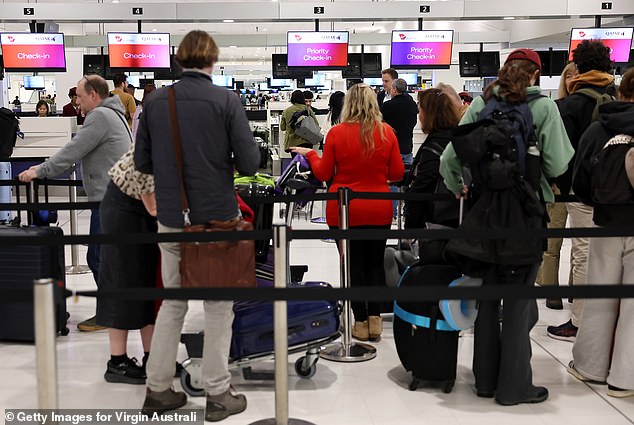
Tourists trying to flee were left stranded last night as flights around the world were thrown into chaos, with dozens cancelled and Dubai International Airport shutting its doors.
Stacey Gibson, 32, and her partner Charles Wright, 34, from Surrey, were in a taxi heading to the airport after a week-long holiday when a loud blast ripped through the air.
Ms Gibson said: ‘It was an almighty bang. We both looked at each other, then at the cab driver, like, ‘What was that?’
She added: ‘As we got into the airport, it was rammed. Then you could see the departure boards in front of you, saying: cancelled, cancelled, delayed.’

Smoke seen from a rocket in the sky over Dubai on Saturday which was reportedly intercepted by UAE defences

Iranian missiles struck Dubai’s The Palm, an artificial archipelago filled with luxury resorts
Outbound aircraft from Heathrow, Birmingham, Manchester, Edinburgh and Dublin were turned around in mid-air.
Mike Boreham, booked on a British Airways flight to London from Dubai, told The Independent: ‘We were all boarded. The flight was completely full. About ten minutes after the ‘boarding complete’ announcement, we were told the airspace is closed.’
Just down the coast in Abu Dhabi, where shrapnel from a missile attack killed one person, plumes of smoke were seen rising from the Al Dhafra air base, which hosts US troops.
Olesia Tyne, from Yorkshire, who has been living in Abu Dhabi for just six months, last night told the MoS of the shock for her and her young family.
She said: ‘Today’s missile attacks came as a complete shock. We were at the pool at the ERTH Hotel when we heard the first explosions at exactly 12.50pm.
‘At that moment, everyone at the pool received emergency alerts on their phones, and we were instructed to evacuate quickly into the hotel. Thankfully, everyone remained calm, but my children [aged five and nine] were understandably very worried and upset.’
In Bahrain, British mother-of-three Emma Clarke said that, while she lived 12 miles from the strike area, she could still hear the distant booms.
She added: ‘We were told to go home, and have just been following the guidance to stay indoors while this plays out. It’s unnerving but so far, we are sitting tight.’
In the Qatari capital of Doha, one British woman told the MoS she was trapped there, having seen missiles being shot down and ‘debris falling from the sky’.
The 56-year-old, from Bath, who wished to remain anonymous, said: ‘It was pretty scary and the windows started shaking.
Even if you’ve never heard a bomb before you know what it is immediately.’
I’ve lost count of the attacks…you get used to it
By Natalie Lisboa in central Israel
The unrelenting, piercing shriek sounded from our phones at 8.13am, telling us to seek shelter, as it has done so many times before. It has become grimly familiar over the past two years, and, as we always do, we raced to take cover.
The grinding sense of inevitability has been building in Israel over the past three weeks. The question was no longer if a regional war would erupt, but when.
The signs were there: schoolchildren had been sent home with their books in anticipation of closures; hospitals activated contingency plans; the US ambassador to Israel, Mike Huckabee, issued an unusually stark warning on Friday urging American staff to leave ‘TODAY’. The British Embassy moved its personnel out of Iran.
But many had clung to the hope that US naval and air power amassing in the region was a calculated show of force, leverage to corner Tehran into a nuclear agreement. As a source told me: ‘It’s in the DNA of Iran’s regime to wreck deals.’
Though it was clear the Trump administration’s patience had worn thin, officials maintained that further talks were scheduled for Friday. Israel, of course, has long prized the element of surprise.
So we still couldn’t quite believe ‘Operation Epic Fury’ was under way. And we soon realised that this time, it really was different.
Even through our bomb shelter’s thick concrete walls, you could hear explosions raining down as Iran retaliated with hundreds of missiles. Some blasts were in the distance, others close by.

People take shelter in an underground parking garage as air raid sirens warn of incoming missiles strike by Iran, in Tel Aviv, Israel, on Saturday February 28, 2026
When you have been sitting here since 8am, you no longer jump at the noise. We have become used to it. I have lost count how many times a new siren has sounded – I would estimate roughly every 10 minutes. We try to keep track, but it quickly becomes pointless.
Iran’s retaliation is relentless. It is angry. It feels like psychological terror, as though they want to exhaust us and erode Israel’s morale. Perhaps they feel they have nothing to lose: they know they are in their last chance saloon.
We are so disconnected from the outside world that it is almost impossible for anyone to understand what this feels like.
The attacks from Iran and its proxies have been going on for years, and they underestimate how robust Israeli people are.
No one here relishes Israeli soldiers facing yet another conflict, but the moment is framed in stark terms.
Ask almost any Israeli and they will say they would rather endure weeks in shelters and take significant blows than allow an existential threat from Tehran to go unanswered. No one wants Iran to get the nuclear bomb.