


Keir Starmer told Donald Trump on Sunday night he wasn’t ready to agree to US demands to ‘send ships’ to protect oil tankers in the Gulf from Iranian attacks.
The two leaders spoke by phone after the US President requested assistance in dealing with Iran’s efforts to shut the Strait of Hormuz.
Downing Street said the pair ‘discussed the importance of reopening the strait to end the disruption to global shipping, which is driving up costs worldwide’.
But, with Iran warning on Sunday of reprisals against the UK, it is understood there are no current plans to send British warships to escort stranded tankers. Instead, ministers are offering mine-hunting drones and missile interceptors as part of an international effort to free up shipping on the route.
On Saturday, Mr Trump said he wanted Britain, France and China to ‘send ships to the area so that the Strait will no longer be threatened by a nation that has been totally decapitated’.
This demand was repeated by Mike Waltz, US ambassador to the United Nations, who said: ‘The conversation is ongoing. The last time Iran tried to constrain global energy supplies, you had French, United Kingdom forces escorting tankers heading towards their markets. That is what President Trump is calling upon the world.’
Downing Street said ministers were ‘discussing with our allies and partners a range of options to ensure the security of shipping in the region’.
But on Sunday night it appeared Britain’s only immediate contribution to unblocking the strait will be autonomous underwater vehicles based in Bahrain which are untested in conflict situations.

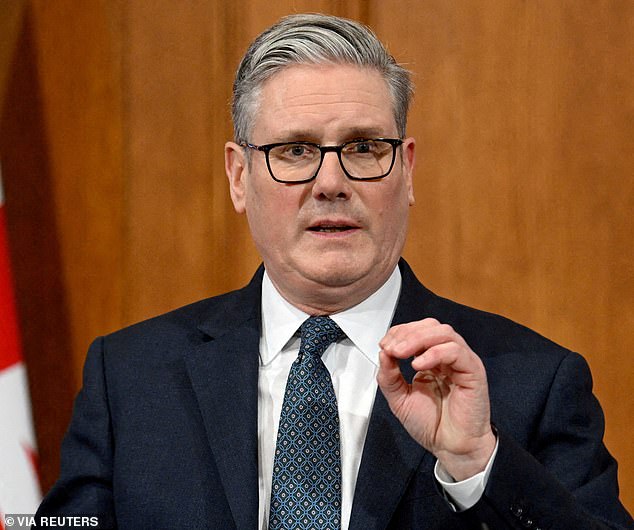
Keir Starmer spoke with the US President after he requested British assistance in dealing with Iran’s efforts to shut the Strait of Hormuz

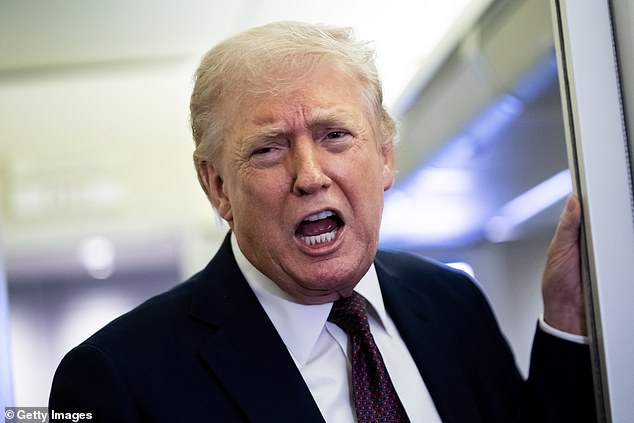
Donald Trump said he wanted Britain, France and China to ‘send ships to the area so that the Strait will no longer be threatened by a nation that has been totally decapitated’
The Royal Navy does not have a single minesweeper to offer after HMS Middleton was withdrawn from the region last year for ‘routine maintenance’.
Government sources stressed that no final decisions had been made on how to respond to Mr Trump’s request.
About 20 per cent of the world’s oil passes through the strait and its closure has seen oil prices rise about $100 a barrel, threatening the world’s economies.
However, ministers are resisting pressure to send scarce warships to the region and instead want to prioritise naval support for a Nato mission in the High North, which is seen as essential to deterring Russian aggression.
Ministers are also concerned about the risk of being dragged deeper into the unpopular conflict and by fears that Iran could intensify its attacks in the Gulf.
On Sunday, the EU was reported to be considering expanding its Aspides mission to protect shipping in the Red Sea from attacks by the Houthi militia.
But German foreign minister Johann Wadephul said he was ‘very sceptical’ about the idea. Iran also signalled it would step up reprisals against the UK if it played any role in reopening the strait.
Foreign ministry spokesman Esmail Baghaei told Times Radio that Iran was ‘not at war with the UK’ at present.
But asked about possible British involvement, he added: ‘That would be complicity in the crime of aggression, crime against peace, and that would for sure be responded [to] by Iran.’
On Sunday night, senior naval figures backed the PM’s stance but highlighted the UK’s ship shortage.
Admiral Lord West, former head of the Royal Navy, said: ‘Our strategic priority remains the High North and we should remain fully committed to Nato manoeuvres… The beneficiary would be Vladimir Putin if we compromised that exercise… What we really need in the strait is mine-hunting capability.
‘It is dreadful that we don’t have a minesweeper in the region and are autonomous assets may not yet have reached maturity.’
Meanwhile, an operation to rescue thousands of Britons stranded in Lebanon moved a step closer.
The Royal Fleet Auxiliary ship Lyme Bay set sail from Gibraltar towards Cyprus where she could lead a Non-Combatant Evacuation Operation. The move came as Israeli tanks pushed deeper inside Lebanon.