


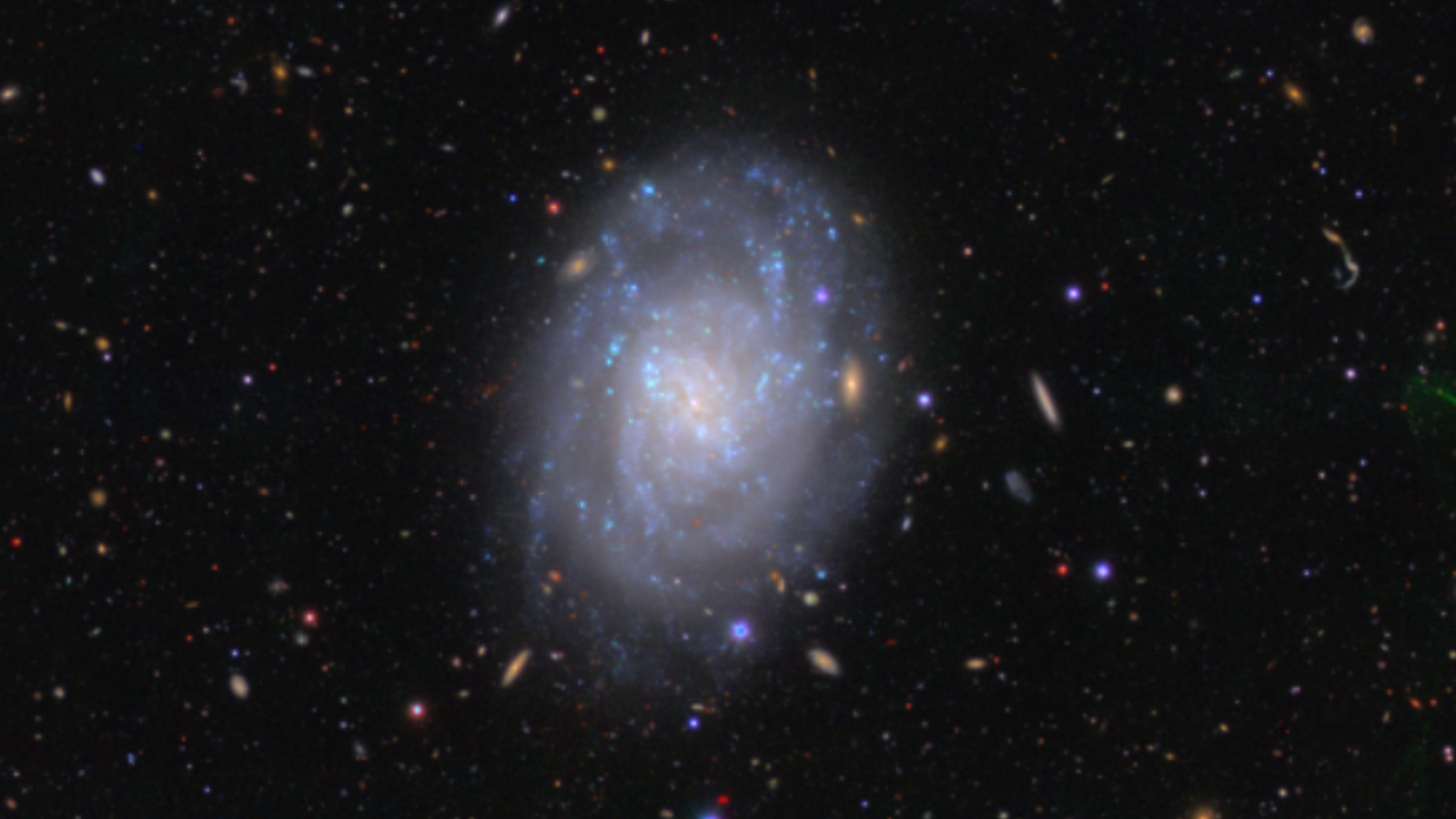

Using the Subaru Telescope located at the summit of the extinct volcano Maunkea in Hawai’i, astronomers have captured a stunning image of a spiral galaxy that resembles a spinning cosmic wheel.
What is it?
The galaxy in question is NGC 941, located around 55 million light-years away from Earth in the constellation Cetus.
NGC 941 is considered an “intermediate spiral galaxy,” which means that, in terms of morphology, it is somewhere between a barred spiral galaxy and an unbarred spiral galaxy.
The “bars” in these classifications refer to a dense churning central structure of stars. Intermediate galaxies have some signs of such a structure, rather than having them well-formed or altogether absent.
Why is it special?
The Subaru Telescope image shows NGC 941 as a bright blue spiral. Within the galactic structure are prominent central dark lanes of cosmic dust. These are signs of ongoing star formation.
Appearing with the spiral are orange blobs that aren’t part of NGC 941 at all. These are much more distant background galaxies that appear through NGC 941 because of how faint this intermediate galaxy is.