


A Spanish holiday hotspot has announced that bars and pubs will have to shut earlier in the latest anti-tourism move by locals.
Authorities in Alicante have identified Acoustically Saturated Zones (ASZ) where most of the after-hours noise complaints about bars, restaurants and nightclubs were registered.
Business in parts of the Old Town and the centres around Calle Castanos that fall into the zones could be forced to close earlier as soon as late March just as Spain’s main tourism season is about to start.
Local police will check whether bars and pubs abide by the 1am closing time on Fridays and Saturdays, while nightclubs will have to close their doors at 3am.
During the rest of the week, nightclubs will have to shut at 1am and other businesses as early as 12.30am, Spanish outlet The Olive Press reports.
Shops open for 24 hours a day will even have to close between 12.30am and 7am. The strict nighttime rules will also apply to shops selling bakery goods, takeaway meals, newspapers and drinks.
The ASZ also suspend new licenses being given to nightclubs, bars, restaurants, cafes and karaoke bars.
Businesses having to shut earlier following a series of complaints by locals is the latest anti-tourism move by authorities after a wave of protests last year.

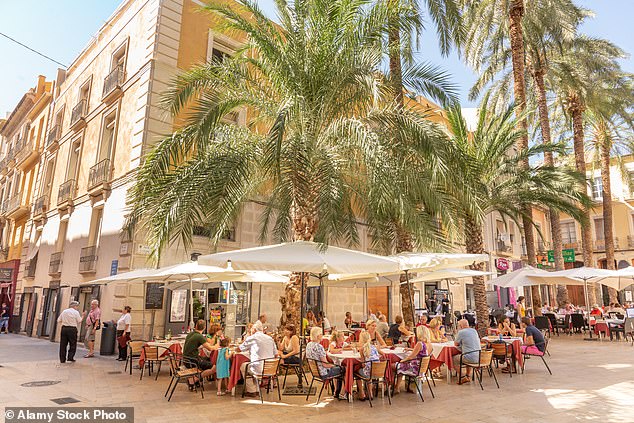
Authorities in Alicante have identified Acoustically Saturated Zones (ASZ) where most of the after-hours noise complaints about bars, restaurants and nightclubs were registered (file image of Alicante)

Demonstrators march shouting slogans against the Formula 1 Barcelona Fan Festival in downtown Barcelona, Spain, Wednesday, June 19
Last month, Spain’s socialist prime minister vowed to completely ban non-resident Brits from buying homes in the country.
Speaking at a Socialist Party event in the Extremadura region in western Spain, Pedro Sanchez said: ‘We are going to propose that these non-EU foreigners, who neither they nor their families reside here and who are therefore only speculating with these homes and houses, be prohibited from buying them in our country’.
Sanchez’s remarks follow on from his announcement earlier last month of a 12-point programme to tackle a mounting housing crisis which has left locals furious with the lack of available homes.
The measures included raising property tax for non-EU foreigners buying a home in Spain to a staggering 100% of the value of the property.
House-buyers in the country are currently expected to pay costs and taxes worth between 10 and 12 per cent of the price of the house, depending on where it is.
Sanchez said that the new tariff would help ‘prioritise the availability of housing for residents’.
He noted that in 2023 alone, non-residents from outside of the EU bought 27,000 houses and flats in Spain, ‘not to live in them, but mainly to speculate’.
He said this was ‘something that, in the context of the shortages we are experiencing, we cannot afford’.

Tenerife locals hold placards raising concerns about the impact of mass tourism, October 2024

Protestors in Alicante rally against overtourism in the Spanish city, in July 2024

Graffiti reading ‘kill a tourist’ has been spotted on a wall in Tenerife amid Spain’s anti-protest movement
This comes after shocking graffiti reading ‘kill a tourist’ appeared in Tenerife las month amid Spain’s ongoing protests against holidaymakers.
The frightening slogan was in January spotted on a house in the south of the Spanish island by a concerned resident who admitted to being worried that the mass protest movement against overcrowding was going too far.
Speaking to LBC, they said: ‘Things on the islands are getting worse due to the large number of tourists and new residents, which leave us without homes and severely affect our natural environment’.
The local, who remained anonymous due to safety concerns, added that people on the island are becoming desperate for change and respect.
‘But perhaps this does not justify those actions, which seem to be escalating. It’s frightening,’ they said.
Footage of the graffiti being painted on to the wall was posted online by the Islas de Resistencia group, which describes itself as ‘a project to recover the memory of social movements in the Canary Islands’.