

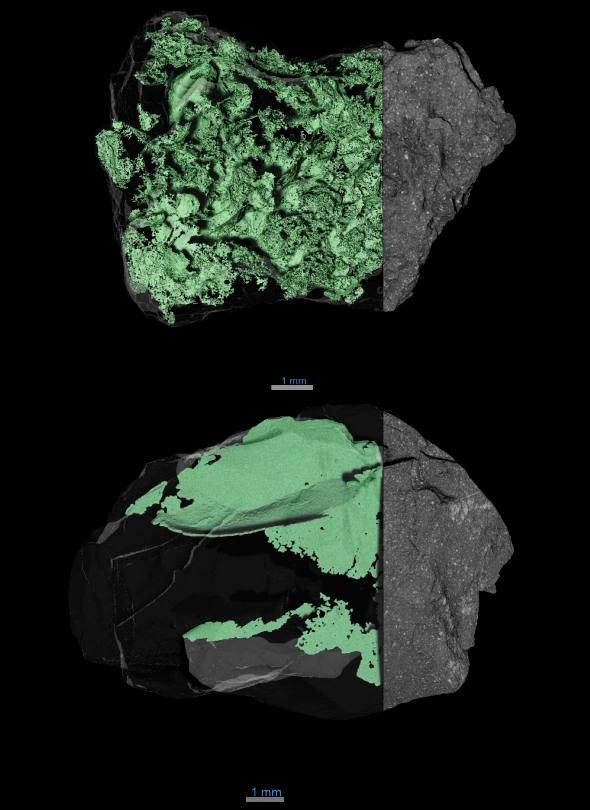
These X-ray computed tomography (XCT) scans released on March 17, 2026, give us a glimpse inside asteroid Bennu. They show the most common types of crack networks observed in Bennu samples; these networks solved a mystery that baffled NASA for years.
When NASA’s OSIRIS-REx spacecraft first approached asteroid Bennu in 2018, scientists expected to see smooth, sandy beach-like surfaces. Instead, they found a celestial body covered in boulders. Observations made in 2007 by NASA’s Spitzer Space Telescope measured low thermal inertia, indicative of an asteroid whose surface heats up and cools down rapidly as it rotates into and out of sunlight, like a sandy beach on Earth. This was at odds with the many large boulders that OSIRIS-REx found upon arrival, which should act more like blocks of concrete, shedding heat long after the Sun has set.
Data collected by the OSIRIS-REx spacecraft during its survey campaign at the asteroid suggested a possible explanation: the boulders could be much more porous than expected. Once the samples were delivered to Earth, researchers were able to investigate this further.
Learn how these XCT scans helped reconcile the discrepancy between what was expected and what was found on Bennu.
Image credit: NASA/Scott Eckley