


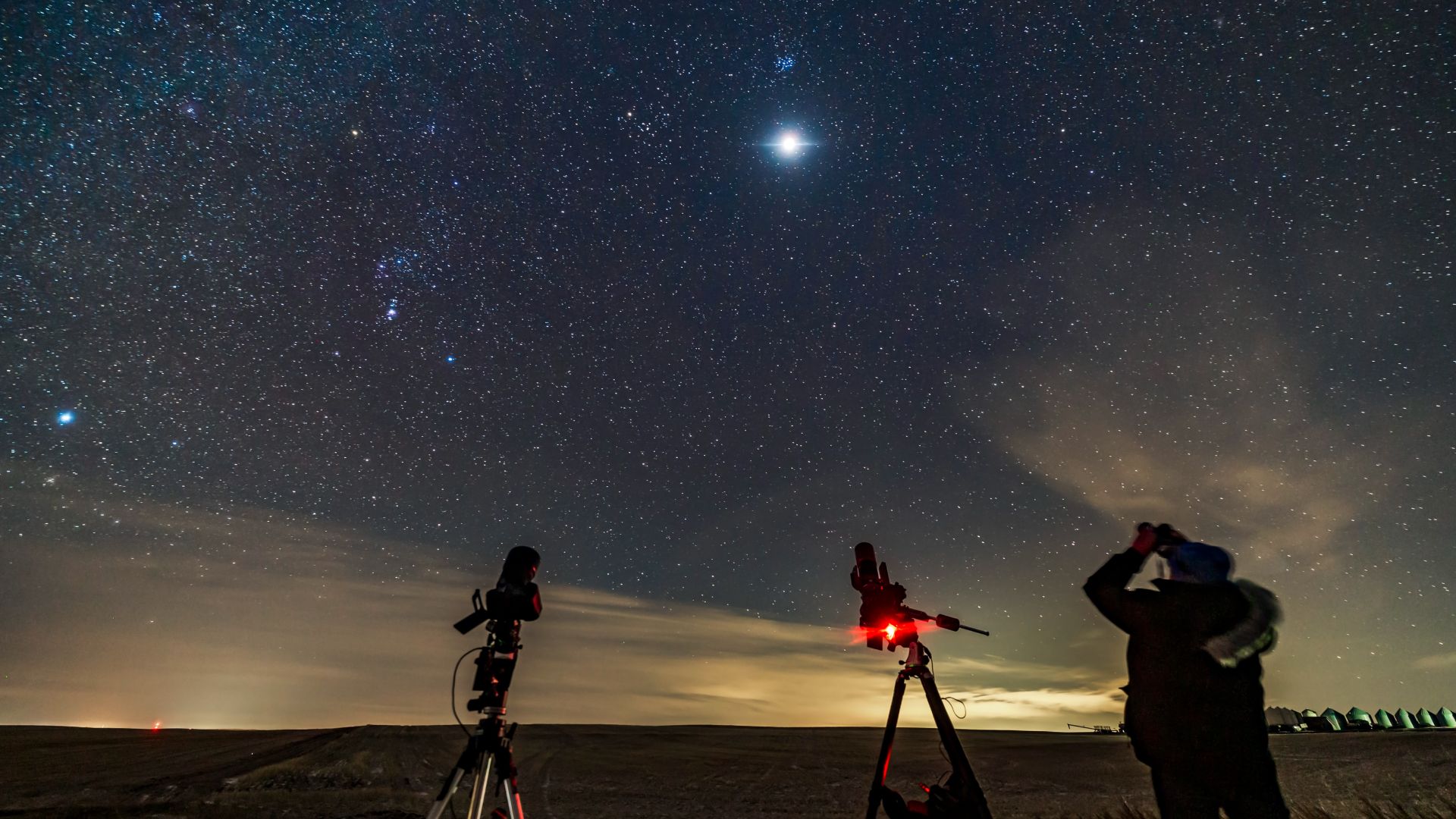
Look high above the southwestern horizon tonight (Feb. 23) to see the blue-white stars of the Pleiades open cluster glowing alongside the waxing gibbous moon, just hours before it reaches its first quarter phase.
Celestron NexStar 4SE

The Celestron NexStar 4SE is ideal for beginners wanting quality, reliable and quick views of the night sky. It’s sturdily built, quick to set up and automatically locates night sky targets and provides crisp, clear views of them. For a more in-depth look at our Celestron NexStar 4SE review
The Pleiades will appear less than 5 degrees — approximately the width of your outstretched three middle fingers — to the upper right of the half-lit moon, close enough to share the field of view of a pair of 10X50 binoculars.
Also known as the Seven Sisters, the Pleiades is an ancient star cluster in the constellation Taurus. Its seven brightest stars are named after daughters of the titan Atlas from Greek mythology: Asterope, Alcyone, Electra, Celaeno, Merope, Maia and Taygete. Through binoculars, they appear to mimic the stars of the Big Dipper asterism in the constellation Ursa Major, surrounded by their fainter cousins and the glow of a nearby reflection nebula.
A telescope will help reveal even more of the Pleiades’ thousand-strong stellar population. After admiring the Pleiades, turn your telescope to the moon’s surface to explore a host of spectacular impact craters and lunar seas scarring Earth‘s natural satellite. The dark basaltic expanse of Mare Serenitatis (the Sea of Serenity), will rest close to the line separating night from day, known as the terminator, marking the site where ancient lava flows poured into impact basins in the ancient past to repave the lunar surface.

Below it rests Mare Tranquilitatis (the Sea of Tranquility), where Apollo 11 astronauts Buzz Aldrin and Neil Armstrong planted humanity’s first historic steps on the moon. The terminator itself plays host to a wealth of dramatically shadowed impact craters, some of which feature overlapping rims and colossal central peaks, forged in moments of cataclysmic violence that cast debris far across the barren surface.

The moon will appear to advance on the Pleiades throughout the night, skimming through its rightmost stars before setting below the northwestern horizon around an hour after midnight for stargazers in New York. Remember, the exact times that the moon rises and sets vary based on your location. Be sure to use Time and Date’s moonrise calculator for precise timings for your location.
Want to get a closer look at Earth’s moon? Then why not check out our roundup of the best telescopes and binoculars for stargazing in 2026? Photographers may also wish to read our guide to the best cameras and lenses for astrophotography.
Editor’s Note: If you would like to snap a photo of the moon and Pleiades and want to share it with Space.com’s readers, then please send your photo(s), comments, name and location to spacephotos@space.com.