


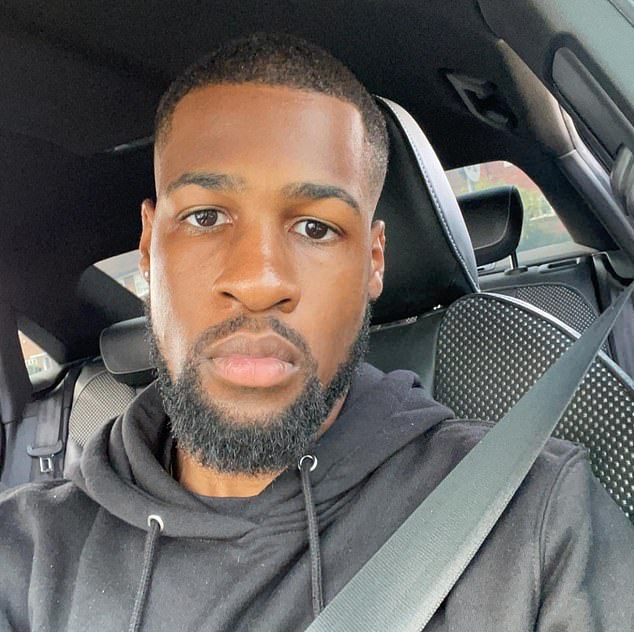
On September 5, 2023, Cliff Mitchell forced a blindfolded woman into the back of his white Audi.
He had already raped his victim multiple times at a property in south London, bound her wrists with cable ties and placed tape over her mouth to muffle her screams before marching her to the vehicle at knifepoint.
Mitchell, now 26, threatened to slit the woman’s throat and said he would harm her family if she tried to get help.
‘You’ve met the devil,’ he told her. If she even dared to try to flee from the vehicle he would ‘kill her in front of everyone’.
It was the culmination of a campaign of horrific sexual and physical abuse of the woman, which had lasted several years.
As the car wound its way through the streets of the capital, she somehow managed to convey that she was about to be sick. When Mitchell, concerned for his vehicle’s interior, stopped momentarily in Hackbridge, south-west London, she seized her chance.
Witnesses and CCTV caught the moment when the ‘distraught and scared’ victim zig-zagged on foot through traffic, losing her shoes along the way.
She was saved when a passing motorist let her into her vehicle and dialled 999. Mitchell was arrested around seven miles away in Putney.

Mitchell was a serving Metropolitan police officer when he was arrested after raping and abusing his victim
The details of this horrific incident have chilling echoes of the case of Sarah Everard – another young woman, in her 30s, who was abducted, raped, bound, gagged and driven to her death in March 2021.
Of course, the crucial difference between the two young women was that poor Sarah never got a chance to escape. Yet there is another, more disturbing, similarity.
For it soon emerged that Mitchell, like Sarah’s murderer Wayne Couzens, was in fact a serving Metropolitan police officer who used his position to intimidate his victim into silence.
Not only that, but Mitchell had been hired by the force in August 2021 – five months after Sarah was murdered – at a time when you’d expect vetting procedures in the country’s most beleaguered force to have been at their most robust.
What’s more, Mitchell’s record clearly showed he’d been arrested and questioned by Met detectives in 2017 over a series of alleged rapes of a child.
Yet still they let him in.
Last week it emerged that, far from being an anomaly, Mitchell was one of at least 131 Met officers and staff who went on to commit crimes or misconduct after they were not properly vetted.
An internal Metropolitan Police review of vetting and hiring practices in the ten years to April 2023 found the lapse was due to a nationwide push to hire thousands more officers – with a particular focus on improving diversity.
More than 5,000 new recruits faced limited checks, the review found, allowing monsters like Cliff Mitchell to find themselves in uniform.
Commenting on the findings in an exclusive interview with the Daily Mail, one furious relative of Mitchell’s rape victim said the police failings had left the family feeling they ‘can’t trust anyone any more’.
‘You’re supposed to trust the police,’ the relative said.
‘He raped and kidnapped her. He abused his power.
‘She wouldn’t have been his last victim if he hadn’t been stopped. She’s a brave girl. He thought he was unstoppable. The police have repeatedly failed.’
Mitchell’s 2017 arrest emerged during vetting as part of his initial application process in 2020 and he was rejected. (He had been told in 2019 that no further action was being taken in respect of the allegations.)
However, a ‘vetting panel’, partly aimed at improving ethnic minority representation, overturned the decision a year later, in 2021. That the U-turn on his application took place in the months following the abduction, rape and murder of Sarah Everard almost defies belief.

Sarah Everard was kidnapped and murdered in March 2021 by Wayne Couzens who, like Mitchell, was serving as a Metropolitan police officer
The Daily Mail can reveal another monster who was able to join the Met due to reduced vetting checks was serial rapist PC Jake Cummings.
Cummings, who joined the Met in 2019, was jailed for 16 years in September for rape, coercive and controlling behaviour, voyeurism and stalking after raping two women while serving as a police constable in London.
He attacked another woman while serving as a special constable in Dorset.
Sentencing him, judge Bilal Siddique said he had ‘abused his position as a police officer to control his victims’.
We can also disclose that PC Ross Benson, who was sacked from the Met in September 2024 for repeatedly ‘spanking a 12-year-old child on her bare bottom’, faced reduced vetting checks.
The Met’s internal review found that the constable, who joined the force in 2003, was not properly vetted during his vetting renewals as the force relaxed rules during its hiring push.
However, a source said that based on the information known to the force, even if all checks had been completed they didn’t believe it would have prevented either Cummings or PC Benson from working for the Met at that time.
Also not properly vetted was serial rapist David Carrick, who joined the Met in 2001 but had a vetting renewal in 2017 which failed to reveal an allegation of domestic abuse against him.
Carrick is now serving 37 life sentences for a campaign of rapes and sexual assaults against girls and women over 30 years, with one victim describing how she had ‘encountered evil’.

Carrick was found guilty of molesting a 12-year-old girl and raping a former partner and is now serving 37 life sentences
The relative of Mitchell’s victim feels the same.
‘He [Mitchell] was so young. He was bloody young. He’s just a monster. You do not just wake up and do what he did. Who even thinks to do what he did? He must have felt invincible.’
The Met has admitted that one of its challenges was to ‘create a more diverse workforce’ to be more representative of London. But, says the relative of Mitchell’s victim, at what cost?
‘They have been rushing to make people police [officers] and not doing the right checks.
‘It’s common now for the police to become the perpetrators – and because they’ve got the authority, no one is going to open their mouths. It doesn’t hurt to do a couple more checks.’
Last week’s report found that the same vetting panel, now disbanded, which allowed Mitchell into the force overturned the decisions to block the applications of 114 potential officers, of which 25 went on to commit misconduct or a criminal offence – a staggering one in five of those who were given a second chance.
The vetting panel mostly re-vetted ‘applicants from ethnic minority groups’ with the aim of ‘reducing disproportionality in vetting decisions’, according to the Met.
The review found that the vetting panel ‘in some cases… overturned the decision of
vetting officers despite adverse intelligence existing’. The Met was under pressure to recruit 4,500 police officers from July
2019 in a national drive to add 20,000 more officers to the ranks by 2023, under the Conservative government’s Police Uplift Programme.
Around 1,200 people who joined the force during this period – there were around 27,300 applications – may have had their vetting refused under normal practices, according to the review. And one of them was Mitchell. He became a PC in the Met’s West Area Basic Command Unit, based in Hounslow. The victim’s relative is convinced the reason was partly due to his ethnicity.
‘The police gave him the power,’ the relative said. ‘Because he was a black man, they were happy to have him. Where he grew up a lot of black men don’t make it without a criminal record.
‘He manipulated the police. They must have been so pleased to get a young black man who had been good in school and was going to university who was qualifying to be a policeman on the streets of Hounslow and Acton [west London].
‘All they [the police] had to do was look at his address and find it [the 2017 rape allegation].
‘Why couldn’t they do it?’
In 2024, at Croydon Crown Court, Mitchell was convicted of 13 counts of rape, including six counts of raping a child under 13, after detectives reviewed the 2017 allegations into his first child victim and passed a file to the Crown Prosecution Service.
It emerged he had raped her over a period of three years when he was also a youth.
He was also convicted of kidnap in relation to his second victim and jailed for life with a minimum term of 14 years.
The relative added: ‘They let him in knowing that he may have already done this [rape] and he will be able to do this again?
‘They gave him the opportunity to use the police to do it again and she [second victim] was the backlash. It just makes me so angry, so angry.’
Yet they weren’t the only ones who failed her. In July 2023, the young woman who months later would scramble for her life from Mitchell’s car, had taken out a non-molestation order [NMO] against him, a civil injunction which can be used in cases of domestic abuse to stop someone contacting or harassing them. Breaching such an order is a criminal offence.
When an NMO is granted, a local police force is notified so it can take action when the order is breached.
The Met received the NMO but said it ‘made no mention of Mitchell being a police officer’.
No further checks were carried out and he was free to continue frontline duties in west London boroughs until his arrest two months later.
Speaking after his sentencing at Croydon Crown Court, then shadow home secretary Yvette Cooper said: ‘There are serious questions as to how Mitchell was able to obtain a job in the Met, having been investigated for rape.
‘The fact that the police did not know Mitchell had a non-molestation order out against him whilst he was a serving officer shows total system failure in tackling violence against women and girls.’
The Met has been hit by an avalanche of bad publicity owing to the actions of rogue police officers since the murder of Ms Everard shocked the nation in 2021.
Seven officers have been sacked following a BBC Panorama investigation broadcast last year which showed police based at Charing Cross police station sharing discriminatory remarks about Muslims, victims of crime and detainees.
In November, PC Daniel Traynor was convicted of assault for attacking his neighbour in east London in a row over parking. He was sacked from the force earlier this month.
Another PC who abused a teenage boy while serving as a police cadet leader was convicted of sexual assault last month.
Grant Fulker, 32, attacked a boy in a Heathrow hotel room in February 2024. He will be sentenced next month.
The Daily Mail revealed last week that the Met still has 300 serving officers with criminal records within its ranks, including two sex offenders.
The officers committed ‘non-contact’ sexual offences in the mid-2000s, a lower category of offending including voyeurism, exposure, ‘up-skirting’, drink spiking and stalking. One officer was convicted before joining the force and the other was already in the job when found guilty.
There are also 54 officers with criminal records for violent offences, data revealed following a Freedom of Information request.
It has also emerged that the practice of not properly checking employment references during the push to recruit thousands of officers nationwide was not just limited to the Met.
Another four forces have admitted they ‘deviated’ from standard recruitment practices during the Police Uplift Programme between July 2019 and March 2023.
Greater Manchester Police, Lancashire, Merseyside and Cumbria Police all told the Home Office and National Police Chiefs’ Council in 2022 that they had switched off pre-employment reference checks in the rush to hit recruitment targets.
Responding to the Met’s review into vetting practices, known as Operation Jorica, assistant commissioner Rachel Williams said: ‘This review is part of our ongoing work to demand the highest standards across the Met so the public can have trust and confidence in our officers.
‘We found that some historical practices did not meet the strengthened hiring and vetting standards we have today.
‘We identified these issues ourselves and have fixed them quickly while making sure any risk to the public has been properly and effectively managed.
‘It is important to highlight that the Met recruits hundreds of officers and staff every year – the overwhelming majority of exemplary character who are dedicated to protecting the public.’
But for the family whose lives were torn apart by the reprehensible crimes of Cliff Mitchell, words are not enough.
‘They [police officers who went on to offend] had the uniform and they knew they were unstoppable,’ they said.
‘The police can recover from this, but it’s going to take a very long time.’