

Pep Guardiola has long forged a reputation as a manager who likes his teams to press high and hard. The logic is simple enough: the quicker and closer to the opposition goal you win the ball back, the shorter the distance you have to go to score.
He might tweak things here and there, adapting to the latest trends and tactical evolutions, but forever rooted in the same principles.
Against Arsenal in the Carabao Cup final, however, Guardiola instructed his Manchester City players to do something completely different – and it won them the trophy.
Whenever the Gunners had the ball at the back, ready to build their attacks from defence as they love to do, City’s attackers lined up in a front four. Rayan Cherki pushed up alongside Erling Haaland with Jeremy Doku on the left and Antoine Semenyo on the right.
But that’s where it stopped. There was no jumping on to the ball carrier. City just let Arsenal’s centre-backs Gabriel and William Saliba, or goalkeeper Kepa Arrizabalaga have it…and have it and have it some more.
This was in the first five minutes of the game as Saliba stands on the ball waiting to be pressed only for City’s front line to stand their ground.

William Saliba is on the ball but City’s players stand and watch rather than press
It bamboozled Arsenal. They tried whatever they could to bait City into a press. Kepa stood with his studs on the ball. He, Gabriel and Saliba passed it around between themselves across the back line, often for more than a minute at a time, hoping someone would step up and leave a gap to play a pass into Arsenal’s midfield duo of Declan Rice and Martín Zubimendi to start the attack.
Kepa even tried fake rolling the ball forward. At the start of the second half, as shown below, Gabriel and Saliba split even wider and deeper. City refused to budge.

Gabriel (top) and Saliba drop deeper but still City refuse to press the ball
One of Arsenal’s greatest strengths this season, what is likely to lead them to a first Premier League title in more than 20 years, but what also leads to the greatest criticism from annoyed observers, is how machine-like Arteta’s side has become. They take few risks, with little room for artistic expression, and play the percentages. And, often, it works.
But when presented with this new problem, it was as though Arsenal’s machine was unable to break its programming to solve it.
By cutting off the passing lanes into midfield, Arsenal didn’t know what to do.
If they moved the ball to the full-back, City could spring into action to close them down and contain them.

If and when Arsenal got the ball to one of their full backs, then City would engage
If Rice dropped deep in front of the City front line, it left a huge gap in midfield to Arsenal’s front line. Just a sea of sky blue shirts. Even so, Kepa played one pass to Rice all game.
One of the biggest frustrations was how poorly Martin Zubimendi showed to receive the ball. While Rice would drift wide or deep in a desperate attempt to make things happen, his midfield partner was frequently stood behind the gigantic frame of Haaland. Gabriel touched the ball 68 times and played three passes to Zubimendi all game.

Martin Zubimendi is no help as he’s hidden behind Erling Haaland as Kepa looks for a way out
And whenever he did get on the ball, he rarely progressed it forward. Take this pitch map of his passes against City. It might take a few moments to realise Arsenal are attacking from left to right.

Zubimendi’s passes against City at Wembley (with Arsenal attacking from left to right) were largely backwards or sideways
On one of the few early occasions Zubimendi dropped deep in front of the City front line to collect it from Rice, he passed it straight out for a throw-in.
In only one of his 31 Premier League appearances this season has Zubimendi played fewer passes in a match where he’s been on the pitch for the full 90 minutes than the 33 against City.
Even when he did drop deeper to entice Kepa to chip a ball to him in space, the Arsenal back-up keeper – as they frequently resorted to – just pumped it long.
And with Viktor Gyokeres often unable to hold it up, the ball kept coming back.
At one point during the first half, Arsenal had the ball in their own defensive third for nearly a minute and a half only to end up with Gabriel trying to lump it long to Kai Havertz only to kick it straight to Bernardo Silva.
You can see from Arsenal’s pass map – the thicker the line, the more passes between those two players – how deep and how little the defence linked to the midfield.

Arsenal’s Wembley pass map shows how little link up play there was betweent the defence and the midfield
You only need compare that to their pass map from the recent 2-0 league victory over Everton. More passes, more connection, more forward play.

Compare that to their pass map from the recent 2-0 league victory over Everton. More passes, more connection, more forward play
Just before City’s second goal too, Saliba goes long once again only for the ball to be headed back into Arsenal’s half by Nathan Ake. Havertz eventually gets dispossessed from a loose ball and 30 seconds later it’s in Arsenal’s net.
The thing is it was not just City that used that tactic. Arsenal did too. They frequently sat off City’s defensive line but Guardiola’s side had the craft and the confidence to play through it.
Their midfield pivot of Rodri and Bernardo Silva were always looking to get on the ball regardless of the bodies around them.
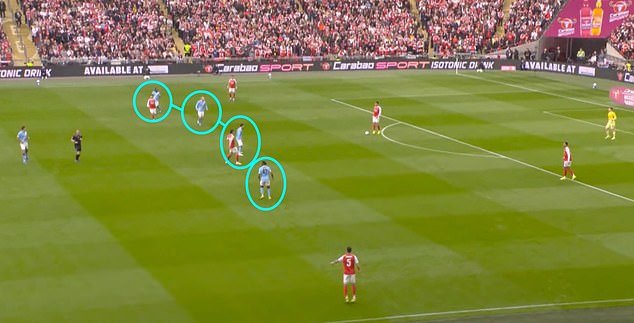
Their centre-backs were also confident enough to play splitting passes, like this from early in the first half from Ake who cuts out four Arsenal players to find Haaland.

Manchester City’s Nathan Ake splits the Arsenal lines with a pass to find Haaland
Arsenal still have to go to the Etihad Stadium in April. The title race will still be on the line. The concern, clearly, is whether Arteta has the answers if Guardiola uses the same tactic again.
There are a few glimmers of hope, however. Firstly, back in goal will be David Raya who is a far, far better passer of the ball than Kepa. He will be able to find gaps, he can spray long, accurate passes instead of hitting and hoping.
Arteta, too, should have Eberechi Eze and Martin Odegaard as options in midfield too. Players who can take the ball in tight areas and move it forward. Players who, when needed, don’t have to feel bound by the machine.