

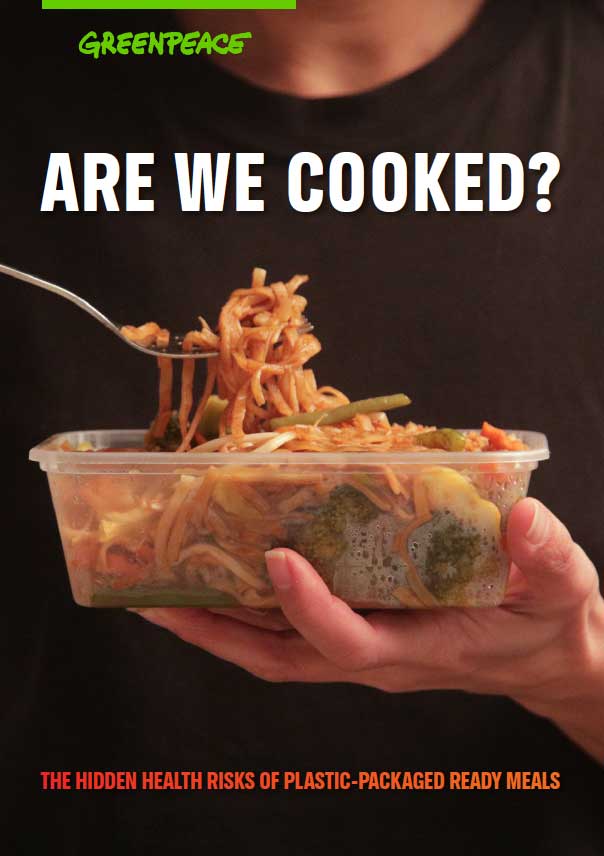
The hidden health risks of plastic-packaged ready meals
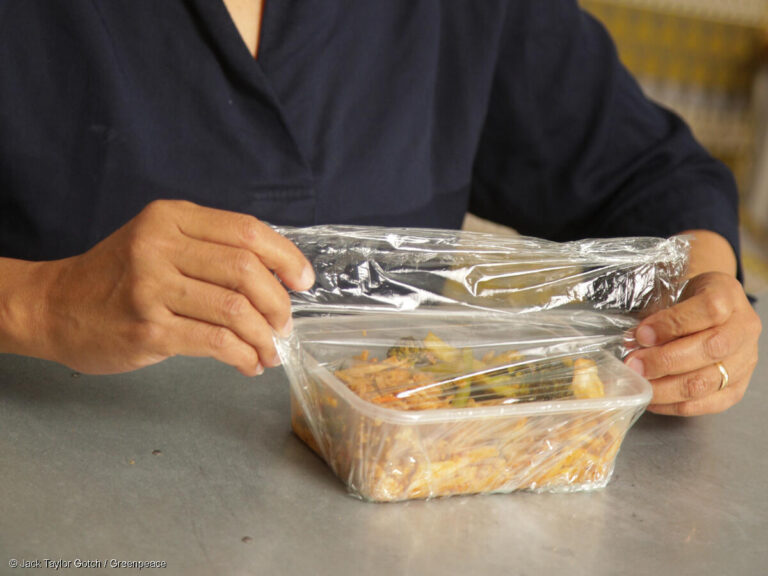
Ready meals and takeaways promise convenience – hot food, fast. The labels on the plastic trays reassure us that they are ‘safe’ to heat in a microwave or oven. But are we exposed to potentially dangerous microplastics and chemical additives along with our food?
Greenpeace decided to check
Greenpeace International’s analysis of 24 research papers in peer-reviewed scientific journals found that the plastics we use to package our food are exposing us to health risks – and none more so than heated ready meals and takeaways. Specifically:
- Plastic containers can release microplastics and toxic chemicals into our food.
- Leaching into food dramatically increases when the food is heated in the plastic packaging.
Regulators and the industry are failing to act on the plastics problem, which is already causing a global waste crisis, yet the production of plastic is set to more than double by 2050 from current levels. The fossil fuel and petrochemical industry is banking on this for its future growth – and relying on the growing trend for plastic packaged ready meals.
Past experience shows that the costs to society multiply when action is delayed by the denial of convincing scientific evidence. This has led to health and environmental disasters, from tobacco, to asbestos, to hazardous chemicals. When it comes to plastics, we already know that their global health impacts are costing trillions, and have more than enough evidence to act.
- At least 1,396 plastic food contact chemicals have been found in human bodies, including several which are a known threat to human health, linked to conditions such as cancers, infertility, neurodevelopmental disorders, and cardiovascular and metabolic diseases like obesity and type 2 diabetes.
Current regulation is clearly insufficient to protect public health. We need to act now and apply the precautionary principle to the way that we package food and stop this uncontrolled chemistry experiment that nobody signed up for.
As negotiations on the UN Plastics Treaty advance, we cannot ignore the potential impacts on human health.
Key Findings:
- Microwaving plastic containers can release hundreds of thousands of micro- and nanoplastics in minutes. One study found 326,000 to 534,000 particles leaching into food simulants after just five minutes of microwave heating, up to seven times more than oven heating.
- Heating dramatically increases chemical contamination. Across multiple studies, every microwave test sample of common plastics such as polypropylene and polystyrene leached chemical additives into food or food simulants, including plasticisers and antioxidants.
- More than 4,200 hazardous chemicals are known to be used in or present in plastics, most are not regulated in food packaging. Some, like bisphenols, phthalates, PFAS “forever chemicals” and even toxic metals such as antimony, are linked to cancer, infertility, hormone disruption and metabolic disease.
- Plastic chemicals are already in our bodies. At least 1,396 plastic-related chemicals have been detected in human bodies, with growing evidence linking exposure to neurodevelopmental disorders, cardiovascular disease, obesity and type 2 diabetes.
- Old, scratched or reused containers are worse. Worn plastic releases nearly double the number of microplastic particles compared to new packaging.
Reducing reliance on plastic packaging is not just an environmental issue – it is a public health imperative. And a global one. That’s why we urgently need governments to agree on a strong and effective Global Plastics Treaty.