



Conny Waters – AncientPages.com – Archaeologists have been carefully investigating a large burial mound from the early Celtic period on the southwestern edge of Riedlingen, in Baden-Württemberg, Germany, and their work is yielding remarkably valuable insights.
The burial itself is magnificent, and despite ancient looting, the thieves left behind grave goods that now offer important clues about the deceased’s high status. Many of these impressive artifacts are still well preserved.

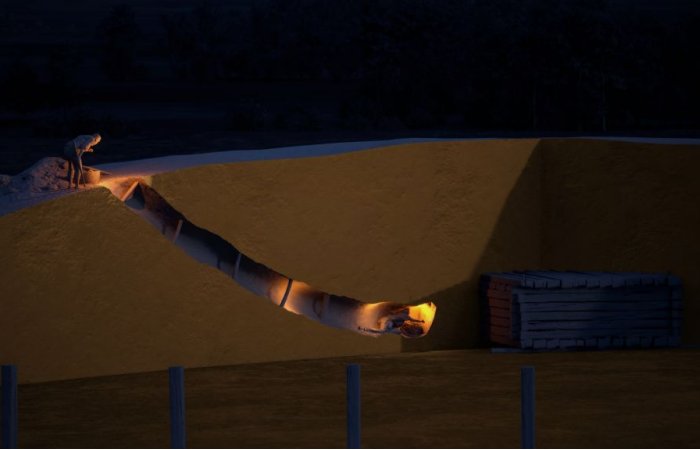
This reconstruction graphic shows how ancient tomb robbers dug their way through the hill to reach the central chamber. Credit: Faber Courtial / Baden-Württemberg Regierungspräsidium Stuttgart – Landesamt für Denkmalpflege
Researchers from the State Office for Monument Preservation in the Stuttgart Regional Council have now shared new and exciting findings from their detailed examination of the Celtic burial chamber. Archaeologist Prof. Dr. Dirk Krausse and Heuneburg expert Dr. Roberto Tarpini uncovered a complete burial chamber made of oak timbers at the center of the mound, extraordinarily well preserved thanks to groundwater. Using dendrochronology, they determined its age with great precision: 2,610 years old, built in 584 BC.
This date places the burial in the peak period of the princely seat of Heuneburg, the oldest known town north of the Alps. Located only about seven kilometers to the southwest, Heuneburg served as a major political and economic center in the early Celtic world, providing important historical context for the burial and its significance.

The chamber floor consisted of eight massive planks resting on two joists. In the southeast corner, a robbery tunnel, clearly visible due to its light discoloration, extended to the wall, which was then breached at the bottom. Credit: LAD im RPS/ Jörn Heimann
Although grave robbers had broken into the chamber in antiquity and plundered it, their focus on precious metals meant that organic grave goods, such as wood and textiles, were left behind. Today, these overlooked items are a gift to science, offering a rare and deeply appreciated window into Celtic craftsmanship, burial practices, and social hierarchy.

At the lower end of the robbery tunnel, in front of the opening in the east wall, lay the scattered remains of the burial and the grave goods that had originally been in the chamber. Credit: LAD im RPS/ Jörn Heimann
“This was a stroke of luck for archaeology, because the unusual preservation conditions caused by groundwater exposure allowed finds to survive that would have disappeared without a trace under normal circumstances,” State Archaeologist Professor Dr. Dirk Krausse said.
Unique Celtic Grave Goods Left Behind
The lower end of the side tunnel driven through the enormous burial mound by grave robbers opened up in 2025 as “a source of many new discoveries,” as Krausse puts it. Here lay the scattered skeletal remains of a man aged 17 to 19, along with countless grave goods made of wood, small metal fragments, textiles, fur, and other organic materials. These had originally been in the burial chamber and were likely thrown back into the still-open shaft after the metal objects and lining had been plundered from above.

Among the items found in the looted shaft were a presumed wooden wheel spoke covered with bronze sheeting, numerous small bronze nails, and several solid iron nails used to fasten iron wheel rims to wooden wheels. Credit: LAD im RPS/ Yvonne Mühleis
“The human remains probably lay on or in a fur—some terminal phalanges (toe bones) of a brown bear suggest that it was a bearskin—with which they were dragged out of the chamber,” explains Dr. Roberto Tarpini, the officer responsible for preserving the Heuneburg monument at the State Office for Heritage Management (LAD) in the Stuttgart Regional Council.
“The most striking and, so far, most interesting part of this unique collection of finds consists of numerous fragments of astonishingly well-preserved, sometimes high-quality wooden objects that cover a wide range and offer insights into both grave goods and ancient grave robbing,” Tarpini continues.

Carefully crafted wooden objects, presumably belonging to a piece of furniture or a cart. The large element with round holes, some of which still contain rods, is particularly striking. Credit: LAD im RPS / Jörn Heimann
“They range, for example, from almost complete pieces of furniture, such as a stool or small table, to larger cart parts or objects like a round lid, down to the smallest fragments of wood with rare geometric decoration.” According to Tarpini, several broken individual elements—rung-like rods, headboards, profiled side panels—could probably have been assembled into an elaborate piece of seating or reclining furniture, or a narrow cart body.
A birchwood torch and a small piece of pine resin were probably used as light sources by grave robbers moving through the dark interior of the burial mound. Evidence also shows that two large wicker baskets were used during the robbery and later discarded in the shaft.
Preliminary radiocarbon dating of one of these baskets suggests that the grave was robbed during the Celtic period, at least 200 years after the original burial took place.
Among the finds, archaeologists highlight a seemingly modest strip of birch bark from the burial chamber as one of the most culturally and historically important objects. It was likely once part of a vessel. This vessel was decorated with figurative motifs created using incised and dotted techniques. A stylized stallion can be identified among the designs, along with other motifs whose meanings are still unclear.

A very rare grave find: a stallion depicted on a strip of birch bark using scratch and dot techniques. Credit: LAD im RPS /Marion Hassold
“The find is unique in several respects,” explains Krausse. “Firstly, figurative motifs—especially depictions of humans and animals—are rare in early Celtic art of the 7th and early 6th centuries BC, and secondly, the known examples are depictions on metal or clay objects.” The newly discovered depiction from the Riedlingen grave thus demonstrates for the first time that such motifs on wooden or birch-bark objects were evidently more common in the early 6th century BC than previously assumed.
Krausse further explains: “The objects left behind by the grave robbers in the chamber, and especially in the robbery shaft, testify that the grave goods were originally exceptionally rich and that the buried young man must have been a member of the social elite.”
See also: More Archaeology News
In the refilled robbery tunnel, an airtight and humid environment must have formed relatively quickly, enabling the excellent preservation of the buried grave goods. “One can certainly speak of a stroke of luck here, because without this ‘preservation measure’ by the grave robbers, the organic finds would very likely have come into greater contact with oxygen and been destroyed,” said Tarpini.
Source: Landesamt für Denkmalpflege Baden-Württemberg
Written by Conny Waters – AncientPages.com Staff Writer