


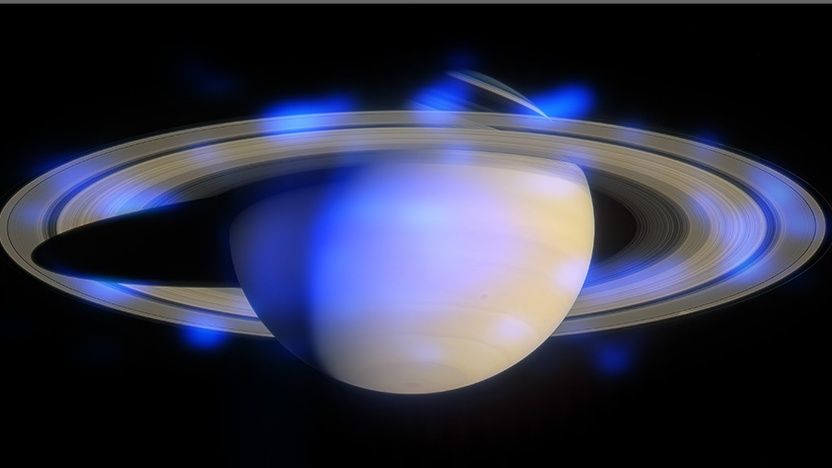
NASA’s Chandra X-ray Observatory has transformed new telescope views of Jupiter, Saturn and Uranus from this month’s “planetary parade” into striking soundscapes — capturing everything from Jupiter’s crackling auroras to the sweeping arc of Saturn’s rings.
Sonification is the process of converting data into sound by mapping brightness, position and energy to pitch, volume and instrument choice. The process begins with real data collected by Chandra, which detects high-energy radiation produced when solar X-rays are reflected by planets, moons and other bodies in the solar system. Those observations are then combined with imagery from other observatories, including the Hubble Space Telescope and past planetary missions, to build a fuller, multiwavelength portrait.
A digital “activation line” then sweeps across the image. As it encounters bright auroras, planetary disks or rings, the data values are translated into sound. Brighter X-ray emissions may become higher or louder notes, while vertical position can shift pitch and stereo placement.

“Sonifications expand options for people to explore what telescopes discover in space, an example of NASA’s ongoing commitment to share its data as widely as possible,” officials said in the statement.
In Jupiter’s sonification, shimmering, wind-like tones evoke the giant planet’s powerful X-ray auroras, while deeper notes roll underneath like distant thunder, reflecting the turbulence of its striped atmosphere and cloud layers. Saturn’s rings sweep in rising and falling siren-like tones, while deep bass notes represent the planet itself. Uranus unfolds more subtly, with gentler, cello sounds that trace the icy planet’s arcing ring, mirroring its cooler, more subdued presence at the edge of the planetary lineup.
Previous sonifications have drawn on observations of the Milky Way, distant galaxies, stars, supernovae, nebulae and black holes. One example, based on the famous black hole in Messier 87, translates its powerful jets into sweeping changes in pitch and intensity, followed by lower, sustained tones representing vast clouds of hot gas, with brief, bell-like notes marking individual stars.
Just as astronomers assign visible colors to otherwise invisible wavelengths to make images comprehensible, sonification gives numerical data distinct sonic qualities. Mapping the planets’ crackle, sweep and hum into different tones brings the solar system to life through both sight and sound.