

Russian opposition leader Alexei Navalny was killed by the Russian state, the Foreign Office has revealed.
Navalny’s death was the result of poison from a South American dart frog toxin called epibatidine.
The politician died aged 47 while in a remote Arctic penal colony two years ago. His death was announced by the Russian state on February 16, 2024.
The toxin is said to be 200 times stronger than morphine and is used by some indigenous tribes in South America in darts or blowguns during hunts. The toxin attacks nerves, causing numbness and paralysis.
In a statement released by the Foreign Office in conjunction with other European nations, a spokesperson said: ‘The UK, Sweden, France, Germany and The Netherlands are confident that Alexei Navalny was poisoned with a lethal toxin.
‘This is the conclusion of our Governments based on analyses of samples from Alexei Navalny. These analyses have conclusively confirmed the presence of epibatidine.
‘Epibatidine is a toxin found in poison dart frogs in South America. It is not found naturally in Russia.
‘Russia claimed that Navalny died of natural causes. But given the toxicity of epibatidine and reported symptoms, poisoning was highly likely the cause of his death. Navalny died while held in prison, meaning Russia had the means, motive and opportunity to administer this poison to him.

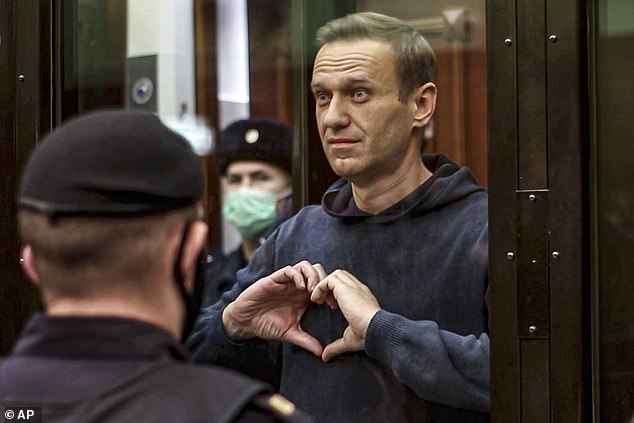
Russian opposition leader Alexei Navalny makes a heart with his hands as he appears in court in Moscow on February 2, 2021

Yulia Navalnaya, widow of Navalny, is seen in St Mary’s Church in Berlin after lighting a candle on what would have been her husband’s birthday in June 2024

Navalny is pictured with his wife after a rally in Moscow, Russia, in September 2013

Yulia Navalnaya attends the 2024 Munich Security Conference on the day Russia announced her husband’s death

Navalny’s death while in Russian detention was announced on February 16, 2024

Russian opposition leader Alexei Navalny’s parents Anatoly and Lyudmila, accompanied by Alla Abrosimova, who is the mother of Navalny’ widow Yulia Navalnaya, come to Navalny’s grave to mark the first anniversary of his death at a cemetery in Moscow in February 2025

Navalny takes part in a march at Strastnoy Boulevard in memory of Russian politician and opposition leader Boris Nemtsov in 2019
‘Russia’s repeated disregard for international law and the Chemical Weapons Convention is clear.
‘In August 2020 the UK, Sweden, France, Germany, The Netherlands and partners condemned Russia’s use of novichok to poison Alexei Navalny.
‘This followed Russia’s use of novichok in Salisbury in 2018, which led to the tragic death of a British woman, Dawn Sturgess.
‘In both cases, only the Russian state had the combined means, motive and disregard for international law to carry out the attacks.
‘These latest findings once again underline the need to hold Russia accountable for its repeated violations of the Chemical Weapons Convention and, in this instance, the Biological and Toxin Weapons Convention.
‘Our Permanent Representatives to the Organisation for the Prohibition of Chemical Weapons have written today to the Director General to inform him of this Russian breach of the Chemical Weapons Convention.
‘We are further concerned that Russia did not destroy all of its chemical weapons.
‘We and our partners will make use of all policy levers at our disposal to continue to hold Russia to account.’
This is a breaking news story and is being updated.