

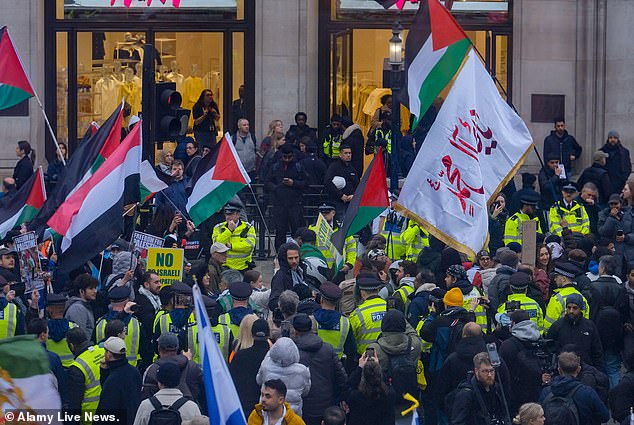
The Home Secretary last night caved in to demands to ban a pro-Iranian rally in London this weekend.
As a Labour minister said the Al Quds ‘hate’ march had no place in British society, 100 MPs and peers told Shabana Mahmood that it would provide a platform for intimidation and extremism.
The Home Office said it had approved Scotland Yard’s request to halt the ‘uniquely contentious’ march.
Ms Mahmood said: ‘I am satisfied doing so is necessary to prevent serious public disorder, due to the scale of the protest and multiple counter-protests, in the context of the ongoing conflict in the Middle East.
‘Should a stationary demonstration proceed, the police will be able to apply strict conditions.
‘I expect to see the full force of the law applied to anyone spreading hatred and division instead of exercising their right to peaceful protest.’
Met Police Assistant Commissioner Ade Adelekan said: ‘The Al Quds march is uniquely contentious having originated in Iran and in London is organised by the Islamic Human Rights Commission, an organisation supportive of the Iranian regime.
‘The threshold to ban a protest is high and we do not take this decision lightly; this is the first time we have used this power since 2012.’

The Home Secretary last night caved in to demands to ban a pro-Iranian rally in London this weekend. Pictured: last year’s rally from Marble Arch to the BBC in Portland Place

Home Secretary Shabana Mahmood said she had approved Scotland Yard’s request to halt the ‘uniquely contentious’ march
He added: ‘But in our assessment this march raises unique risks and challenges. We must consider the likely high numbers of protesters and counter-protesters coming together and the extreme tensions between different factions.
‘We have taken into consideration the likely impact on protests of the volatile situation in the Middle East, with the Iranian regime attacking British allies and military bases overseas.’
It came after Sarah Sackman yesterday became the first minister to call for action against the annual march on Sunday.
Shortly afterwards, the Prime Minister’s chief secretary, Darren Jones, hinted that restrictions could be placed on the rally.
Organisers from the Islamic Human Rights Commission (IHRC) have described Iran’s assassinated Supreme Leader, Ayatollah Ali Khamenei, as a martyr and a ‘rare role model’ following his death in US-Israeli strikes.
Marchers have previously called for Israel to be ‘wiped off the map’ while carrying the flags of Iranian-backed terror group Hezbollah.
The demonstration is held every year during Ramadan and named after the Arabic name for Jerusalem. But given the situation in the Middle East, it is feared it poses a higher-than-usual risk this year.
Courts minister Ms Sackman said: ‘Those expressing support for the malign regime in Iran and the IRGC (Islamic Revolutionary Guard Corps) and its proxies have no place in our society.’
She told LBC: ‘They shouldn’t be on the streets of London calling for hate and hostility against this country.
‘That’s thoroughly anti-British and I expect the police and the Home Secretary to take the necessary action…’
Ms Sackman, a barrister and MP for Finchley and Golders Green, which has a large Jewish population, told Times Radio: ‘This sort of thing has no place in our society.’
Shadow home affairs minister Alicia Kearns added: ‘It would be an enormous insult to our brave Armed Forces if the very people currently attacking them were being celebrated here on our streets.’
There are likely to be counter-protests from activists opposed to the Iranian regime, including from Stop The Hate, set up to combat anti-Semitism during pro-Palestine marches.
Scotland Yard does not have the power to ban a protest but asked Ms Mahmood to intervene.
A source said it was possible that demonstrators could be prevented from marching but permitted to stage a static protest outside the Home Office, which is the group’s intended meeting point.
But the Met last night made it clear that it will ‘place strict conditions on any static assembly’.
Join the debate
Should protests be restricted if they risk promoting extremism?

The march is held in the capital each year during Ramadan and was established in 1979 following the Iranian revolution
Mr Adelekan added: ‘Given the tensions, we have to accept that confrontations could still take place.’
A cross-party group of MPs has already written to the Home Secretary to say the march will legitimise Iran’s agenda and send an ‘unmistakably troubling message’.
Demonstrators at last year’s rally chanted ‘Zionism has to fall’.
Among those who signed the letter are Labour peers Baroness Hodge of Barking and Lord Mendelsohn, Labour MP Luke Akehurst, former anti-extremism tsar Lord Walney and Reform UK leader Nigel Farage.
They said that allowing the march to go ahead would weaken Britain’s credibility internationally and undermine domestic cohesion.
The IHRC said the event ‘offers a platform for all those who stand for justice against colonialism, oppression and apartheid to come together’.