

Australia is probably right to resist Donald Trump’s pressure to send warships to the Strait of Hormuz.
But we need to be mindful of the law of unintended consequences when it comes to dealing with someone like the US President.
Labor has already drawn a line between helping protect Australians and Gulf partners from attack and joining offensive operations against Iran. Our air force deployments so far have been framed as defensive support for Gulf airspace.
It’s one thing to help shield civilians and Australian nationals in a dangerous theatre. It’s another thing entirely to let ourselves be dragged, by alliance habit or presidential bluster, into an open-ended regional conflict with no clear Australian objective.
Australia does have an interest in keeping the Strait of Hormuz open. Any serious disruption there can push up fuel costs here and hit global supply chains that Australia depends on.
But having an economic interest in free passage isn’t the same as having a strategic interest in joining a US-led naval operation in the middle of an escalating conflict.
The real problem isn’t that Australia has said no. It’s that Trump has made it clear he thinks alliances are transactional and conditional.
In lashing out at countries that refused to help reopen the strait, Trump said he has long regarded NATO as ‘a one-way street’, adding ‘we will protect them, but they will do nothing for us, in particular, in a time of need’.

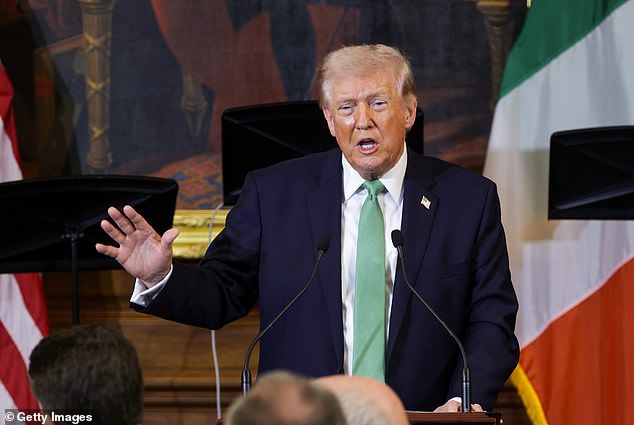
Donald Trump (pictured at the US Capitol on Tuesday) turned on allies including Australia after he claimed they rejected his plea for help in the Strait of Hormuz

Trump also complained that allies were making a ‘very foolish mistake’ and the US would remember who declined to help (picured, smoke rises after an airstrike on Tehran)
Trump also complained allies were making a ‘very foolish mistake’ and the US would remember who declined to help. That’s not a minor outburst. It’s a threat that might carry real risks for Australia.
The opposition appears to be as uninterested in letting Trump push us around as Labor is.
Andrew Hastie described Trump’s broadside as ‘petulant’, adding that ‘you don’t treat allies like that’.
The issue now is whether the US under Trump still sees alliances as enduring strategic commitments.
Hopefully his comments are little more than an outburst without lasting consequences because the US is the core of our defence posture.
The ANZUS treaty underpins the alliance, binding Australia and the US to consult on mutual threats and act to meet common dangers.
It’s not a cast-iron guarantee that automatically triggers whenever the US goes to war, but it is the insurance policy around which Australia’s defence planning has been built.
So, Trump’s rhetoric can’t just be shrugged off as another tantrum, or at least not without a few sweat beads forming on the foreheads of our decision makers.

Once alliance commitments are openly framed as payback for participation in unrelated conflicts, every Australian government has a harder problem to solve

Albanese has said the US is still on board with the AUKUS deal, but we know there is no plan B in place if they pull out
Even if no reprisal comes this week, the precedent risks becoming corrosive. Once alliance commitments are openly framed as payback for participation in unrelated conflicts, every Australian government has a harder problem to solve.
A middle power can survive disagreements with an ally, but it’s much harder to live with an ally that treats every disagreement as disloyalty. Trump’s comments matter because they inject doubt into the alliance.
And what about the AUKUS subs deal? Albo assures us that the US is still on board, but we know there is no plan B in place if they pull out.
If Trump decides tomorrow that allies who don’t join his wars should wait longer for submarines and generally get fewer favours, Australia might quickly discover how little leverage comes from being strategically dependent.
There is also an irony behind Australia’s refusal to help.
While Trump is asking for allied naval assistance, the Royal Australian Navy is busily preparing its 125th anniversary fleet review on Sydney Harbour for this Saturday, with up to 30 ships from 19 countries providing a display of international sea power.
While our fleet might be capable of participating in such events, there are genuine question marks over just how ready it is for major deployments.
Perhaps we are incapable of providing Trump with the kind of assistance he needs, even if the government wished to do so?
While Australia is probably right to say no to Trump’s request, it would be a mistake to assume that the saga ends here. Hoping that it does isn’t much of a strategy in a dangerous world.