



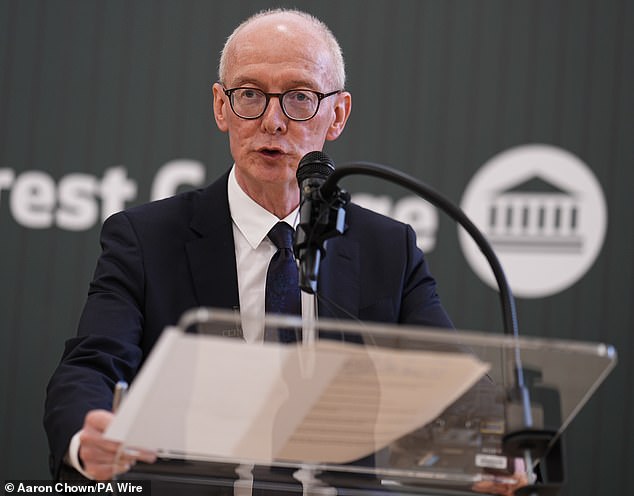
Labour MPs were today urged to support ‘radical’ reforms to turn Britain’s welfare state into a ‘working state’ amid growing alarm at the UK’s ballooning benefits bill.
Pat McFadden, the Work and Pensions Secretary, told his party it is ‘not just here to keep things ticking over’ following its 2024 general election victory.
‘I want us to use our time in office well, we’re not here just to keep things ticking over,’ he said in a speech in east London.
‘We won on a platform of change, and changing the welfare state to a working state is a change the country needs.’
A backbench Labour rebellion last year forced Prime Minister Sir Keir Starmer and Chancellor Rachel Reeves to abandon plans for £5billion in welfare cuts.
But, speaking on Monday, Mr McFadden signalled the Government will return for another battle with its MPs and won’t give up efforts to overhaul the benefits system.
The Work and Pensions Secretary said he had told Alan Milburn and Stephen Timms, who have both been tasked with major reviews of welfare spending, to ‘take this chance to advocate radical and powerful change’.
Mr McFadden added benefits reform ‘should be about opportunity and work’ and said his approach to the welfare system would be to put ‘work at its heart’.
He insisted that many of those currently on sickness and disability benefits ‘want to work with the right support’ but added ‘the state found it too easy to sign people off’.

Pat McFadden, the Work and Pensions Secretary, told Labour MPs they are ‘not just here to keep things ticking over’ following their 2024 general election victory

Mr McFadden signalled the Government will return for another battle with its MPs and won’t give up efforts to overhaul the benefits system
Recent forecasts by the Office for Budget Responsibility showed the cost of sickness and disability benefits is set to rise to £110billion a year by the start of the next decade.
Meanwhile, Department for Work and Pensions data has revealed that nine in ten people on health-related Universal Credit since the Covid crisis and who are not required to look for work say they have a mental or behavioural disorder.
Mr McFadden suggested that getting people into work ‘can improve their mental health’ and ‘improve their confidence’.
He also said the country faced a ‘generational challenge’ in trying to reverse the growing number of young people who are not in education, employment or training, known as ‘Neets’.
As part of £1billion in funding aimed at tackling worklessness, Mr McFadden announced a new ‘youth jobs grant’.
Through this scheme, businesses will receive £3,000 for every young person they hire between the ages of 18 and 24 who has been searching for a job for six months or more.
Some 60,000 people are expected to be supported by the proposals.
He also announced a new apprenticeship incentive, under which small and medium-sized businesses will be paid £2,000 for every new employee between 16 and 24-years-old they take on.
The Government also plans to expand its existing jobs guarantee from the current age range of 18 to 21, to those up to 24-years-old.
The scheme offers young people a guaranteed six-month job if they are on Universal Credit and have been looking for a job for 18 months.
The share of 16 to 24-year-olds not in education, employment or training who reported a work-limiting condition has surged by 70 per cent in a decade.
The trend is potentially putting this generation ‘at even greater risk of harm to their future opportunities’, the Health Foundation said.
Research by the think tank found that between 2015 and 2025, the share of Neet young people who reported conditions that stop them from working increased from 26 per cent to 44 per cent.
Last year, mental health problems and autism made up more than two-thirds of Neet youngsters who cited health issues as a barrier to employment.
According to the Office for National Statistics , the number of Neets aged 16 to 24 was 957,000 in the three months to December up from 946,000 in the previous quarter.
Labour has been blamed for fuelling youth unemployment through Ms Reeves’ £25billion raid on National Insurance, increases in the minimum wage and the introduction of a wave of new employment rights, which have discouraged firms from taking on young staff.
Senior Tory MP Helen Whately, the shadow work and pensions secretary, said: ‘The best way to tackle youth unemployment is to back businesses to create jobs, not tax them out of existence to fund benefits and subsidies.
‘That’s why Conservatives will cut business rates for thousands of high street businesses and roll back Labour’s Employment Rights Act.
‘That’s the way to create real opportunities for young people and get Britain working again.’