


Repeated institutional failings may have left a paranoid schizophrenic free to kill three people during a violence knife rampage, an inquiry was told today.
Mentally ill Valdo Calocane slaughtered fellow university students Barnaby Webber and Grace O’Malley-Kumar, both 19, and 65-year-old Ian Coates in a random stabbing spree in Nottingham in June 2023.
Three pedestrians were also seriously hurt when Calocane stole Mr Coates’ van and drove it at members of the public before he was stopped by police.
He had a long history of contact with NHS mental health services and is serving an indefinite hospital order after admitting manslaughter with diminished responsibility.
An inquiry starting today will explore 34-year-old Calocane’s history of violence, and worrying behaviour.
This includes visiting MI5 headquarters demanding to speak with officials, and bringing a hammer to a hospital ward – as well as concerns he was not taking medication properly after being sectioned multiple times.
His behaviour was so troubling that a doctor warned in July 2020 that Calocane ‘will end up killing someone’, yet he was dischagred two weeks later.
The victims’ families said they want the inquiry to hold individuals and institutions to account, saying: ‘We want it to expose systemic neglect with a thorough examination of the missed opportunities by mental health services, law enforcement, and judicial bodies.’

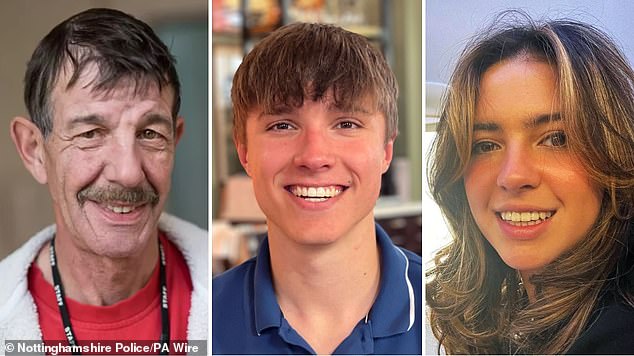
The three people killed by a mentally ill man in Nottingham in 2023 are: (left to right) Ian Coates, Barnaby Webber and Grace O’Malley-Kumar

Valdo Calocane has been handed an indefinite hospital order for the killing spree
In her opening statement, inquiry chairman senior retired judge Deborah Taylor sitting in London said the probe will ‘examine what could and should have been done, and the effects of key actions, omissions and decisions’.
She added: ‘Words of condolence, sympathy and apology can be given substance by commitment to establishing the detailed facts and bringing clarity to what happened and how it may be prevented from happening again.
‘It’s therefore important that all recognise that the engine of change is powered by frankness, by reflection, rather than deflection, by insight and by acceptance of both personal and collective responsibility where required.’
In her opening remarks, Rachel Langdale KC, counsel to the inquiry, suggested some ‘key themes emerge from these investigations and reports’, and said ‘whether described currently as learning points, failings or criticisms, they provide a baseline critiqie upon which we will build’.
She said: ‘The approach to risk assessment, the dynamic nature of risk and the need to have a clear and accurate history are all key themes.
‘When should the risk (Calocane) presented in the community have been recognised and what should have been done about it? Was there any attempt to reduce the risk?’
She outlined multiple occasions where police were involved after Calocane became violent – this included leaving a woman with a major back injury after she leapt from a first floor window to escape him.
Five students also moved out of their houseshare after becoming so concerned about Calocane’s violent unpredictability, the inquiry heard. But he never faced conviction until he struck in 2023.

Ms O’Malley-Kumar was just 19 when she was killed

Mr Webber, also 19, was a fellow university student

School caretaker Mr Coates, 65, was brutally killed by Calocane
Calocane’s mother repeatedly flagged her own concerns about her son’s behaviour, and he was sectioned four times.
The inquiry heard on one occasion a team of medical professionals ‘considered the research evidence that shows over-representation of young black males in detention’ and decided to release him back into the community.
Calocane failed to attend meetings as his mental state fluctuated.
And Ms Langdale suggested there was an ‘astonishing failure of information sharing’ where the University of Nottingham were unaware the medical reason Masters student Calocane had been absent for months.
The actions of prosecutors, police staff and medical professionals will be scrutinised by the statutory public inquiry.
Ms Langdale described how Calocane was waiting in the shadows to ambush Mr Webber and Ms O’Malley-Kumar on the night he struck, going equipped to the scene with a Boker dagger, a Gerber survival knife, a large pointed knife and a mental scaffolding pole.
He later called his brother, saying: ‘This will be the last time we speak’.
Calocane was sentenced to an indefinite hospital order in January 2024 after admitting manslaughter by diminished responsibility and three counts of attempted murder – something which has been widely criticised by the victims’ families.

Calocane, pictured here as a child, may never be released
The Independent Office for Police Conduct (IOPC) previously prepared a report which concluded that officers failed to properly investigate an assault on warehouse workers by Calocane which could have stopped his killing spree a month later.
An NHS review last year found Calocane was not forced to take long-lasting antipsychotic medication before his rampage because he was scared of needles.
When the inquiry was announced, the Ministry of Justice said the management of Calocane’s risk to others in the lead-up to the attacks and public servants accessing information without authorisation will form part of the inquiry.
Speaking before the start of the inquiry, Mr Webber’s mother Emma Webber told reporters: ‘We’ve seen reviews, we’ve read reports – none of which have served their purpose. Virtually all of which are useless.
‘Apologies do not keep the public safe, but change does. This inquiry must not become a procedural exercise.’
And in a statement ahead of the inquiry this morning, the families of Mr Webber, Ms O’Malley-Kumar and Mr Coates said: ‘This inquiry represents a critical turning point in our pursuit of truth and justice.
‘For too long, we have been met with failure and silence.
‘This inquiry is not just about looking back; it is about holding those who neglected their jobs to account.
‘We will no longer accept the institutional shielding of individuals who failed our loved ones.’
The statement continued: ‘We hope that it brings individual and institutional accountability, holding to account not just the organisations that failed in their duty of care, but the specific individuals whose decisions allowed these events to unfold.
‘We want it to expose systemic neglect with a thorough examination of the missed opportunities by mental health services, law enforcement, and judicial bodies.
‘Finally, we want it to address what we view as a miscarriage of justice with Calocane being sentenced to a hospital order.
‘We want to challenge the legal framework and decision making which we feel led to an enormous miscarriage of justice that could see the killer of our loved ones released in as little as a few years.’
The inquiry is expected to hear from more than 100 witnesses and will run for four months, with the final report back in May next year.
The chairman said Calocane would be referred to throughout by his initials, VC.