


Newcastle United chief executive David Hopkinson and chief financial officer Simon Capper have presented the club’s latest accounts showing a record turnover of £335.3million, an increase of £15m on 2023-24.
The pair met with journalists at St James’ Park and, during a bombshell briefing, it was revealed that the stadium has been sold to a subsidiary company controlled by the club’s ownership.
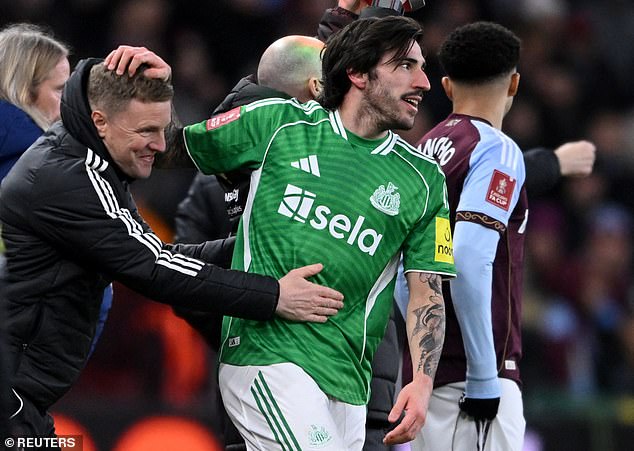
But the biggest news to emerge is that the future of Eddie Howe is uncertain, as is that of star players such as Sandro Tonali.
Our chief football reporter CRAIG HOPE was in the room, and here he brings you the headlines and breaks down exactly what all of it means on a hugely significant day inside St James’…

The biggest news to emerge from David Hopkinson and Simon Capper’s bombshell briefing is that the future of Eddie Howe is uncertain, as is that of star players such as Sandro Tonali

Hopkinson met with journalists at St James’ Park – here we reveal the truth behind the headlines
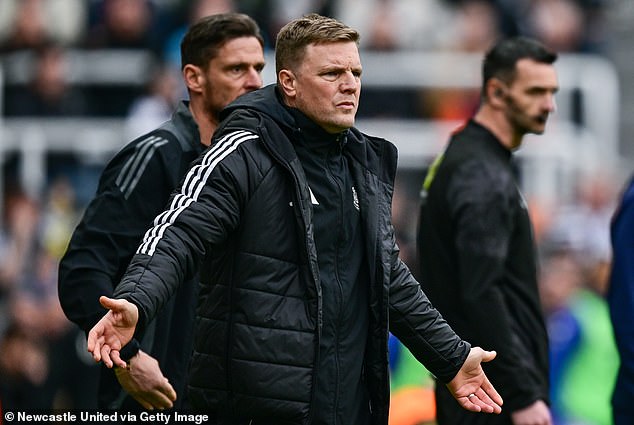
Eddie Howe’s future in doubt
CONTEXT: Newcastle were beaten 2-1 by Sunderland last time out and, post match, Howe and his players were booed by some supporters inside St James’. The result left the team 12th in the Premier League and, inevitably, there was an angry backlash. It has led to debate over Howe’s future on Tyneside and beyond.
QUESTION: Do you have an update on Eddie’s Howe future?
HOPKINSON: ‘I don’t have a stance on his future. What I can tell you is that the derby loss hurt. We take it seriously. There’s nothing within us that thinks, “Well, it’s just three points and on we go”. It has resonated. I spent a couple of hours in a one-on-one lunch recently with Eddie and we talked through a multitude of things, including that.
‘Eddie’s our manager. I expect to have a great run to the end of the season here and we’ll talk about the future when it’s time. Right now, we’re focused on this season’s competition.’
Q: Can you clarify your comments about the manager, as it seemed you were leaving it open, saying his future will be assessed in the summer?
‘I would not frame it that way. We are not looking to make a change at the moment. We are not having those conversations. We are still in the midst of the season. Right now we are focused on the seven matches we have remaining and not distracting ourselves with speculation about what we may or may not do in the summer. Right now, all of us have only got so much bandwidth and we are focused on this season and finishing strongly.’
Q: What does the summer look like? Is there capacity to make 4/5 top signings to take club where it wants to be?
HOPKINSON: ‘First off, we’ve got seven matches to go and we don’t know in which regulatory regime we are going to be operating. If the season ended today, we’d be outside European competition, although that is not our ambition.
‘We have two directions of planning. Two scenarios with a multitude of strategies that follow either scenario. What I can tell you is that Ross Wilson (sporting director), Simon, Eddie and myself, everybody who is attached, is working through what our strategy is this summer in either scenario. We all agree we need to be prepared for either scenario, deeply and extensively now, as opposed to waiting to see which scenario we are in.’

There is now doubt over manager Eddie Howe’s long-term future at Newcastle United
HOPE ANALYSIS: In September, Hopkinson called Howe the club’s ‘Bruce Springsteen’ and said it was his job to give the head coach all he needed to succeed. The fact the CEO was not as forthright this time leaves his comments open to misinterpretation.
What I can tell you is that this was not, ‘Howe has seven games to save his job’. All of my information remains that there is support for Howe among the hierarchy inside St James’. However, there is doubt over his long-term future. Should the club miss out on Champions League qualification, as looks likely, the ability to invest and reshape the squad will be dependent on at least one big sale, if not more. Naturally, this has led to some uncertainty over the direction of travel on and off the pitch.
Howe sees this season as an end-of-cycle moment and wants to go again with a rebuild – he loves the club and the area – but discussions over how the summer looks and what scope there is to spend on transfers and wages will continue. While so much is uncertain, Howe’s future is part of that – and only at the end of the season will all parties sit down to determine the best way forward.
For me, Newcastle have to find a way of sticking to what Hopkinson vowed in the autumn – and that is giving Howe what he needs to succeed. He has been the overriding reason for the club’s journey from 19th to the Champions League (twice) and the lifting of a first domestic trophy in 70 years (last season’s Carabao Cup).
Tonali and other top stars could be sold this summer
CONTEXT: Newcastle sold Alexander Isak for a British record £125m to Liverpool last summer. This time around, Sandro Tonali is wanted by Manchester United and others, while Anthony Gordon and Tino Livramento have also been linked with moves away.
Q: There was a stigma (historically) of Newcastle being a selling club. It then went to a buying club. Is it now a trading club?
HOPKINSON: ‘Going forward, our strategy is to buy well and sell well. Buying well does not necessarily mean spending the most money. It means working in the market place for the players that generate the most value for this club rather than the fee paid for them. So there are a multitude of strategies we need to employ, including developing our own, looking for opportunities in the market place and making sure we are maximising our opportunity within the available price we can produce.’
Q: Does this mean extracting maximum price when selling a player?
HOPKINSON: ‘It absolutely does.’
Q: In hindsight, was Alexander Isak a good sale?
HOPKINSON: ‘To me, Isak was a good sale.’
Q: If players like Tonali come to your door and want to leave, what do you do?
HOPKINSON: ‘We haven’t got an overall strategy with regards players out, necessarily. We think through what players might or might not want to do this summer. But if an Isak-like scenario presents itself again, any player under contract is going to leave on our terms and we’re going to maximise the opportunity that might represent for the club. Players that leave this club will need to do so on our terms.’
Q: Can you make a box office signing this summer?
HOPKINSON: ‘We can do that. But we might not be able to do that without selling somebody.’
Q: Does Eddie Howe need to make Nick Woltemade and Yoane Wissa work because of spending rules, as they could only, realistically, be sold at a big loss?
HOPKINSON: ‘I go back to the analogy of a house, every asset, every multi-million player has a value. We will need to look for any opportunity to extract maximum value from every player, whether that’s here or someplace else.’

Yoane Wissa (left) and Nick Woltemade have struggled to make an impact in their first season on Tyneside
Q: There’s a perception that Howe doesn’t want to part with players. Is he on board with the need to trade going forward?
HOPKINSON: ‘Eddie is experienced, thoughtful and understands squad cost management and the need to maximise our competitive opportunity. Eddie wants the exact same things we do and we have lots of good dialogue with him. What I can tell you is he is aligned and understands this.’
HOPE ANALYSIS: Let’s start with the second-to-last answer, in which Hopkinson had earlier spoken to us about even your own home having a number at which you would sell, regardless of sentimental attachment. That clearly translates to – every player has a price. And, in a new world of the Premier League’s Squad Cost Ratio and UEFA’s spending rules, this should not be a surprise. If Man United offer £100m for Tonali, for example, I think he would be sold. Gordon and Livramento and others will also be the subject of interest. This leaves a very uncertain picture for Howe and the hierarchy to consider.
But the message from this briefing was clear – Newcastle have to trade to get ahead of spending rules. Also, it is my understanding that the £250m spent on players last summer means a big sale is necessary to unlock spending this summer.
Hopkinson’s comments about ‘Isak being a good sale’ is sure to raise eyebrows with supporters and beyond. But he was speaking in the context of a player wanting to go and Newcastle extracting a British record fee – it was a pragmatic view and one the club should have taken last June, instead of playing cat and mouse with Liverpool until the final day of the window.
The main constraint on Newcastle going forward is UEFA’s 70 per cent equivalent of the Premier League’s Squad Cost Ratio, which operates at 85 per cent. If Newcastle are out of European competition next year, for example, why don’t they just spend to the max of the Premier League limit? Well, because this would leave them in a position where it would be almost impossible to comply with UEFA’s rules the following season.
In short, if Newcastle don’t make the Champions League and want to reshape the squad significantly, they will have to sell to buy.
Newcastle sell St James’ Park… to themselves!
CONTEXT: The 72-year lease on St James’ Park has been sold to a subsidiary company (PZ Holdings Ltd) under the control of the club’s owners – PIF and the Reuben brothers – for £172.1m and leased back to the club for what appears to be 50 years. The transaction has generated a profit of £129m and was valued at fair market rate by the Premier League.
Q: Was this an accountancy ploy to beat PSR and avoid a points deduction?
CAPPER: ‘The motivation was very much to reorganise our property assets and get them into the correct legal boxes to allow us to go forward with our potential development, either at St James’ Park or for a new stadium, and to facilitate that with financing and other similar items. There may be more similar transactions to come in the future, depending on what we end up doing.
‘But the profit calculation that had to be done is then a consequence of the detail of the accounting rules that the Premier League require us to follow in doing any transaction with a company that is associated with us. So it does create a very significant accounting profit because of that.’

Newcastle’s 72-year lease on St James’ Park has been sold to a subsidiary company
Q: Does this give you a transfer war-chest, then? What does it give you re player investment?
CAPPER: ‘Because of the consequence of the profit calculated on the sale, it gives us a significant amount of PSR headroom. The ability to deploy that PSR headroom is very limited because we have to comply with UEFA rules and because the PSR regime is coming to an end, so that profit does not roll forward into squad cost. In a very narrow window, yes (it gives us more scope to spend on players), but we are very constrained in how we can use that.’
HOPE ANALYSIS: This, you will recognise, is an accounting trick previously used by the likes of Chelsea. It has generated huge PSR headroom for the club, so why don’t they use it? The problem is that PSR is changing to SCR, while UEFA’s rules disallow such transactions, so going forward this does not really impact on transfer/wages outlay.
Why have they done it, then? The club say it is common practice to set up such a company to act as a means of holding funds for infrastructural work, such as a St James’ renovation or new stadium.
What they will not comment on either way is whether it helped them comply with PSR this year. I suspect it did help with the calculation, especially as the club are still carrying a lot of debt from 2023, and this in turn helped avoid a points deduction.
Without the stadium sale in the latest set of accounts, for 2024/25, they would have recorded a loss of £99m.
When the club really should have sold St James’ to themselves was in 2023/24, the season after which they were forced to sell Elliot Anderson and Yankuba Minteh to get by PSR.
So while this news may excite some fans, it does not release vast sums for summer investment.
Newcastle have no added benefit selling to Saudi clubs, unlike rivals
CONTEXT: Newcastle have only sold one player, Allan Saint-Maximin, to a PIF-owned Saudi club since the 2021 takeover. It has raised the question as to why they have not done it more, given the need at various times to sell players.
Q: Do UEFA rules on associated-party player sales stop you doing business with Saudi clubs?
CAPPER: It doesn’t stop us doing business. What it means is if we make a profit, it doesn’t count. We sell a player that’s worth a pound for £10million and make a profit of £9.999million in the Premier League but make a profit of zero in UEFA. We just don’t get a profit.

Newcastle would see no benefit of selling a player like Kieran Trippier to Saudi Arabia
Q: But other clubs benefit from doing business with Saudi?
CAPPER: This is some frustration for us. Our competitors can sell a player to a Saudi club for massive profit and bank that for their various compliance calculations.
HOPE ANALYSIS: This is useful in explaining why Newcastle don’t sell, for example, Kieran Trippier to a Saudi club for £50m. If Trippier is valued at £10m, that £40m profit counts for nothing in the calculations of financial rules. The frustration is understandable, given rivals have benefited from this.
But I would argue it’s then on PIF to find other ways to help Newcastle. Have they done enough to push back on spending boundaries? Not when you look at sponsorship opportunities that have not been pursued, plus the ongoing failure to update on a new training ground or stadium.
Hopkinson doubles down on 2030 ‘best in the world’ vision
CONTEXT: David Hopkinson stated last year that Newcastle want to be among the conversation as the best club in the world by 2030.
Q: You’ve got to double revenue in four years to get close to the 2030 vision, how are you going to do it? Is that realistic?
HOPKINSON: ‘First off, the size of the challenge you’ve under-scoped, because those other clubs are also going to be moving forward too. When I think about our competitors, they are formidable and they have already got a head-start on us. But all they’ve got is a head-start and we’ve got a tremendous opportunity for growth right in front of us.
‘I look at the commercial opportunity and we have significant headroom to catch up. It means we’ve got to work harder, we’ve got to work smarter with high conviction and energy every single day to capture that headroom. We’ve got to catch these guys, and by the way they are on the racecourse too.
‘We can debate how long that is going to take, but I think we can get there quickly into a group that is competing for those top prizes.’

For all Newcastle’s progress, there is still a major gap to Europe’s truly elite clubs
HOPE ANALYSIS: I admire and applaud Hopkinson’s ambition and his drive in making his vision a reality – we’d soon criticise if he was not trying to make Newcastle one of the world’s best. But, looking at the current landscape re financial restrictions, the absence of a training ground or new stadium and the continuing growth of their rivals, the 2030 deadline seems unrealistic. This, in turn, could create an issue around expectation for those on the playing side.
What needs to happen at Newcastle is less words and more action. Build a training ground. Announce a new stadium or St James’ redevelopment. Bring in some big sponsors. Show more engagement and presence from the ownership. All of these are worth far more than statements of intent, as much as Hopkinson is well intended and recognises the need to change the culture inside the club.
No updates on stadium or training ground
CONTEXT: Hopkinson was asked for updates on a new training ground and stadium and replied to both by saying, ‘We are not in a position to announce today’. He did say the training ground was closer, though, and also stressed that work was ongoing daily on both projects.
HOPE ANALYSIS: I don’t understand why, approaching five years into their ownership, PIF have made no tangible progress on either project, especially as infrastructural investment falls outside of PSR.
The training ground, especially, would be such a huge difference-maker when it comes to attracting and retaining players. An announcement is close on a site for this development in Woolsington, near Newcastle Airport, but getting this into the public domain before the summer would certainly help with the optics around the club.
Not least because all of the above within this article, and the fallout from it, does not paint a picture of a club ready and able to challenge at the very top.