



Fury is mounting today over the state of the Royal Navy after the Senior Service suffered the humiliation of potentially having the French do its job for them in Cyprus.
Fresh concerns have been raised at the state of the UK’s warship and submarine fleet in the wake of an Iranian attack on RAF Akrotiri.
The Cypriot president yesterday appealed to Paris for help protecting the island after the base in the Eastern Mediterranean was successfully hit by a drone fired from Lebanon late on Sunday.
President Macron responded by pledging to send two frigates and other assets, to add to the Charles De Gaulle aircraft carrier strike group which has been redeployed to the region (but which will take some time to arrive).
Greece also agreed to send warships and Cyprus even asked the Germans for naval assistance.
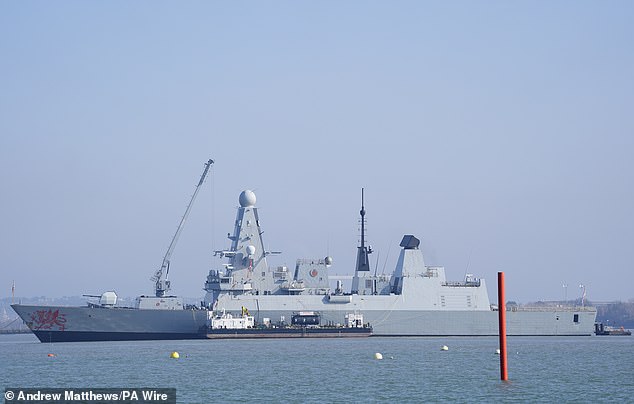
The humiliation of having to rely on other countries to provide sea-borne protection eventually sparked Keir Starmer and Navy commanders into life and they hastily announced last night that HMS Dragon, a Type 45 air defence destroyer will be sent to the eastern Mediterranean.
She was pictured today loading up with ammunition in Portsmouth. But it will take more than a week to get there, prompting questions as to why, with Donald Trump spending weeks sabre-rattling against Iran before launching attacks at the weekend, was there no ship in the area already.
The well connected Naval Lookout website reports that Navy commanders offered to send a ship out to Cyprus in readiness for possible attacks, but that ministers decided to go ahead with planned Nato exercises off Northern Europe instead.
The row prompted a major clash between Keir Starmer and Kemi Badenoch at Prime Minister’s Questions today.
And former head of the Royal Navy, Admiral Lord West told the Mail ‘Nelson will be spinning in his grave’, adding: ‘When I was First Sea Lord, I tended to send warships towards the sound of the guns.’

HMS Dragon, a Type 45 air defence destroyer will be sent to the eastern Mediterranean. She was pictured today loading up with ammunition in Portsmouth
Today he said the Royal Navy is ‘too small’ and has ‘not been looked after properly’.
‘The bottom line is the Navy’s in a more parlous state than at any stage in the 60 years I’ve been on the active list,’ he said.
‘It’s too small, it’s not been looked after properly, there’s been insufficient (funds) spent on it, and I’m afraid it doesn’t deliver what the nation needs.’
An unofficial list of Royal Navy readiness which has circulated online in the days since the attack suggests that of its major warship and submarine fleet just one is at sea.
The rest are in various naval bases, either having just returned from deployment, undergoing regular maintenance or having more major refits.
Of the six Type 45s the UK has, just three are able to put to sea. The other three are in various stages of repair in Portsmouth after a major issue was found that prevented their engines from working in warm seas.
Astonishingly, HMS Daring, the lead ship of the class, has been out of action for almost nine years.
Similarly, the UK’s two aircraft carriers Queen Elizabeth and Prince of Wales are both in dock undergoing repairs and maintenance. Queen Elizabeth has been out of action for almost 18 months.
Only two of the seven Type 23 frigates based in Plymouth are in a state to set sail.
Britain also has five Astute Class attack submarines, which would not help protect Cyprus but could launch pre-emptive cruise missile strikes at Iranian sites.
But of the five only HMS Anson is overseas, and it is in Australia on a PR visit that has been coupled with a maintenance period in Perth to promote the new AUKUS nuclear sub agreement.

Emmanuel Macron has ordered units to the eastern Mediterranean island after RAF Akrotiri was struck by a drone which pierced its air defences on Sunday

Queen Elizabeth has been out of action for almost 18 months and has been in dry dock in Scotland since last July
At the height of the Cold War, when the threat of a nuclear apocalypse sparked by Russia was at its worst, the Royal Navy had hundreds of warships.
In 1960, its vast fleet had eight aircraft carriers at its disposal and could call upon 156 frigates and destroyers.
By the early 1980s, however, this number had almost halved and the end of the Cold War saw a new wave of cuts as politicians envisioned a new period of peace that failed to materialise.
Now, there are just two aircraft carriers – both of which have been bedevilled by breakdowns – six one-billion-pound-a-piece Type 45 destroyers and a handful of ageing frigates and patrol ships.
But Labour and the Conservatives have to shoulder blame for cuts, with governments of both parties making cutbacks over the decades since the end of the Second World War.
Sir Keir Starmer and Kemi Badenoch clashed on the issue at Prime Minister’s Questions today.
Conservative leader Kemi Badenoch told the Commons that Labour’s priorities ‘are all wrong’, saying: ‘He says that we are pre-deploying – the one ship which we are sending, HMS Dragon, is still in Portsmouth. The fact is the Type 45 cannot take out incoming missiles. This is not enough.
‘He’s read out a long list but the people who understand know it is not enough – he should be doing more.’

Sir Keir posted a statement on X this afternoon
Turning to the spring forecast statement which Chancellor Rachel Reeves made on Tuesday, Mrs Badenoch continued: ‘Yesterday, the Chancellor could have given more money to defence. Instead, she gave more money for welfare. Their priorities are all wrong.’
She asked: ‘Why is he leaving the job of funding our armed forces to the next government?’
Sir Keir replied: ‘I’m not going to take lectures on defence from the party opposite. They came into office and what did they do? They cut the defence budget.’
Sir Keir later said: ‘Not only did they cut the defence budget, they missed Army recruitment targets every year for 14 years, they left morale in our armed forces at an all-time low and our forces hollowed out – that’s the words of Ben Wallace, the former defence secretary.’
He later added his Government was ‘delivering the biggest boost of defence spending since the Cold War – £270 billion over this Parliament’.
Facing questions from broadcasters on Wednesday, Chief Secretary to the Treasury James Murray insisted the UK had been building up defensive capability in recent weeks amid criticism of a lack of air defence in the region.
He told Times Radio: ‘What’s important is that we have been prepared in the build-up toward this and that we now step up and make sure we have the defensive capability there.’
But Former Royal Navy Falklands conflict commander Rear Admiral Chris Parry decried Labour’s ‘strategically illiterate’ approach to the Iran crisis.
The retired officer, now a Reform UK election candidate, told the Daily Mail: ‘The Government has been shamed into this token, paltry effort by the actions of other countries such as France and Greece.
‘As a proud maritime country, our politicians should not have to be dragged kicking and screaming into a conflict in which British lives and interests were clearly going to be at stake.’
The Type 45s, which cost over £1bn, were described as ‘the backbone of the Royal Navy’ when the ships were first launched.
They are equipped with Sea Viper missiles capable of shooting down energy aircraft missiles and drones.
But it quickly became apparent that problems with the destroyers’ Rolls Royce engine cooling system meant that the ships were prone to losing power in hot climates, such as the Persian Gulf and the Caribbean.
All Type 45s have undergone or are undergoing a refit known as the Power Improvement Programme at a cost of more than £160m.
‘The repair work involves replacing two existing diesel generators with three new ones and modifying the high voltage system on each ship.
The Royal Navy has also been embarrassed by mechanical issues suffered by HMS Queen Elizabeth and HMS Prince of Wales.
In February 2024 Queen Elizabeth was due to lead Exercise Steadfast Defender – the largest Nato exercise since the Cold War – but this was cancelled at the last minute after a problem with her starboard propeller shaft was spotted during final checks.
Two months later, the Royal Navy Flagship was also forced to undergo additional repairs after a fire onboard which caused damage to the crews’ sleeping quarters.
The 932ft-long warship, with a displacement of around 80,000 tonnes, entered service in 2018.
It did complete a global deployment in 2021, operating in the Mediterranean, the Indian Ocean and the Asia-Pacific region.
However, in November of that year a UK-operated F-35B crashed on take-off from the carrier into the sea after the crew forgot to remove a cover from an air vent.
It spend nine months tied up in Portsmouth before sailing last July to Rosyth in Scotland, where it was built, for what was branded a seven-month ‘MOT’ in dry dock.
In 2022 Prince of Wales broke down as she was heading out for joint exercises with the US Navy, the Royal Canadian Navy and the US Marine Corps.
The carrier came to a halt off the Isle of Wight and was brought back under tow into Portsmouth harbour for the problem to be identified.
It was repaired and last year went to the Pacific in a show of strength to China. But it has been undergoing maintenance since it returned.
New ships are being built, modern Type 31 and 26 frigates which will replace the ageing Type 23 vessels.
But though it will mean eventually the RN has almost double the number of frigates it now has, the first ones are not due to enter service until later this decade.
And their planned introduction will exacerbate the Navy’s other probloem, which is finding enough sailors to man the ships it does have.
Long gone are the day of ‘press-ganging’, where any man able to pull on ropes could be essentially kidnapped and forced to serve on a slab-sided wooden ship of the line.
According to Ministry of Defence figures the Navy’s regular strength was 35,545, in the last quarter of last year.
That figure is down almost 3,400 since 2012 – enough to crew around 17 Type 45s or two Queen Elizabeth carriers, including air wing.
And the fighting with Iran is of course not the only conflict which the UK has to have its eye on.
The head of the Royal Navy warned in December that Britain must ‘step up’ on defence or risk losing its advantage in the Atlantic, as Russia continues to spend billions on its capabilities at sea.
In a speech in London, First Sea Lord General Sir Gwyn Jenkins said there was ‘no room for complacency’ while Moscow invests heavily in its northern fleet.
Sir Gwyn said there had been a spike in ‘Russian incursion in our waters’ – activity which is most visibly seen in the presence of spy ships like the Yantar near UK waters – but warned: ‘It’s what’s going on under the waves that most concerns me.’
The Government announced earlier this year that UK defence and security spending would rise to 5 per cent of GDP by 2035 at the latest.
Its strategic spending review last year said the country should move towards having a ‘more powerful but cheaper and simpler fleet’ with a hybrid mix of crewed, uncrewed and increasingly autonomous vessels and aircraft.
But Defence Secretary John Healey and Chancellor Rachel Reeves are said to be at odds over the speed of the spending increase.
Last month the government announced military personnel will give advice in jobcentres to people looking for a career in the armed forces, under new plans to boost recruitment.
The agreement between the MoD and the Department for Work and Pensions (DWP) will connect Jobcentre Plus directly to military training and careers.
The MoD said the move would create ‘opportunities for tens of thousands of young people’, with armed forces career offices partnered with jobcentres.