

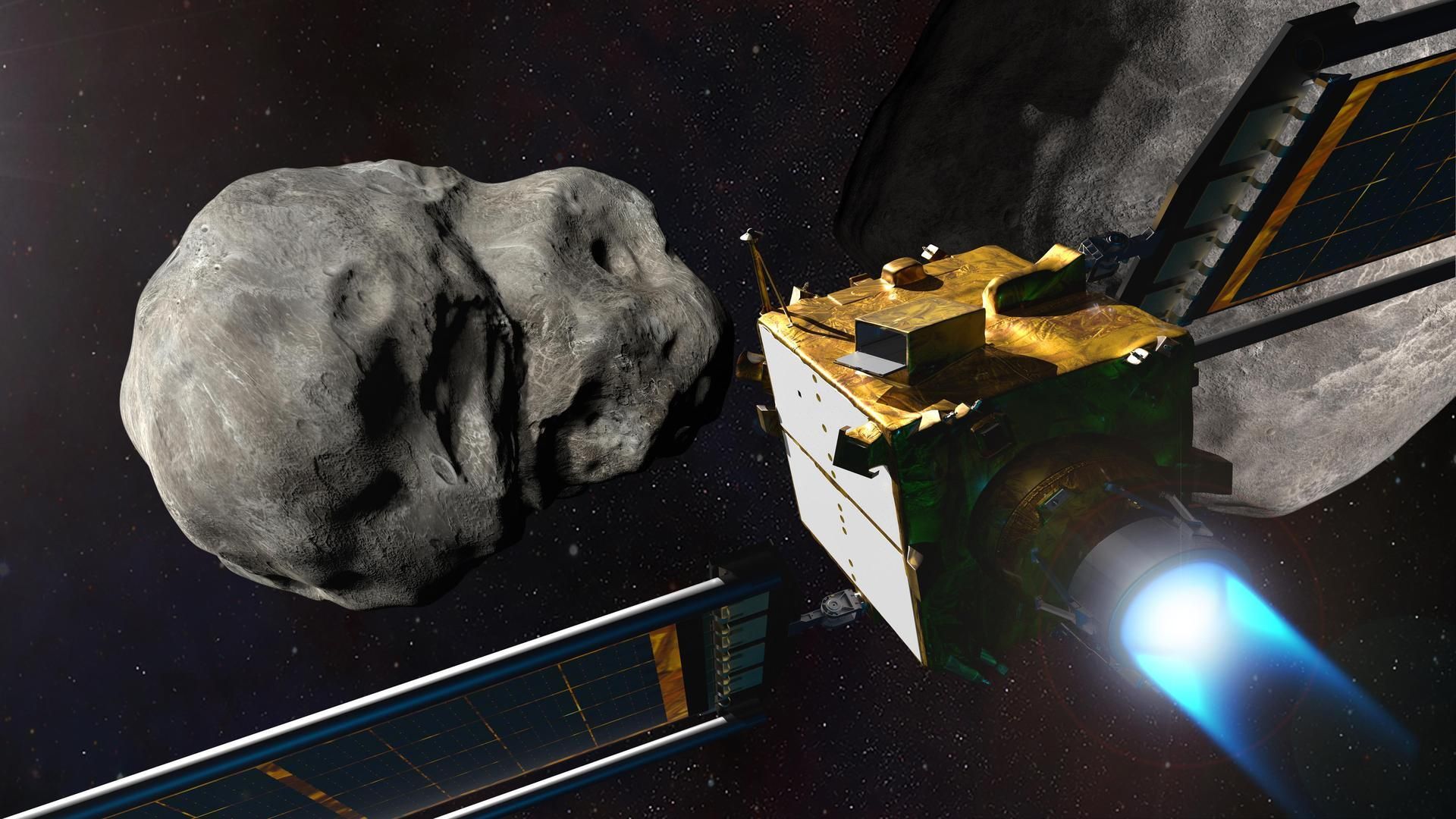
Scientists analyzing images from NASA’s Double Asteroid Redirection Test (DART) mission have found the first visual evidence that small asteroids exchange rocks and dust in a slow process that reshapes their surfaces over millions of years.
Images captured in late 2022 by the DART spacecraft — an experiment that tested asteroid-deflection technology — moments before it deliberately struck the asteroid moon Dimorphos revealed faint, fan-shaped streaks across its rocky surface, according to a new study.
Article continues below
“At first, we thought something was wrong with the camera, and then we thought it could’ve been something wrong with our image processing,” study lead author Jessica Sunshine, of the University of Maryland, said in a statement.
However, further analysis showed the streaks were consistent with gentle, low-speed impacts from material drifting through space, “like throwing ‘cosmic snowballs,'” Sunshine said.
“We had the first direct proof for recent material transport in a binary asteroid system.”

The findings, described in a paper published March 6 in The Planetary Science Journal, come as another team of scientists confirmed DART not only altered Dimorphos’ orbit around its companion asteroid but also slightly changed the entire binary system’s orbit around the sun.
The shift in the system’s orbital speed was about 11.7 microns per second, or roughly 1.7 inches per hour, researchers reported in a different paper published March 6 in the journal Science Advances.
“Over time, such a small change in an asteroid’s motion can make the difference between a hazardous object hitting or missing our planet,” Rahil Makadia, a planetary defense researcher at the University of Illinois Urbana-Champaign, who led the Science Advances paper, said in a separate statement.
About 15% of near-Earth asteroids are estimated to be binary systems, in which a smaller asteroid orbits a larger companion. These systems can host surprisingly complex processes, in part because sunlight can gradually speed up the rotation of small asteroids until loose material breaks free from their surfaces.
This phenomenon, known as the YORP effect, occurs when an asteroid absorbs sunlight and re-emits that energy as thermal radiation, creating a tiny but continuous thrust that can slowly spin the space rock faster.
Evidence of this process has been seen elsewhere in the solar system. Observations by NASA’s Lucy spacecraft, for example, revealed ridges around the equators of the asteroid Dinkinesh and its moon Selam — features scientists believe formed as material migrated and accumulated during such spin-ups. Similar ridges appear along the equators of Dimorphos and Didymos, likely formed by material shed from the spinning asteroids that later settled back onto their surfaces.

In the new study, Sunshine and her team identified the fan-shaped streaks by developing sophisticated image-processing techniques to remove shadows cast by boulders and correct for uneven lighting across the surface, the statement said.
“As we refined our 3D model of the moon, the fan-shaped streaks became clearer, not fainter,” study co-author Tony Farnham, a research scientist at the University of Maryland, said in the statement. “It confirmed to us that we were working with something real.”
The team found that debris left Didymos at about 30.7 centimeters (12.1 inches) per second — so slowly that the impacts would create deposits rather than craters. The streaks are also clustered around the moon’s equator, matching models predicting where the material spun off from Didymos would most likely land, scientists say.
Scientists are eager to see what the transformed Dimorphos now looks like up close. That opportunity may come as soon as this December, when the European Space Agency’s Hera spacecraft arrives at the Dimorphos-Didymos system.
The $398 million Hera mission will conduct a detailed post-impact survey of Dimorphos and could reveal whether the fan-shaped streaks survived the collision, researchers say. It may also detect new ray-like patterns created by boulders that were knocked loose during the impact, offering new clues about how asteroids evolve and which ones could pose a threat to Earth.
“These new details emerging from this research are crucial to our understanding of near-Earth asteroids and how they evolve,” Sunshine said in the statement. “We now know that they’re far more dynamic than previously believed, which will help us improve our models and our planetary defense measures.”