

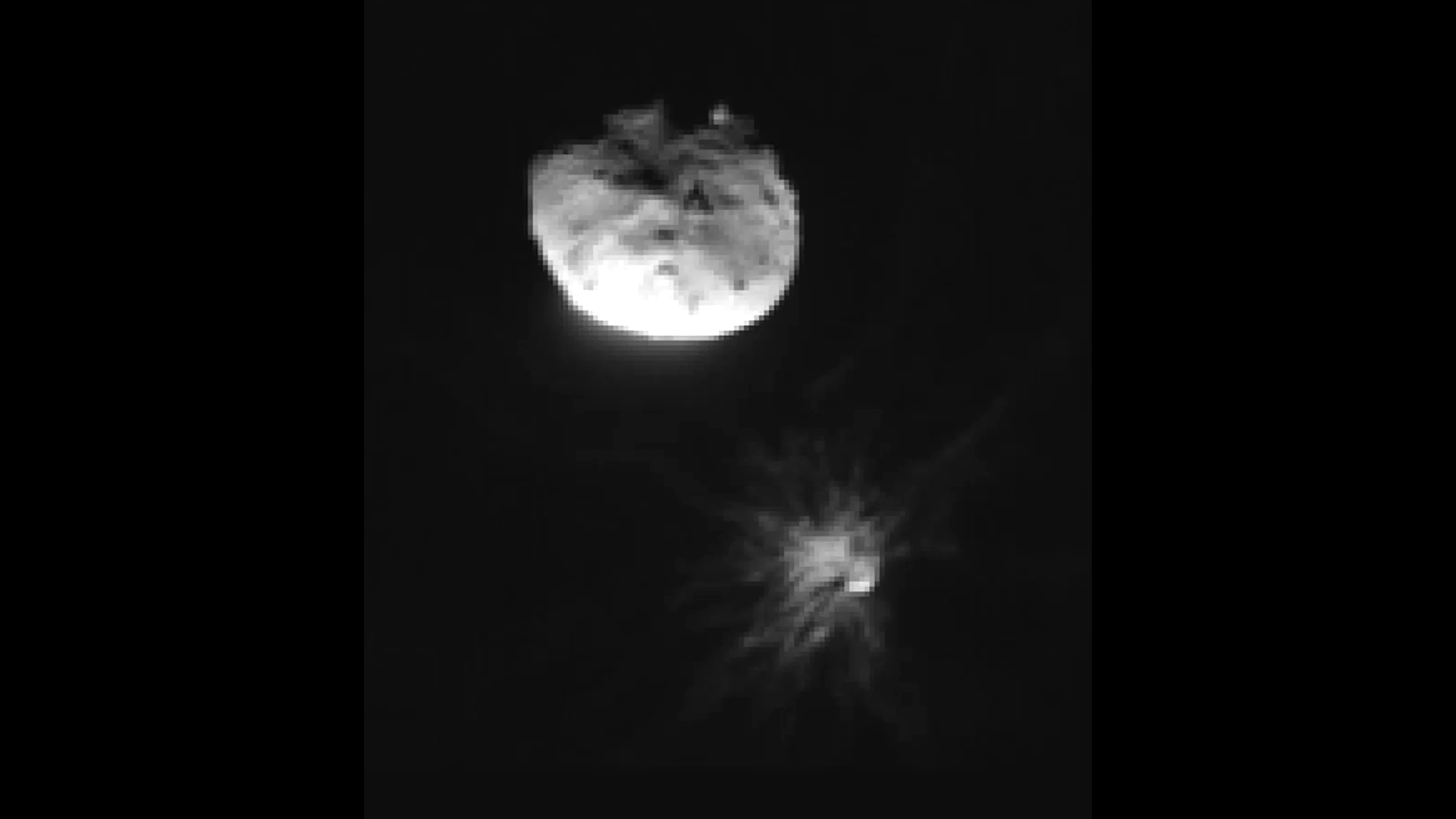
New research reveals that when NASA’s DART (Double Asteroid Redirection Test) spacecraft intentionally impacted the asteroid moonlet Dimorphos in September 2022, it didn’t just change the motion of Dimorphos around its larger companion, Didymos; the crash also shifted the orbit of both asteroids around the Sun. Linked together by gravity, Didymos and Dimorphos orbit each other around a shared center of mass in a configuration known as a binary system, so changes to one asteroid affect the other.
As detailed in a study published on Friday in the journal Science Advances, observations of the pair’s motion revealed that the 770-day orbital period around the Sun changed by a fraction of a second after the DART spacecraft’s impact on Dimorphos. That change marks the first time a human-made object has measurably altered the path of a celestial body around the Sun.
“This is a tiny change to the orbit, but given enough time, even a tiny change can grow to a significant deflection,” said Thomas Statler, lead scientist for solar system small bodies at NASA Headquarters in Washington. “The team’s amazingly precise measurement again validates kinetic impact as a technique for defending Earth against asteroid hazards and shows how a binary asteroid might be deflected by impacting just one member of the pair.”
When DART struck Dimorphos, the impact blasted a huge cloud of rocky debris into space, altering the shape of the asteroid, which measures 560 feet (170 meters) wide. Because the debris carried its own momentum away from the asteroid, it gave Dimorphos an explosive thrust — what scientists call the momentum enhancement factor. More debris being kicked out means more oomph. According to the new research, the momentum enhancement factor for DART’s impact was about two, meaning that the debris loss doubled the punch created by the spacecraft alone.
Earlier research showed that the smaller asteroid’s 12-hour orbital period around the nearly half-mile-wide (805-meter-wide) Didymos shortened by 33 minutes. The new study shows the impact ejected so much material from the binary system that it also changed the binary’s orbital period around the Sun by 0.15 seconds.
“The change in the binary system’s orbital speed was about 11.7 microns per second, or 1.7 inches per hour,” said Rahil Makadia, the study’s lead author at the University of Illinois Urbana-Champaign. “Over time, such a small change in an asteroid’s motion can make the difference between a hazardous object hitting or missing our planet.”
Although Didymos was not on an impact trajectory with Earth and it was impossible for the DART mission to put it on one, that change in orbital speed underscores the role spacecraft — aka kinetic impactors in this context — could play if a potentially hazardous asteroid is found to be on a collision course in the future. The key is detecting near-Earth objects far enough in advance to send a kinetic impactor.
To that end, NASA is building the Near-Earth Object (NEO) Surveyor mission. Managed by NASA’s Jet Propulsion Laboratory in Southern California, this next-generation space survey telescope is the first to be built for planetary defense. The mission will seek out some of the hardest-to-find near-Earth objects, such as dark asteroids and comets that don’t reflect much visible light.
To prove DART had a detectable influence on both asteroids — not just on the smaller Dimorphos — the researchers needed to measure Didymos’ orbit around the Sun to exquisite precision. So, in addition to making radar and other ground-based observations of the asteroid, they tracked stellar occultations, which occur when the asteroid passes exactly in front of a star, causing the pinpoint of light to blink out for a fraction of a second. This technique provides extremely precise measurements of the asteroid’s speed, shape, and position.
Measuring stellar occultations is challenging: Astronomers have to be in the right place at the right time with several observing stations, sometimes miles apart, to track the predicted path of the asteroid in front of a specific star. The team relied on volunteer astronomers around the globe who recorded 22 stellar occultations between October 2022 and March 2025.
“When combined with years of existing ground-based observations, these stellar occultation observations became key in helping us calculate how DART had changed Didymos’ orbit,” said study co-lead Steve Chesley, a senior research scientist at JPL. “This work is highly weather dependent and often requires travel to remote regions with no guarantee of success. This result would not have been possible without the dedication of dozens of volunteer occultation observers around the world.”
Studying changes in Didymos’ motion also helped the researchers calculate the densities of both asteroids. Dimorphos is slightly less dense than previously thought, supporting the theory that it formed from rocky debris shed by a rapidly spinning Didymos. This loose material eventually clumped together to form Dimorphos, a “rubble pile” asteroid.
The DART spacecraft was designed, built, and operated by the Johns Hopkins Applied Physics Laboratory in Laurel, Maryland, for NASA’s Planetary Defense Coordination Office, which oversees the agency’s ongoing efforts in planetary defense. It was humanity’s first mission to intentionally move a celestial object.
For more information about the DART mission visit:
https://science.nasa.gov/mission/dart/
Media Contacts
Ian J. O’Neill
Jet Propulsion Laboratory, Pasadena, Calif.
818-354-2649
ian.j.oneill@jpl.nasa.gov
Karen Fox / Molly Wasser
NASA Headquarters, Washington
240-285-5155 / 240-419-1732
karen.c.fox@nasa.gov / molly.l.wasser@nasa.gov
2025-015