

March 27, 2026
2 min read

NASA’s Artemis II astronauts arrive in Florida ahead of moon launch
During their 10-day mission, this four-person crew will swing around the far side of the moon—and potentially travel farther from Earth than anyone in history
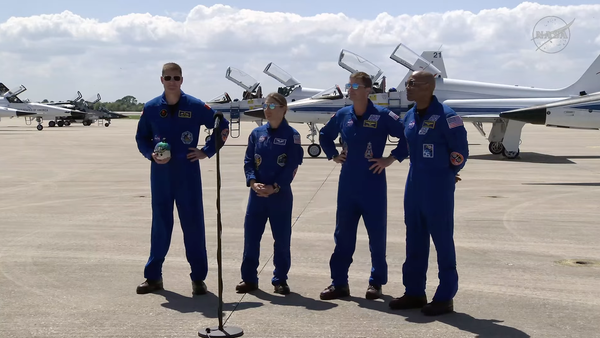
Canadian Space Agency astronaut Jeremy Hansen and NASA astronauts Christina Koch, Reid Wiseman and Victor Glover speak with press after arriving at NASA’s Kennedy Space Center in Florida on March 27 in preparation for the Artemis II mission.
Before they set off on a historic flight to the moon next week, the four astronauts of the Artemis II crew had to make one final terrestrial commute—to Florida.
NASA astronauts Reid Wiseman, Victor Glover, and Christina Koch and Canadian Space Agency astronaut Jeremy Hansen arrived at NASA’s Kennedy Space Center on March 27, five days before their scheduled April 1 liftoff. The astronauts flew themselves from Houston, which houses NASA’s Johnson Space Center, in two T-38 training jets and then disembarked to speak with reporters.
The 10-day mission will mark the first time humans have left Earth orbit since the Apollo 17 mission ended in 1972. Depending on the precise trajectory their spacecraft takes, the Artemis II crew may travel farther from Earth than any humans to date.
On supporting science journalism
If you’re enjoying this article, consider supporting our award-winning journalism by subscribing. By purchasing a subscription you are helping to ensure the future of impactful stories about the discoveries and ideas shaping our world today.
“Hey, let’s go to the moon!” said Wiseman, the mission commander, to open the crew’s remarks. “I think the nation and the world has been waiting a long time to do this again.”
“I am fired up,” Hansen added. “We’re all fired up to go do this.”
Artemis II is due to blast off from Kennedy’s Launch Complex 39B at 6:24 P.M. EDT on April 1. If the mission is scrubbed during the initial two-hour window, additional launch opportunities will continue through April 6.
The crew has been in medical quarantine since March 18 to protect their voyage from hitchhiking germs. Although the astronauts previously isolated for target launch dates in February and March that were ultimately delayed, this represents the first attempt that has seen the crew land in Florida.
Wiseman acknowledged that even with several upcoming opportunities, his feet may stay on the ground for weeks or even months to come. “We are ready for that,” he said. “A little piece of my brain is always holding on that April 1 is not a guarantee, April 6 is not a guarantee.”
Glover concurred. “It’ll go when the engines light at T-zero; we totally understand that.”
Despite the looming uncertainties of rocket science, the crew remains focused. Koch shared how moved she was that, during the flight over, an air traffic controller wished her and the crew luck on the launch. “We’re ready to do this and fulfill our mission for all of you,” she said.
Editor’s Note (3/27/26): This is a developing story and may be updated.
It’s Time to Stand Up for Science
If you enjoyed this article, I’d like to ask for your support. Scientific American has served as an advocate for science and industry for 180 years, and right now may be the most critical moment in that two-century history.
I’ve been a Scientific American subscriber since I was 12 years old, and it helped shape the way I look at the world. SciAm always educates and delights me, and inspires a sense of awe for our vast, beautiful universe. I hope it does that for you, too.
If you subscribe to Scientific American, you help ensure that our coverage is centered on meaningful research and discovery; that we have the resources to report on the decisions that threaten labs across the U.S.; and that we support both budding and working scientists at a time when the value of science itself too often goes unrecognized.
In return, you get essential news, captivating podcasts, brilliant infographics, can’t-miss newsletters, must-watch videos, challenging games, and the science world’s best writing and reporting. You can even gift someone a subscription.
There has never been a more important time for us to stand up and show why science matters. I hope you’ll support us in that mission.