

Astronomers have captured the first views of a young sun-like star blowing bubbles, offering a rare glimpse at how our solar neighborhood might have behaved in its youth.
Using NASA’s Chandra X-ray Observatory, researchers observed HD 61005 — a young star located about 120 light-years from Earth with roughly the same mass and temperature as our sun — and detected a vast bubble of hot gas surrounding it. This wind-blown bubble, known as an “astrosphere,” forms when a star’s powerful stellar wind slams into surrounding interstellar gas and dust, carving out a protective cavity much like the sun’s heliosphere that shields our solar system from galactic cosmic rays, according to a statement from NASA.
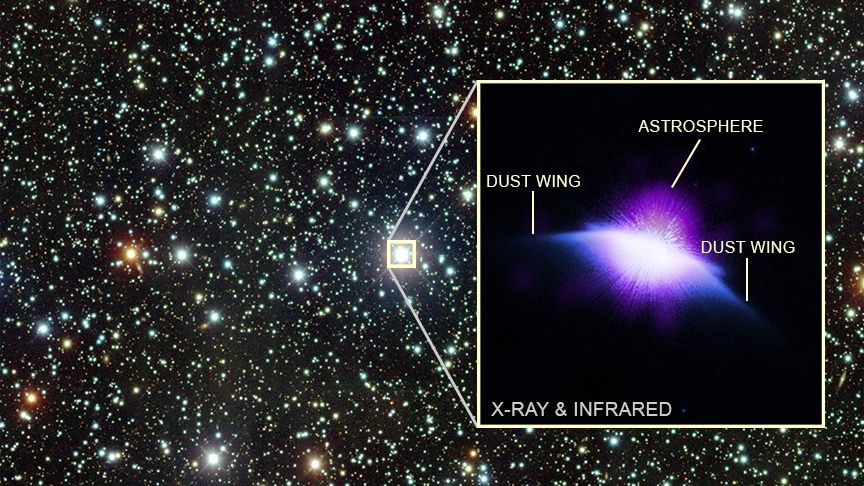
This marks the first X-ray evidence of an astrosphere around a star like our sun, giving astronomers their clearest look yet at one of these stellar bubbles beyond our solar system. Chandra’s sharp X-ray vision allowed astronomers to detect faint, extended emission around HD 61005 — the glowing outline of its astrosphere. The X-rays are produced where the star’s fast, dense wind collides with colder surrounding interstellar gas. When high-speed particles from the stellar wind interact with cooler material in space, they generate the X-ray light that makes the bubble visible to Chandra.

HD 61005 is about 100 million years old — young compared to our 4.6-billion-year-old sun — and its stellar wind is far more intense. Researchers estimate it blows roughly three times faster and is about 25 times denser than the wind from our sun today. That added power helps inflate a larger, brighter astrosphere with hot gas. The surrounding interstellar environment also appears about a thousand times denser than our sun’s current neighborhood, amplifying the interaction and boosting the X-ray signal enough for Chandra to detect.
“This new Chandra result about a similar star’s astrosphere teaches us about the shape of the sun’s, and how it has changed over billions of years as the sun evolves and moves through the galaxy,” lead author Carey Lisse from Johns Hopkins University said in a statement sharing Chandra’s observations.
Astronomers have nicknamed HD 61005 the “Moth” because of its wing-shaped debris disk seen in infrared light — dusty remnants from the star’s formation that appear sculpted by its motion through space. Observing its astrosphere offers a rare window into what the early solar system may have experienced, when the young sun’s wind was stronger and interactions with surrounding gas and dust more dramatic. The study also provides new insight into how stellar winds shape planetary environments and may influence the habitability of worlds around other stars.
“We are impacted by the sun every day, not only through the light it gives off, but also by the wind it sends out into space that can affect our satellites and potentially astronauts traveling to the moon or Mars,” co-author Scott Wolk, from the Center for Astrophysics, Harvard & Smithsonian (CfA), said in the statement. “This image of the astrosphere around HD 61005 gives us important information about what the sun’s wind may have been like early in its evolution.”
The team’s findings have been accepted for publication by The Astrophysical Journal.