



The idea that gemming is bad is a very old debate that used to get a lot of action on the menswear forum ‘StyleForum’. It was mainly a bootmaker out of Oregon who hated gemming and didn’t mind saying so. Rightfully so as he took the time to learn the art of handmade shoemaking and anything less to him was considered inferior. The problem is that he used strong words and might have given the wrong impression to those who didn’t know any better. But the reality is that gemming is used in the production of most of the ‘welted’ shoes we wear. By that logic, it simply cannot be bad. So let’s look at it further.
The main argument against gemming is the fact that it ‘apparently minimizes the lifespan of the shoe.’ Claims have stated that after 3 to 4 resoles, the gemming will break (either the rib or the cement (shoe glue) will come loose) and then make the shoe un-resoleable. They claim that hand lasting and hand welting are far superior which of course they are. Sadly neither are practical for mass production though.
The other alternative, which most people probably know not about (as it is so rarely used) is the machine that cuts the rib directly from the leather insole. A superior method, as it goes, but a harder one to come by. It is therefore then claimed that many top shoemakers are in fact using the gemming method and because of this they are “ripping people off” with their ‘so-called’ inferior product. This type of rhetoric spread by keyboard warriors is what causes poor expectations of soon-to-be consumers to don’t know any better than to believe the loudest warrior shouting.
Let me first start by saying that the majority of everyone whose Goodyear welted shoes are made in a factory were made using the gemming method. Most of your favorite shoemakers are doing so, such as John Lobb, Gaziano and Girling, myself, Crockett & Jones, Edward Green, Allen Edmonds, Alden, etc. So according to the people who claim this theory of gemming is bad and thus creates an inferior product, they are all basically saying that these brands’ products aren’t worth the long-standing reputation that many of them have. That’s a bold ideology.
So what is the alternative? Well, it would have to be using a much thicker and thus more expensive insole to cut the wall that holds the upper and the welt, by hand. However doing this process by hand then adds at least an extra 4-5 hours of shoemaking to each pair of shoes, not to mention the extra costs to them too. This might be fine if your workers are being paid per piece or earning far less than the British or American minimum wage standard. It might also be fine if you are only producing 100-200 pairs per month, but not when you are making 5000-10,000 per month or more, such as your larger factories like Allen Edmonds and Crockett & Jones are doing, easily.
The other alternative, as stated before, is using the rare machine, like J.M. Weston and Bridlen do, that instead of using gemming, actually cuts the rib into the insole. It is said that this method limits you in doing certain things, like extremely tight waists, as you admire from brands such as Gaziano & Girling. And as far as I know, there really is also no conclusive evidence that this method actually lasts longer than gemming. I won’t lie, I would prefer this method on my own shoes as I am a traditionalist who prefers leather as opposed to cheaper material alternatives. But this post is about whether those alternatives are bad or not, not what is preferable.
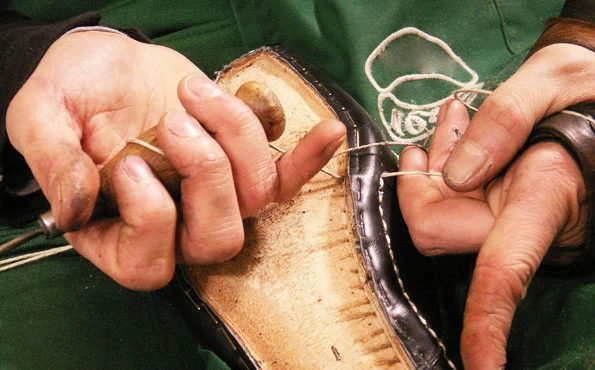
There is a sad reality that people often forget to think about. It is that large factories have production lines. The movements of those lines are meant to go quickly. If one section significantly slows them down, it decreases output. When you decrease output prices have to shoot up to maintain profit margins. It simply isn’t possible for large factories to mass produce a handmade feature, such as ‘hand welting’. The European brands that manage to do it are doing so on a relatively small scale and even that makes a relatively high cost for the end retail price. The ones that manage to keep those retail prices low are simply paying their wages much lower than the rest. It is simple mathematics. So in order to supply the shoes you all love, gemming is used to keep the production flowing.
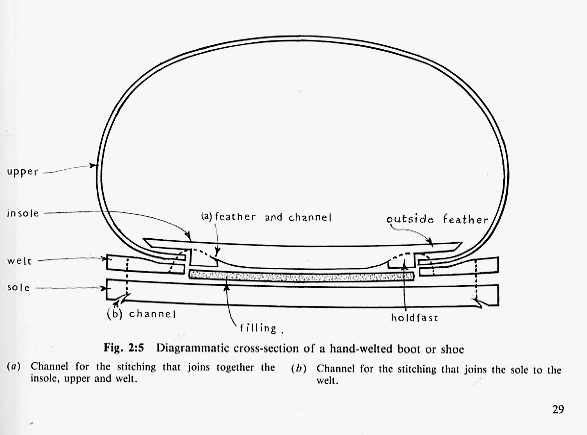
If you look at the picture above, you see where it says “holdfast,” well this is the bit that connects the upper to the insole, and then the welt to the insole. When doing this by hand, you can cut a holdfast (and/or rib) into the insole that is maybe 2mm high and 4-8mm wide (depending on country preferences e.g. Italy (4mm) vs. England (8mm)), which is quite strong and controlled by hand the entire way. However, in gemming this holdfast is like 3-4mm high and about 1mm wide (due to the fact that a machine is stitching all of the thread and it therefore needs to be tall and thin).
Now the alternative of the machine which cuts the holdfast directly into the leather insole, still needs to create the same type of holdfast (in height and width) as the canvas one used in gemming, and there really is not any conclusive evidence that the leather holdfast is any stronger than it’s gemmed counterpart. The other argument could be that it is cut into the insole as opposed to cemented on, as in the case of gemming. While I am not a fan of cemented soles myself, I have seen many that have lasted a very long time, and being a sole, they are subjected to constant strain and moisture from rain (which is what slowly breaks down cement holding). But being inside the shoe (and covered by cork), it is less likely to separate as quickly (as in years and years) as cementing would on the sole.
Therefore, there is really no argument that using leather instead of the canvas alternative (as for doing things strictly by machine) is any better. If it was, then Gaziano & Girling, John Lobb, and Edward Green would be out of business for their shoes would be falling apart quickly. But they’re not. Sure, cutting the holdfast by hand and then welting by hand is much better, but it is simply not practical for selling shoes at a reasonable price when manufactured in a country that pays their workers what might be considered justified wages.
Now as a counter-argument to my own discussion, I will say that using all genuine leather products inside of a shoe and doing it the hand method way is always going to be better, but it does not make it the fact that the new ways make RTW shoes ‘rip off’s’.
Vintage shoes, made in the early 1900s, were in fact much better made than the shoes of today (in terms of all-around quality), as there was a lot more handmaking involved, as well as better materials. But the world was a different place then. Leather was more in supply and superior in quality. Nowadays, good leather is becoming more scarce, and inevitably more shoemakers are fighting for it. Wages are higher than they have ever been. People are also lazier than they were before. Pride in one’s product was more important than, getting your paycheck is more important now. Work ethic/quality is not the same.
It’s more about profits and turnaround. But this still does not mean that shoes today are not good (or even great for that matter), they are just different. And it’s not the shoemaker’s fault. It’s the way that the world is structured. Prices are simply too high, cost of living is absurd. In order to make it in this day and age, things have to be sacrificed. And what’s even more so, is the consumer, all of you, expect the best at the lowest cost. You guys have it all backward.
You want Gaziano & Girling quality at Meermin prices. It doesn’t work. Something has to give in order to get lower prices. So gemming is used to save time and cost, to get you a lower price (or maybe the company a higher profit). Whatever it may be, it does not change the fact that a Gaziano & Girling who uses gemming, is going to last any less than a JM Weston or Bridlen who uses the machine that cuts the rib directly into the leather. There is simply no evidence for that, and that is what this all boils down to.
So, is doing things by hand better than gemming? Yes, in my opinion, it is. Well then is Gemming bad? No, it is not. And why not? Because in reality unless you are the type of guy to wear one pair of shoes day in and day out it is not really going to affect the lifespan of your shoes, not a lifespan that you are going to notice anyway. If it was so bad, do you think that many of the great shoemakers would be using it? No, they wouldn’t.
So why is this even a discussion? Well because there are many people on the web who just simply love to start talking bad about something (or simply love to compare apples and oranges, i.e. handwelted vs gemming) just for the sake of it, to do their best to prove a point and be heard. But more often than not these people have no real experience in manufacturing nor are even using common sense when saying these things if they were they would have realized that if no one used gemming and instead did things only by hand, then no one could afford shoes coming out of England, Western Europe or The States. Simple mathematics proves this.
So to all of the people who are bashing this method, please realize that many, if not all, of your favorite shoes that you have loved for years, which have been comfortable, supportive, and “well made” were constructed using Gemming.
And if you are fortunate enough to only wear/afford hand-welted shoes, well then count yourself blessed.
—Justin FitzPatrick, The Shoe Snob
Shop · Marketplace · J.FitzPatrick Footwear · Patreon
***Please note: The pictures do not belong to me, if you are the owner please email for credit as I forgot where I got them from***