



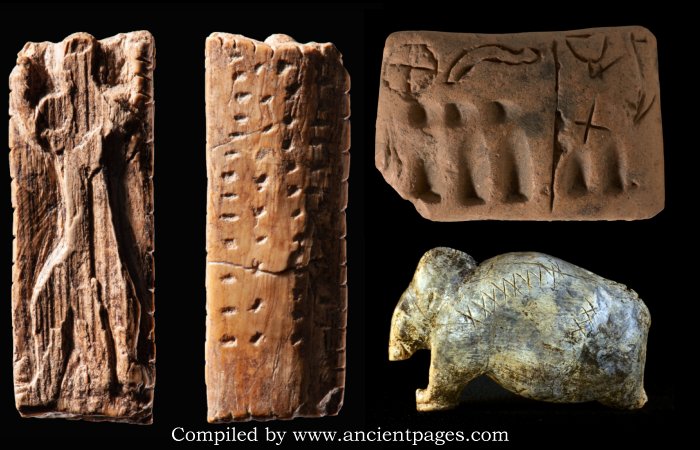
Conny Waters – AncientPages.com – Paleolithic artifacts dating back 34,000 to 45,000 years feature intriguing sequences of signs—such as repeated lines, notches, dots, and crosses. Many of these objects have been unearthed in caves within the Swabian Jura region of southwestern Germany.

The Adorant figurine from Geißenklösterle Cave, approximately 40,000 years old, consists of a small ivory plate bearing an anthropomorphic figure and multiple sequences of notches and dots. The application of these marks suggests a notational system, most notably in the rows of dots on the back of the plate. Credit: Landesmuseum Württemberg / Hendrik Zwietasch, CC BY 4.0
Notable examples include a small mammoth figurine from Vogelherd Cave and the “Adorant,” a mammoth ivory plate depicting a lion-human hybrid from Geißenklösterle cave. These artifacts are significant because they demonstrate that early humans were already engraving symbols onto tools and sculptures over 40,000 years ago.
The Earliest Attempts To Produce Writing
Recent research by linguist Christian Bentz at Saarland University and archaeologist Ewa Dutkiewicz at Berlin’s Museum für Vor- und Frühgeschichte has shed new light on these ancient markings. By analyzing more than 3,000 signs across 260 objects using computational methods, the researchers discovered that the complexity and information density of these Paleolithic sign sequences are comparable to those found in proto-cuneiform script—the earliest known form of writing—which appeared tens of thousands of years later around 3,000 B.C.E.
For example, the mammoth figurine was carved from tusk material and engraved with rows of crosses and dots. Similarly adorned artifacts include other animal figures and mythical hybrids like the Lion Human from Hohlenstein-Stadel Cave; this figure features regularly spaced notches along its arm.

The mammoth figurine from Vogelherd Cave, approximately 40,000 years old, bears multiple sequences of crosses and dots on its surface. Credit: Universität Tübingen / Hildegard Jensen, CC-BY-SA 4.0
The study’s findings indicate that these marks were intentionally created to convey information or record thoughts—suggesting that symbolic communication through written signs began much earlier than previously believed.
‘Our research is helping us uncover the unique statistical properties – or statistical fingerprint – of these sign systems, which are an early predecessor to writing,’ explains Professor Christian Bentz of Saarland University.
‘The Swabian Jura is one of the regions where objects with this type of sign have been found most frequently, but there are, of course, other important regions. Countless tools and sculptures from the Palaeolithic, or the Old Stone Age, bear intentional sign sequences,’ elaborates PhD archaeologist Ewa Dutkiewicz.
The researchers travel together throughout Europe, visiting museums and archaeological sites to find new Stone Age signs. ‘There are many sign sequences to be found on artefacts. We’ve only just scratched the surface,’ says Dutkiewicz, who is a research associate and curator of the Stone Age department at the Staatliche Museen zu Berlin.
‘The artefacts date back to tens of thousands of years before the first writing systems, to the time when Homo sapiens left Africa, settled in Europe and encountered Neanderthals,’ explains the archaeologist. In a project funded by the European Research Council, the two researchers and their team are examining how Stone Age humans encoded information in sign sequences.
Thousands Of Undeciphered Signs
The researchers examined over 3,000 geometric signs across approximately 260 objects using computational methods. Their objective was not to determine the exact meaning of these undeciphered signs.
Not Similar To Modern Writing
As Bentz explains, while numerous theories exist regarding their purpose, there has been limited empirical research focused on the measurable characteristics of the signs themselves. His study investigates frequency patterns and other quantifiable features of the symbols. This approach enables comparisons between these ancient sign systems and later writing systems, highlighting both similarities and differences. Ultimately, Bentz aims to use statistical analysis to gain insights into how information encoding may have originated.

Proto-cuneiform tablet of Uruk V period (VAT 15085), approximately 3500 to 3350 years old. This so-called numero-ideographic tablet carries numerical signs on the left-hand side and one ideograph representing a vessel of unknown content on the right-hand side. Credit: Staatliche Museen zu Berlin, Vorderasiatisches Museum / Olaf M. Tesmer, CC-BY-SA 4.0
“Our analyses demonstrate that these sign sequences have nothing to do with the writing systems of today, which represent spoken languages and are characterized by high information density. In contrast, the signs on the archaeological objects are frequently repeated – cross, cross, cross, line, line, line. This type of repetition is not a feature found in spoken language,” explains Christian Bentz.
“However, our findings also show that Palaeolithic hunter-gatherers developed a system of symbols that has an information density that is statistically comparable to the earliest proto-cuneiform tablets from ancient Mesopotamia, which came 40,000 years later.
Sign sequences in proto-cuneiform script are also repetitive and the individual signs are repeated at a similar rate. In terms of complexity, the sign sequences are comparable,” says Bentz. “Figurines exhibit higher informational density than do tools,” reports archaeologist Dutkiewicz, who also used to curate the Vogelherd archaeological park in the Swabian Jura.
The researchers were particularly surprised by how the sign systems measured up to proto-cuneiform.
“We hypothesized that the early proto-cuneiform script would be more similar to the writing systems of today, especially due to their relative proximity in time. Yet the more we studied them, the clearer it became that the early proto-cuneiform script is very similar to the much older Palaeolithic sign sequences.” That also means that little changed between the Old Stone Age and the emergence of the first proto-cuneiform scripts.
“Then, about 5,000 years ago, a new system emerged relatively suddenly that represents spoken language. The new system therefore has completely different statistical characteristics,” explains Bentz.
AI Analysis Of The Stone Age Signs
The team digitizes sign sequences from archaeological objects and stores them in a database for analysis of Stone Age sign inventories. Using computer-assisted methods, Bentz assessed the information conveyed by these signs and compared it to early cuneiform and modern scripts. The researchers used quantitative linguistic techniques, including statistical modeling and machine learning classification algorithms.
“Because of the high rate of repetitions and the high predictability of the next sign, we were able to show that the entropy – a measure of information density – is comparable to that of proto-cuneiform, which came much later,” explains Christian Bentz.

“The human ability to encode information in signs and symbols was developed over many thousands of years. Writing is only one specific form in a long series of sign systems,” Bentz elaborates.
“We continue to develop new systems for encoding information. Encoding is also the basis of computer systems.” Large language models, which are currently one of the most visible forms of AI, rely on the fact that language sequences are predictable, meaning the model is able to determine which part of a word is likely to come next.
Unlocking The Secrets Of Stone Age Encoding
The study does not specify what Stone Age humans intended to record with their signs. However, as Ewa Dutkiewicz explains, the findings help narrow down possible interpretations. While modern humans benefit from thousands of years of accumulated knowledge and information sharing, anatomically, Stone Age humans were already at a comparable stage of development. This suggests they likely possessed cognitive abilities similar to our own. The capacity to record and communicate information would have been crucial for Palaeolithic humans, potentially enabling them to coordinate groups more effectively or even aiding in their survival.
See also: More Archaeology News
“They were highly skilled craftspeople. You are able to see that they carried the objects with them. A lot of the objects fit right in the palm of your hand. That is another way in which the objects are similar to proto-cuneiform tablets,” explains Ewa Dutkiewicz.
Source: Saarland University
Written by Conny Waters – AncientPages.com Staff Writer