

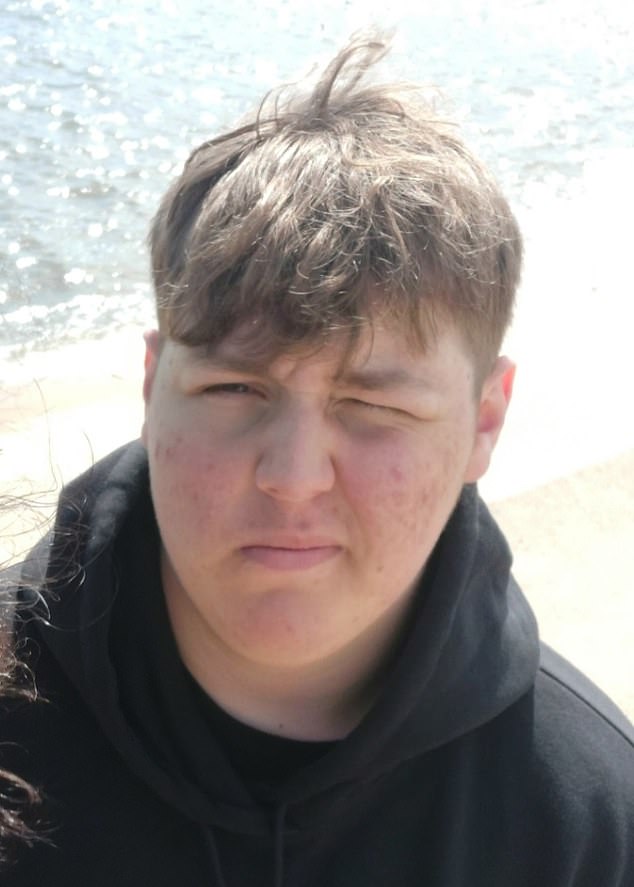
A mother who lost her teenage son to Meningitis B hours after he came home from school complaining of a headache has condemned the government for not protecting young people from the disease.
Alfie Mullans, 18, went to bed with the mild symptom in June 2023 – waking the next morning with a blotch on his chest, prompting his parents to rush him to hospital.
But by the time the Manchester-based teen reached medical care he had turned purple, before his heart tragically stopped.
Marissa Mullans, Alfie’s distraught mother, said her son’s death – as well as the two young people in Kent on the weekend – could have been spared had the government offered the vaccine to all teenagers.
‘The government are failing our young people, they have a right to be protected, same as Alfie did,’ she told the Daily Mail.
She has launched a petition to introduce an awareness campaign in schools about the early signs of Meningitis B, and for the vaccine to be made available to all teenagers.
‘Every single young person has a right to their life and this life saving vaccine,’ she said.
The menB jab was introduced on the NHS for babies in 2015, meaning the majority of young people born before then are not protected against it unless they had the jab privately.

Alfie Mullans, 18, died of Meningitis B in 2023, a mere 18 hours after he first complained of a headache
‘I’m determined for the government to do the right thing, I wish it could have been in time for Alfie but I will not hear about any more young people not being vaccinated.
‘Alfie was such a beautiful, kind-hearted young man. Every mother believes that but he touched so many people, his teachers still reach out saying their heart breaks for all these young people and Alfie.’
She wrote on the petition: ‘Meningitis stripped us of a bright future that should have been, ruthlessly snatching Alfie away at the tender age of 18.
‘Every dream, every aspiration Alfie harboured, ripped out of our lives, leaving us in a storm of devastation and lost hopes.
‘A whole generation has been left in a gap between policy and protection. They are no less vulnerable simply because of when they were born.
‘The government needs to find some money to roll out this vaccine, and I have also said that saving my son’s life wasn’t seen as cost effective.’
She said that the current reasoning why it was not offered to all young people was because it was not ‘cost effective’.
‘For me as a grieving mother, knowing that he wanted to serve for his country, my son who is my world, to then hear that he wasn’t cost effective is just fundamentally wrong,’ she told the Mail.

Heartbroken Marissa Mullans said that her son’s death, as well as the two young people in Kent on the weekend, could have been spared if the government offered the vaccine to all teenagers
She continued: ‘The current comments from Wes Streeting about the outbreak being unprecedented are not true. It has happened before where they’ve needed to do targeted vaccination programs.
‘But they need to stop these reactionary processes and protect young people from the start.
‘Young people are being discriminated against based on the year they were born. Age is a protected characteristic.
‘Human rights include a right to life and life saving medication. That should include this vaccine.
‘I was totally unaware that Alfie did not have this vaccine, as are thousands of other parents in this country.
‘You have a Meningitis vaccine in secondary school, but most parents are unaware that this won’t cover the Meningitis B strain.
‘I know Alfie is sending me his strength to fight in his stead so other parents don’t have to go through this.’
Ms Mullans said the early signs of Meningitis B were not noticeable and within 18 hours her son passed away.
She said: ‘When he came home from college he had a headache, but we weren’t concerned, we just thought it was a bit of a long day at school.
‘So he went to go lie down and we gave him paracetamol. He wasn’t very hungry so I made him a light snack for dinner.
‘He just wanted to sleep and the headache wouldn’t go away. So he went to bed and we monitored him in the night.
‘At 7 the next morning, I checked on him again and brought him some water and another paracetamol when he said he wanted the day off college.
‘I told my husband that he was still very lethargic and we started to worry.
‘We went into his bedroom and then saw on his chest a tiny mark, about the size of a 5p, Alfie had no idea how it got there.
‘I FaceTimed my sister who is a paramedic and showed her the mark.
‘She said she didn’t want to alarm me but said we need to go to A&E right now. When she said the word meningitis, my heart just sank.’
Alfie’s condition then deteriorated very quickly and despite his parent’s best efforts for him to get to a doctor, he soon stopped breathing from the consequent sepsis.
Ms Mullans said: ‘My husband and I tried to get Alfie dressed, but he was so lethargic at this point but we managed to get him downstairs to the car.
‘By the time he was in, he had gone purple from head to toe.
‘As we drove, I called A&E so that they were ready for him and they were waiting with a wheelchair when we arrived.
‘They took one look at him and immediately took him into a patient consultation room.
‘Then it just turned into our worst nightmare.
‘While they tried to put him on a ventilator, his heart stopped beating.
‘I just had to stand there and watch them work on Alfie, watching this team revive my son, my world, my heart.
‘They couldn’t do it but I was begging them not to stop.’
She added that this week has been particularly ‘traumatising’ after the news that two young people have died from the outbreak.
The UK Health Security Agency (UKHSA) said that as of 5pm on Wednesday, 15 cases of meningitis have been confirmed and a further 12 are under investigation.
This takes the total to 27 cases of either confirmed or suspected meningitis. Currently, nine of the 15 confirmed cases are known to be caused by menB.
Juliette Kenny died on Saturday, March 14, one day after first showing symptoms of the deadly bug which has swept across the country, with cases confirmed in several towns in Kent and London.
The year 13 student at Queen Elizabeth’s Grammar School in Faversham had been ‘fit, healthy and strong’ before her death and had completed the practical assessment for her PE A-level on Thursday, March 12.
Her father Michael Kenny first became aware that his daughter was ill when she vomited in the early hours of Friday, March 13.
‘In the morning on Friday, she was taken, by us, to our local emergency drop-in as a discolouration appeared on her cheeks,’ Mr Kenny said.
The teen was not showing any other symptoms at the time and was given antibiotics before being taken to A&E in an ambulance.
‘Juliette fought bravely for hours, but despite the fantastic NHS hospital staff fighting alongside her, meningitis took her from us less than 12 hours later,’ Mr Kenny added.
‘We were with her at the end, and the last sounds that she heard were the voices of those who loved her telling her how very much loved and cherished she is.’
Along with the Meningitis Research Foundation, Mr Kenny and his family are calling for the UK to take urgent action to improve access to the menB vaccination for teenagers and young people.
He said: ‘No family should experience this pain and tragedy. This can be avoided. There are young people currently battling this and young people still at risk.
On Thursday, 40 MPs signed a letter addressed to the Health Secretary calling on the Government and health officials to work with universities across the country on catch-up vaccination programmes, and to improve awareness.
It also said the joint committee on vaccination and immunisation (JCVI) review of eligibility for meningitis vaccines should be conducted at pace.
The outbreak, which has been linked to Club Chemistry, a nightclub in Canterbury, has also killed a 21-year-old University of Kent student.
Meningitis Now, a charity which works towards no one in the UK losing their life to meningitis, told the Daily Mail: ‘Meningitis Now is calling for the MenB vaccine to be available at a fair price on the high street – so more people can make an informed choice and have the option to privately vaccinate their loved ones if they wish.
‘But we also believe the MenB vaccine should be offered to teenagers and young people as part of the NHS vaccination programme.
‘There is no other way to prevent MenB disease – we must vaccinate young people to protect them.’
Wes Streeting, the Health Secretary, said: ‘I’m asking the JCVI, which is the independent body of science here, to make recommendations to government based on evidence to look at what’s happened in Canterbury, to test that against the recommendation they’ve made before and to issue us with fresh advice. And obviously I will follow that advice.’