



Jan Bartek – AncientPages.com – The archaeological complex of Athribis lies about ten kilometers west of the Nile, directly opposite the ancient city of Akhmim. In antiquity, it served as the cult center of the lion goddess (Ta-)Repit and comprised several key components: a temple district, a residential settlement, a necropolis, and nearby limestone quarries.

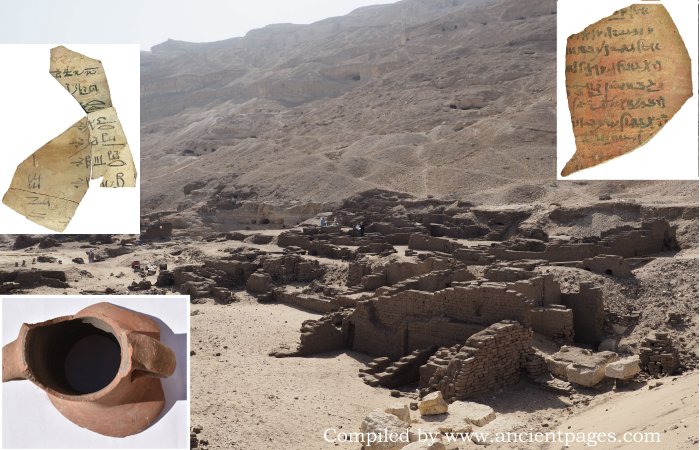
View of the site where both ostraca and a settlement are being excavated. Credit: Marcus Müller / Tübingen Athribis Project
For archaeologists, historians, and enthusiasts of ancient Egyptian history, Athribis is an exceptionally rich source of information. A joint archaeological mission by the University of Tübingen and the Egyptian Ministry of Tourism and Antiquities (MoTA) has documented the world’s largest collection of inscribed pottery sherds at this Upper Egyptian site. Between 2005 and 2026, the team has recovered more than 43,000 ostraca, with over 42,000 of them found in just the last eight years.
Ostraca are broken pieces of pottery that were reused as a writing surface in antiquity, typically for brief, everyday texts such as notes, accounts, lists, or writing exercises. With this unprecedented quantity of finds, Athribis has become the most productive site for ostraca discovered so far, surpassing even Deir el-Medina, the well-known workers’ village in the Valley of the Kings.
The excavations in Athribis are being conducted under the direction of Professor Christian Leitz from the University of Tübingen Institute for the Cultures of the Ancient Near East (IANES), Egyptology in cooperation with Mohamed Abdelbadia and his team from MoTA.
Rich Source Of Social History Spanning An Entire Millennium
The earliest known texts are tax receipts from the 3rd century BCE, written in Demotic script, which served as the standard administrative writing system during the Ptolemaic and Roman periods. The latest texts in this sequence are Arabic inscriptions found on vessels, dating from the 9th to the 11th centuries AD.

In front of the western rock face: Remains of a temple where numerous astrological ostraca were found. This may have been where the temple astronomer worked. Credit: Marcus Müller / Tübingen Athribis Project
“The ostraca show us an astonishing variety of everyday situations,” says Leitz. “We find tax lists and deliveries, along with short notes about everyday activities, exercises by schoolchildren, religious texts, and priestly certificates attesting the quality of sacrificial animals. This mixture is what makes the find so valuable,” Leitz adds.

Drawing of a shrew, the sacred animal of the god Haroeris. Credit: Tübingen Athribis Project
“This everyday content gives us a direct insight into the lives of the people of Athribis and makes the ostraca an important source for a comprehensive social history of the region.”
Most of the ostraca are written in Demotic script, with a substantial number also bearing Greek inscriptions. A smaller yet noteworthy portion of the sherds is decorated with figurative and geometric designs. In addition, a few rare examples contain texts in Hieratic, hieroglyphic, Coptic, or Arabic script.
Athribis is regarded as the world’s most important site for demotic-hieratic horoscopes, with over 130 such texts discovered. These birth predictions are key sources for understanding the development of ancient astronomy and astrology.
Growing Excavation Areas, Increasing Number Of Finds
The scale of the discoveries became clear in 2018, when archaeologists opened a 20-by-40-meter area west of the Temple of Ptolemy XII and extended the excavation to the southwest. This work revealed a large deposit of ceramics, which gradually transitioned into the remains of a settlement. In addition to numerous ostraca (inscribed pottery sherds), the team uncovered mudbrick buildings, residential spaces, and storage facilities.

Hieratic school text, a version of the “bird alphabet. Credit: Tübingen Athribis Project
Around three years ago, the excavation area was further expanded to the west. In the newly opened 40-by-40-meter sector, approximately 40,000 ostraca were recovered, with 50 to 100 inscribed sherds found each day. To identify each ostracon, hundreds of sherds had to be examined on both sides. Additional ostraca were also discovered during the clearance of an older temple, which, until 2022, was represented above ground only by its 52-meter-wide gateway.

Demotic inscription on an amphora: “the first (delivery from) the southern vineyard”. Credit: Tübingen Athribis Project
“We expect to find many more ostraca. The high and ever-growing number of objects is encouraging, but it also presents us with challenges,” says Leitz. For example, the complete three-dimensional digitization of the more than 40,000 sherds in the local depot is labor-intensive and requires specialized equipment, high computing capacity, and specially trained staff.

List in Demotic script including several personal names referring to local gods. Credit: Tübingen Athribis Project
“In principle, it would be possible to accelerate the digitization and cataloging of the ostraca by using AI systems,” says Leitz, “but the effort required to train and maintain such a system, though appealing, would be high.”
See also: More Archaeology News
“This impressive project demonstrates the power of joint, long-term research. Through expertise, patience, and passion, inconspicuous pot sherds are transformed into a vivid picture of past worlds,” says Professor Karla Pollmann, President of the University of Tübingen.
“The project is also a successful part of the long-standing collaboration between the University of Tübingen and its Egyptian partner institutions. Together, we bear responsibility for preserving and researching a cultural heritage that has significance far beyond national borders.”
Written by Jan Bartek – AncientPages.com Staff Writer