



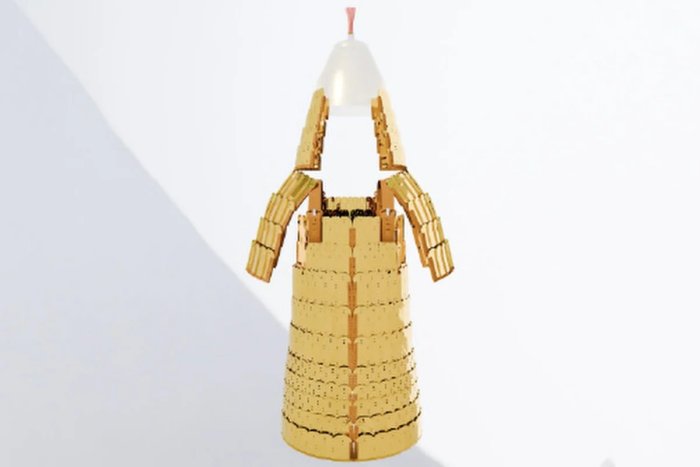
Jan Bartek – AncientPages.com – For centuries, ancient China’s legendary golden suits of armor were known primarily through literary works. Now, a team of Chinese conservators has published their findings on reconstructing a golden suit of armor that remained buried in a royal tomb along the Silk Road for approximately 1,200 years.
Mythical Golden Armor Of Tang-Era Warriors
A famous poem from the Tang dynasty by Wang Changling illustrates the enduring image of soldiers clad in golden armor: “We will not leave the desert till we beat the foe, although in war our golden armour be outworn 100 times.”

Credit: Chinese Academy of Social Sciences (CASS)
While such verses captured the spirit and grandeur associated with Tang-era warriors, physical examples had never been discovered—until now. This reconstruction bridges historical records and archaeological evidence, offering new insights into ancient Chinese craftsmanship and military history.
According to the South China Morning Post, the Key Laboratory of Archaeological Sciences and Cultural Heritage at the Chinese Academy of Social Sciences (CASS) has revealed the only known physical example of Tang dynasty “golden” armour. This suit of gilded bronze armour was discovered in a royal tomb on the Tibetan plateau and has been meticulously restored by a dedicated team.
The restoration process involved reassembling the armour piece by piece and creating a video reconstruction to illustrate its probable original appearance. In addition to the armour, other artefacts, such as lacquerware and metal objects, were recovered and restored from the Tuyuhun royal tombs during excavations conducted between 2022 and 2025.
“We adopted a strategy of ‘disassembling the whole into parts and reassembling the parts into a whole’, conducting layered cleaning, extraction and protection while meticulously cataloguing each armour plate,” cultural heritage conservation expert Guo Zhengchen said at a press conference during the armour’s unveiling on January 14.
The royal tomb had been subjected to earlier looting and salvage excavations, resulting in the armour plates becoming severely fragmented and degraded.

Pieces of the armour pieces pictured during the excavation process. Credit: Chinese Academy of Social Sciences (CASS)
A 2024 excavation report in the journal Archaeology described the find thus: “Several bronze armour plates were discovered … The plates are nearly rectangular with a semicircular lower edge … A large number of lacquered armour pieces were also found.”
Copper and lacquered armour fragments were found mixed in a heap with no structure and were very fragile. Conservators used 3D scanning to record each plate’s position and employed electron and ultra-depth microscopy to study their techniques and composition. Analysis revealed the armour was not just bronze but also gilded, identifying it as golden armour. This discovery allowed them to create a detailed restoration video.
The reconstructed armour in the video brings to life another Tang poem: “Like golden scale on water, sunrays strike our coats of mail.”
Tomb Of A Tuyuhun King
According to the conservation report, the tomb was dated to the mid-8th century based on gold artifacts, silk textiles found within, and tree-ring analysis of its wooden structure. The occupant has been identified as a Tuyuhun king, with the gold armor discovered in the tomb likely being among his most valued possessions.
The Tuyuhun kingdom was established by Xianbei nomads in China’s Qilian Mountains and upper Yellow River valley. It existed from 284 to 670 CE, with Fuqi as its capital. After subjugating the Qiang people, the Xianbei founded Tuyuhun and expanded its territory by conquering neighboring kingdoms, including Western Qin and Xia, during the 4th century. The Tuyuhun also launched military campaigns into regions like Hotan in Xinjiang and areas near Kashmir and Afghanistan, eventually controlling much of northwest China.
In the 7th century, invasions by the Tibetan Empire led to internal divisions within Tuyuhun between pro-Tibet and pro-Tang factions. In 670 CE, a significant defeat at Daifeichuan—where a Tibetan army of 200,000 overcame a Tang force of 100,000—resulted in Tibet’s conquest of Tuyuhun.

The excavation revealed other artefacts, including equestrian gear and iron and lacquered armour.Credit: Chinese Academy of Social Sciences (CASS)
Over time, Tuyuhun became subordinate first to China’s Sui and Tang dynasties, then a vassal state under Tibet’s Tubo empire on the plateau. The tomb contained not only golden armor but also equestrian gear along with iron and lacquered armor pieces—artifacts that shed light on martial practices during this era.
This archaeological discovery corroborates historical accounts found in Ouyang Xiu’s New Book of Tang from the 11th century. These records describe Tubo warriors equipped with full-body armor that left only openings for their eyes—a design so effective that it offered strong protection against arrows or blades.
See also: More Archaeology News
Dulan County in Qinghai province—the location of this tomb—was historically an important hub for east-west trade along the Qinghai route, a branch of the Silk Road. This corridor connected major powers such as Tibet’s Tubo empire and China’s Tang dynasty while facilitating commerce between Chang’an (modern Xi’an), Xinjiang, Persia (now Iran), and other regions across Central Asia.
Written by Jan Bartek – AncientPages.com Staff Writer