



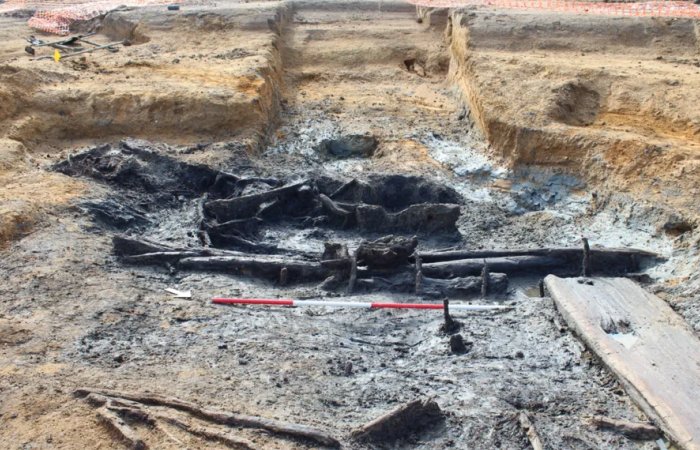
Conny Waters – AncientPages.com – A rare, well-preserved timber structure more than 3,500 years old has been uncovered near Gloucester, UK.
Initially, archaeologists believed they were seeing only scattered pieces of wood in the ground. However, as investigations continued, it became clear that the remains formed a Bronze Age structure used for collecting water.

Credit: Cotswold Archaeology
The discovery was made by the Cotswold Archaeology team during a routine archaeological excavation conducted in advance of a proposed housing development just south of Gloucester, an area already known for previous Roman and Anglo-Saxon finds.
Brief History Of Gloucester
Gloucester has a long and layered history, beginning with its early Iron Age inhabitants and developing into a significant Roman and later Saxon centre.
Before the Romans arrived, the area was inhabited by factions of the Dobunni, a Celtic tribe. The Romans established Gloucester as a city, naming it Glevum. Around 49 CE, they first built a fortress at Kingsholm, and then, around 61 CE, relocated the main military site to what is now the city centre.
By the late 1st century CE, Glevum had developed into a planned Roman town. A Forum and Basilica were constructed on the site now known as “the Cross,” forming the civic and commercial heart of the settlement. As the town grew and attracted settlers, traders, and local people, stone defensive walls and gates were added to protect the community and the Roman legions stationed there.

Jan Kip’s West prospect of Gloucester, c. 1725, emphasises the causeway and bridges traversing the water meadows of the floodplain. Credit: Public Domain
Under Emperor Nerva (96–98 CE), the town was elevated to colonia status as “Colonia Nervia Glevensis,” making it one of the administrative capitals of Roman Britain. This was the highest status a Roman town could achieve, shared only with Colchester, Lincoln, and York. At this time, the city featured villas, colonnades, and temples for its citizens.
After the end of Roman rule, the historical record for Gloucester becomes sparse until the late Saxon period. During this time, Queen Aethelflaed, Lady of the Mercians, made Gloucester an important political centre. She redesigned the city’s street layout, repaired its walls and defences, and established it as a Saxon burh (fortified town). Aethelflaed also founded St Oswald’s Priory in Gloucester, where she was later buried.

Credit: Cotswold Archaeology
As England moved towards greater political unity, Gloucester continued to play a national role. Kings such as Edward the Confessor and William the Conqueror frequently held councils with their nobles at the Saxon palace in Kingsholm. In 1085, it was in Gloucester that William the Conqueror ordered the compilation of the Domesday Book, one of the most important administrative records in English history.
Discovery Of The 3,500-Year-Old Wooden Structure
As reported by the BBC, Cotswold archaeologists say they identified the structure as a well, noting that it features an upper platform constructed from planks and roundwood. This platform is connected to a log ladder that descends into a lower chamber, indicating a carefully engineered water-access system.

Credit: Cotswold Archaeology
“It’s not quite that often that we find wood. Water-logged conditions are some of the best for the preservation of organic matter like timber,” Paolo Guarino, post-excavation manager at Cotswold Archaeology, said.
“One of the things we do wonder is why we have such a feature in an area that is now rich in streams and rivers,” added Guarino.
“We know from pollen analysis that during the Middle Bronze Age there was a period of weather-warming. The fact we’re finding more of these water holes suggests communities were digging them to access water near their settlements.”
See also: More Archaeology News
He explained that the well was most likely preserved by consistently high water levels over an extended period, which is somewhat ironic. The excavation and analysis phases are now complete, and the results will be shared with developers and local councillors.
These findings could lead to further archaeological investigations across a wider area. In the meantime, specialists are examining the preserved timbers, and selected pieces have been set aside for conservation.
Written by Conny Waters – AncientPages.com Staff Writer