
March 16, 2026
2 min read

Landmark offshore wind farms come online in the U.S.
Revolution Wind and Vineyard Wind are two of several wind farm projects that have come under fire from the Trump administration in recent months
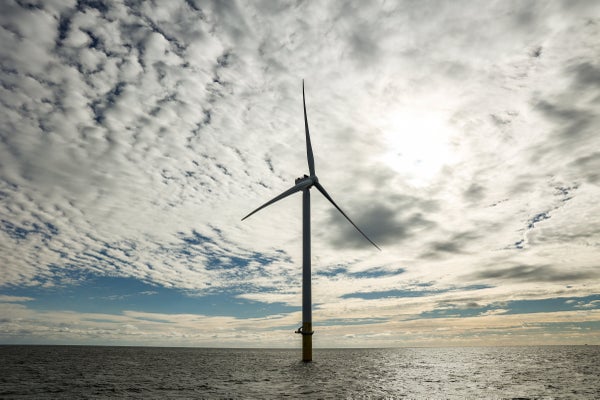
An operational wind turbine at the South Fork Wind Farm off Long Island on December 7, 2023.
Steve Pfost/Newsday LLC/Getty Images
Two offshore wind farms that were targeted by the Trump administration are making strides toward providing clean energy for the East Coast.
One installation, Revolution Wind, came online last week, marking a significant milestone for the U.S. renewable energy industry. Meanwhile Vineyard Wind, another wind energy project targeted by the Trump administration that has already been generating power, had its final blade installed, according to reporting from the New Bedford Light.
Revolution Wind, which is situated off the coast of Rhode Island, will deliver power to the Rhode Island–Connecticut region, the company developing the project announced in a recent press release.
On supporting science journalism
If you’re enjoying this article, consider supporting our award-winning journalism by subscribing. By purchasing a subscription you are helping to ensure the future of impactful stories about the discoveries and ideas shaping our world today.
Revolution Wind is one of several offshore wind projects to come under fire from the Trump administration in recent months: last December the administration announced a pause on leases for Revolution Wind, Vineyard Wind and three other wind farm projects being built off the East Coast, citing national security concerns about the installations potentially interfering with radar. Before then, wind energy advocates anticipated that some 5.8 gigawatts’ worth of new offshore wind energy would be constructed between 2025 and 2029.
Notably, President Donald Trump has repeatedly criticized wind energy, describing wind turbines as “ugly” and claiming without evidence that offshore wind is harming whales.
Now, after a legal battle, Revolution Wind is up and running. Once it’s at full capacity, the farm will be capable of powering more than 350,000 homes and businesses and will save residents $500 million per year in energy costs, according to Danish offshore wind company Ørsted, which developed Revolution Wind with Germany-based Skyborn Renewables, an offshoot of Global Infrastructure Partners.
Vineyard Wind was reportedly 95 percent complete when the Trump administration forced it to pause its operations last December. In January a judge allowed construction to resume.
The three other targeted wind projects—which are located off the coast of Virginia and New York State—have also been allowed to resume construction, with one of those projects, Coastal Virginia Offshore Wind, expected to begin generating electricity as early as this month, Canary Media reports.
It’s Time to Stand Up for Science
If you enjoyed this article, I’d like to ask for your support. Scientific American has served as an advocate for science and industry for 180 years, and right now may be the most critical moment in that two-century history.
I’ve been a Scientific American subscriber since I was 12 years old, and it helped shape the way I look at the world. SciAm always educates and delights me, and inspires a sense of awe for our vast, beautiful universe. I hope it does that for you, too.
If you subscribe to Scientific American, you help ensure that our coverage is centered on meaningful research and discovery; that we have the resources to report on the decisions that threaten labs across the U.S.; and that we support both budding and working scientists at a time when the value of science itself too often goes unrecognized.
In return, you get essential news, captivating podcasts, brilliant infographics, can’t-miss newsletters, must-watch videos, challenging games, and the science world’s best writing and reporting. You can even gift someone a subscription.
There has never been a more important time for us to stand up and show why science matters. I hope you’ll support us in that mission.