



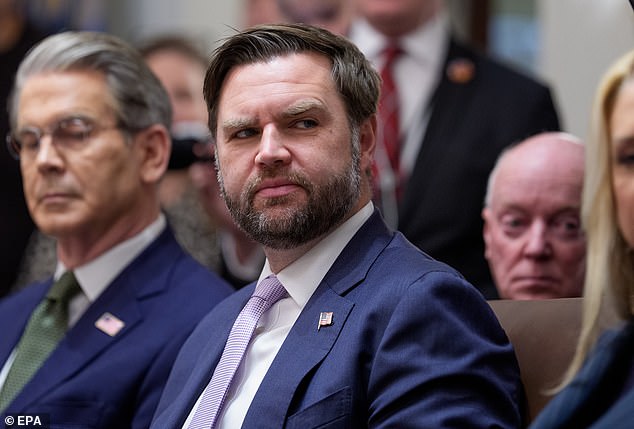
JD Vance confronted Benjamin Netanyahu in a tense phone call, accusing the Israeli leader of being overly optimistic about the chances of regime change in Iran.
The Vice President told the Israeli leader on Monday that many of his predictions about the war which he had sold to Donald Trump had not materialized.
Despite the killing of Iran’s Supreme Leader Ayatollah Ali Khamenei, hardline factions have tightened their grip on power and the regime remains firmly in control.
‘Before the war, Bibi really sold it to the President as being easy, as regime change being a lot likelier than it was. And the VP was clear-eyed about some of those statements,’ a source told Axios.
Vance, who reportedly advised Trump against going to war with Iran, was appointed by the President to help lead negotiations to end the conflict.
A day after Vance’s call with Netanyahu, a right-wing Israeli news outlet owned by GOP donor Miriam Adelson reported that the Vice President had yelled at Netanyahu over Israeli settler violence against Palestinians in the West Bank.
White House officials, who described the story as false, began suspecting that Israelis planted it to try to smear Vance.
An Israeli official denied that Netanyahu had planted the story and said his office issued a full denial when approached by reporters.
The Daily Mail has contacted the Vice President’s office for comment.

Vance confronted Benjamin Netanyahu in a tense phone call, accusing the Israeli leader of being overly optimistic about the chances of regime change in Iran

The Vice President told the Israeli leader on Monday that many of his predictions about the war which he had sold to Donald Trump had not materialized

Despite the killing of Iran’s Supreme Leader Ayatollah Ali Khamenei, hardline factions have tightened their grip on power and the regime remains firmly in control

The Trump administration appears to have created distance with their regime change goal after strikes against senior leadership have failed to overthrow the government
Vance has been actively involved in diplomacy with Iran in the last few days as Trump seeks to end the conflict in the coming weeks.
The Vice President met with senior Emirati officials, as well as the prime minister of Qatar on Thursday in meetings focused on ending the war and providing aid to Gulf allies.
The White House suggested to foreign diplomats that Vance could lead a US delegation for high-level peace talks with Iran last weekend.
Pakistani, Egyptian and Turkish mediators were told by the White House to tell the Iranians that their willingness to have Vance lead the talks was proof that Trump was serious.
Trump on Thursday extended his deadline to not strike Iranian energy plants, writing on Truth Social: ‘As per Iranian Government request, please let this statement serve to represent that I am pausing the period of Energy Plant destruction by 10 Days to Monday, April 6, 2026, at 8 P.M., Eastern Time. Talks are ongoing and, despite erroneous statements to the contrary by the Fake News Media, and others, they are going very well.’
The 15-point plan, modeled on Trump’s Gaza deal, would require Iran to dismantle all nuclear and long-range missile capabilities, open the Strait of Hormuz, and abandon proxy terror groups.
But Iranian state TV on Wednesday said that the regime had rejected the ceasefire proposal. Instead, Tehran is demanding the closure of all US bases in the Gulf, reparations, and an end to Israeli military strikes against Hezbollah in Lebanon.
Tehran is also seeking to bring the strait – a chokepoint for roughly a fifth of the world’s oil – under its control, allowing it to charge transit fees on passing vessels, much like Egypt does with the Suez Canal.

Smoke and flames rise at the site of airstrikes on an oil depot in Tehran on March 7

Israel is engaging in a wide range of military strikes across the Middle East, including in Gaza and Lebanon, where Iran’s proxies are active against Netanyahu’s forces (pictured: a fireball erupts following an Israeli strike near a tent encampment sheltering people displaced by war in Deir el-Balah in the central Gaza Strip on March 25)

Iran has refuted Trump’s peace plan with far-reaching demands
A Trump official described Iran’s demands as ‘ridiculous’ and ‘unrealistic’, warning that reaching a deal is now more difficult than before the war began as the President prepares a potential ground invasion force.
Iran’s Revolutionary Guards warned civilians across the Middle East Friday to stay away from areas near US forces, in a mark of defiance after President Donald Trump claimed talks to end the month-long war were “going well”.
The Guards’ warning came after Trump again extended a deadline for Tehran to open the Strait of Hormuz or face the destruction of its energy assets, pushing it from Friday to April 6.
With war engulfing the region four weeks after the United States and Israel first attacked Iran on February 28, Tehran resident Ensieh said every day she was “losing more hope”.